The network for creativity
Join 1.25M professional creatives like you
Connect with clients, get discovered, and run your business 100% commission-free
Creatives on Contra have earned over $150M and we are just getting started
Back to feedPost
Some sounds don't make it into the future.
A dial-up modem. A school bell. A cassette rewinding.
I built "Echoes We Forgot" — a digital museum that archives them before they vanish completely, and pairs a lost sound or a forgotten painting with the story of why it faded.
Designed entirely in @Wonder, brought to life through MCP → Cursor.
🔊 Experience it: https://echoes-we-forgot.netlify.app/
🎨 Wonder file: Wonder File
Tagging: @usewonder @contra
Some things deserve to be remembered.
#WonderChallenge #ContraChallenge


Sounds Good !


Love how storytelling, design, and emotion come together here. This is the kind of project that stays with you

This feels like more than a project—it feels like digital preservation. Beautiful concept.

The subtle color shifting on the landing page is gorgeous. It adds so much life without being distracting. ✨

Thank you Sir
I recovered 8 of 8 sounds at Echoes We Forgot — 10/10 stars!
https://echoes-we-forgot.netlify.app/sound-museum
Thank you Sir!

Saw this on X and had to check it out. The first thing that caught my eye was the beautiful color-shifting landing page—such a clean and immersive experience. Great work!
Am also get a 8 starts out of 8

Good Gob Sir

This is such a thoughtful use of Wonder. I really like how “Echoes We Forgot” turns forgotten sounds into something emotional and archival, not just nostalgic. The idea of pairing each lost sound or artwork with the story of why it faded makes the project feel meaningful and memorable. Good luck
This means a lot, Faadil Sir — thank you. I wanted each lost sound to carry a little story of its own, so I’m happy the project felt meaningful beyond nostalgia.
Thank you Shiva, I appreciate that 🙏


Every songs gave me my childhood


Excellent design !
Thank you so much, Sahil! Really glad you liked the design 🙌


Nice 👍

Good idea.
Thanks a lot, Ethan! I’m really glad the concept resonated with you.

Such a creative concept. Nice work!
Thanks a lot, Devowise Studios! I wanted the concept to feel both creative and meaningful, so I’m really happy that came through.

Nice work @Abhishek RG
Thank you so much, Suleman Sir! Really appreciate it 🙌


Cool

We spend so much time designing for the future that we rarely think about the sensory history we're leaving behind.
yes absolutely Michael you get !


Excellent design !
Thank you Bayazid !

Sounds good 😊

Great 👍
Thank you @OLAJUMOKE ADEYOJU Madam
The network for creativity
Join 1.25M professional creatives like you
Connect with clients, get discovered, and run your business 100% commission-free
Creatives on Contra have earned over $150M and we are just getting started



Related posts

The best detail is that the nostalgia does real work. The radio dial controls volume, the tuning scale scrubs the video, and your friends’ cars light up as they join. Anca turned a video player into a place to hang out.

Pull into the drive-in and save three spots for your friends. 🚘
I built LOT 66, a custom Video.js v10 skin for the Contra challenge. Start a live watch room for up to four people and share the invite link. As each friend joins, their car lights up and their name appears above...

I had so much fun working on this challenge and exploring how we interact with media on a daily basis. It pushed me to rethink familiar interfaces from scratch. Here is what I came up with:
SOMA / Control, Reimagined
Most video players force your eyes down to a rigid bar at the bottom of the screen, pulling you out of the moment every time you want to take control. SOMA changes that by turning playback into a smooth, circular gesture right where your attention already is.
Built around how our hands naturally move, SOMA gathers timeline scrubbing, scene previews, audio, and settings into one intuitive dial. Whether you are clicking with a mouse or guiding with a thumb, you stay inside the story while moving through time effortlessly.
Let me know how you feel about this in the comments! 😊

Replacing the rigid bottom bar with a single circular dial is a really clear idea — gathering scrubbing, scene previews, audio and settings into one gesture where your attention already is, instead of pulling your eyes down every time. It feels built around how a hand actually...

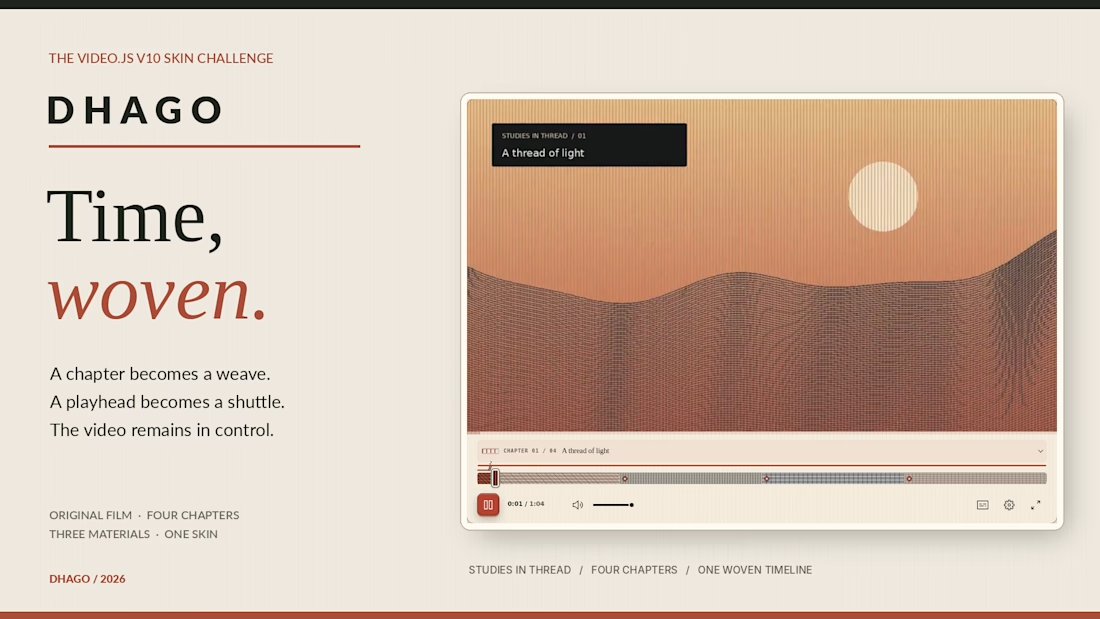
DHAGO | Time, Woven.
What if a video player could do more than measure time? What if it could give time texture, rhythm, and memory?
DHAGO began with that question.
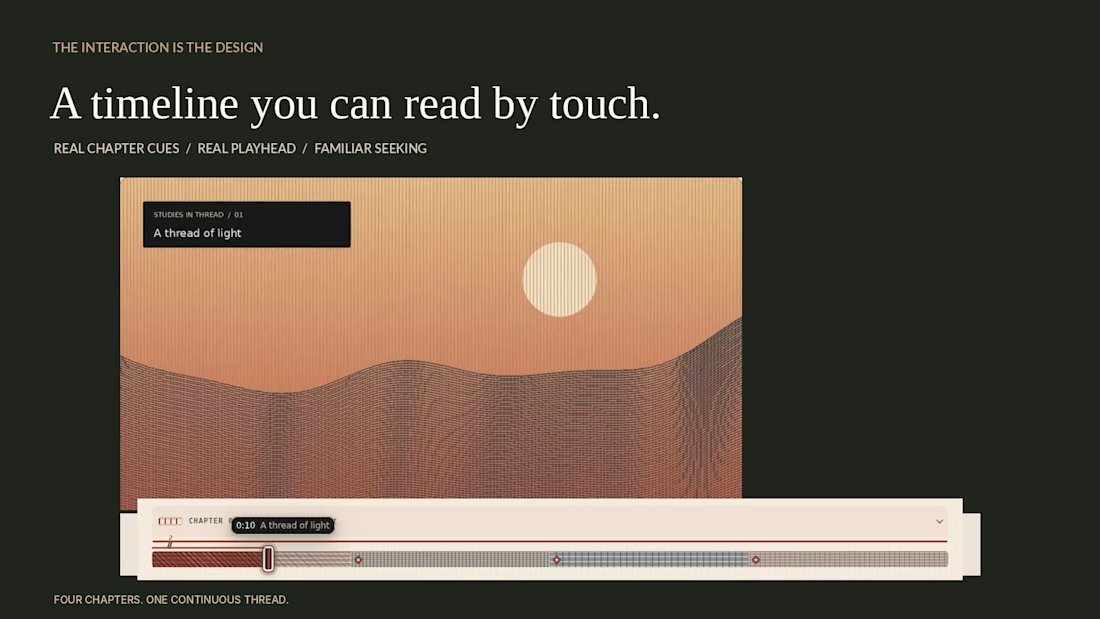
Inspired by Dhago, the Nepali word for thread, I designed a Video.js v10 skin where the timeline becomes part of the storytelling itself. Chapters form sections of a woven surface, while a shuttle-inspired seek control follows the real movement of playback. Move forward and the story is woven. Move backward and the thread traces its way through moments already passed.
The idea was not to decorate a familiar player. It was to translate the logic of weaving into interaction while keeping play, seek, sound, captions, speed, fullscreen, keyboard navigation, and responsive behavior immediately understandable.
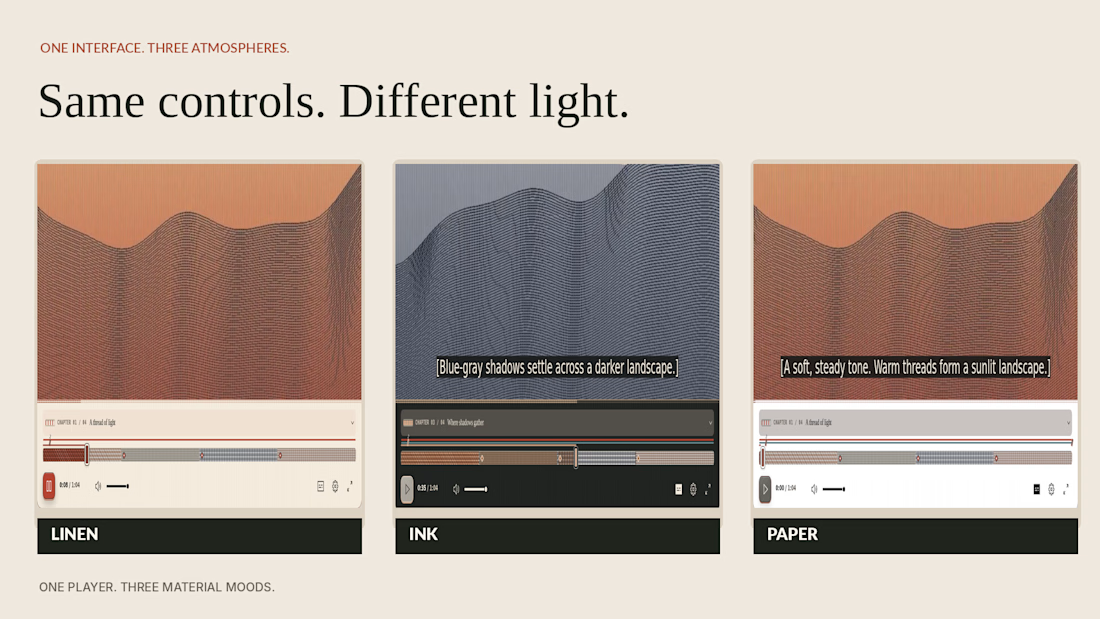
The same design language is expressed through three visual treatments, Linen, Ink, and Paper, without changing the underlying interaction model.
I also created Studies in Thread, an original four-chapter motion study designed specifically around the player, and a Studio Journal that places the same DHAGO skin inside a more editorial viewing experience. The journal connects written scene notes directly to moments in the film, showing that the identity of DHAGO belongs to the player itself, not only to a showcase page.
Behind the visual work is a reusable player architecture, a standalone woven timeline component, Mux support, chapter and caption handling, accessibility considerations, and extensive testing across narrow layouts and difficult playback states.
DHAGO is ultimately an exploration of how cultural inspiration can become functional design rather than surface decoration.
A single thread may seem insignificant. Woven together, threads create structure, memory, and meaning.
Most video players tell us how much time has passed. DHAGO asks what that time has woven.