The network for creativity
Join 1.25M professional creatives like you
Connect with clients, get discovered, and run your business 100% commission-free
Creatives on Contra have earned over $150M and we are just getting started
Back to feedPost

A CRM automation can look broken in one place while the real failure began two systems earlier.
When I investigate an unreliable workflow, I trace five layers:
Capture and field mapping — did the correct record and values enter the system?
CRM structure — did the contact, opportunity, owner, stage, and tags reach the expected state?
Workflow logic — did entry rules, branches, delays, and stop conditions behave correctly?
Handoffs and access — did the next platform receive the correct event and grant the intended access?
Reporting and evidence — can the team prove what happened without relying on memory?
This sequence separates the visible symptom from the root cause and produces a safer repair order. It also prevents a quick fix from creating another failure elsewhere.
When automation fails in your business, which layer is hardest to verify: capture, CRM state, workflow logic, handoff, or reporting?
Use the free 15-point CRM Automation Health Check to score these layers and identify where evidence is missing:
https://contra.com/products/0I3NY4XB-crm-automation-health-check-15-point-field-guide

The network for creativity
Join 1.25M professional creatives like you
Connect with clients, get discovered, and run your business 100% commission-free
Creatives on Contra have earned over $150M and we are just getting started



Related posts


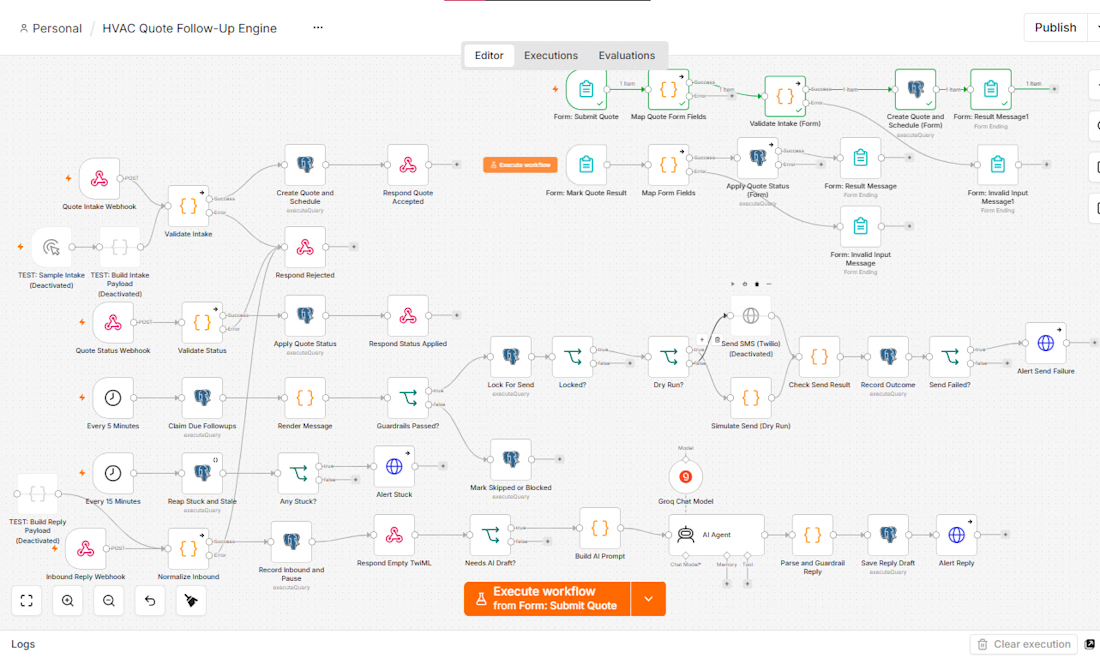
Quote Follow-Up Automation for HVAC & Plumbing
Most home-service quotes don’t get rejected, they just go quiet. I built a system that follows up on them automatically.
What it does
Takes each quote through a simple form
Schedules up to 8 timed texts over 30 days
Stops instantly on a reply, a STOP, or a booked/lost update
Uses AI to draft replies to objections, with a human approving every one
Built with safety first
No duplicate texts, even when processes overlap
Only contractor-approved wording is sent
Texts go out only during local business hours
Opt-outs are honored immediately
Stack: n8n, Postgres, Groq, Docker, Twilio
Status: built and tested end to end, ready to pilot.
I build automation systems like this for service businesses. Message me if you’d like one for yours😊 .



Clients often start with the same request: "Let's build an AI agent."
My counter-question is always: which manual process actually costs you time, errors, or money right now?
My selection rule: remove it first. If it can't be removed, simplify it. If it's still needed, automate it with a plain script. Only then add an integration or an agent. Often the best result is the process that no longer exists.
Safe automation means real scenarios, error handling, and alerts. Without alerts, a workflow can silently lose data for weeks. I always define what stays with a human and what goes to the system.
Question for you: which process would you automate first, and why is it still manual?
Service for audit and implementation: https://contra.com/s/BmWLbgFU-ai-automation-from-your-dream-to-working-implementation?r=auto_booster