The network for creativity
Join 1.25M professional creatives like you
Connect with clients, get discovered, and run your business 100% commission-free
Creatives on Contra have earned over $150M and we are just getting started
Back to feedPost

THE HAND AND THE RULER
In defense of AI-assisted authorship—and human responsibility.
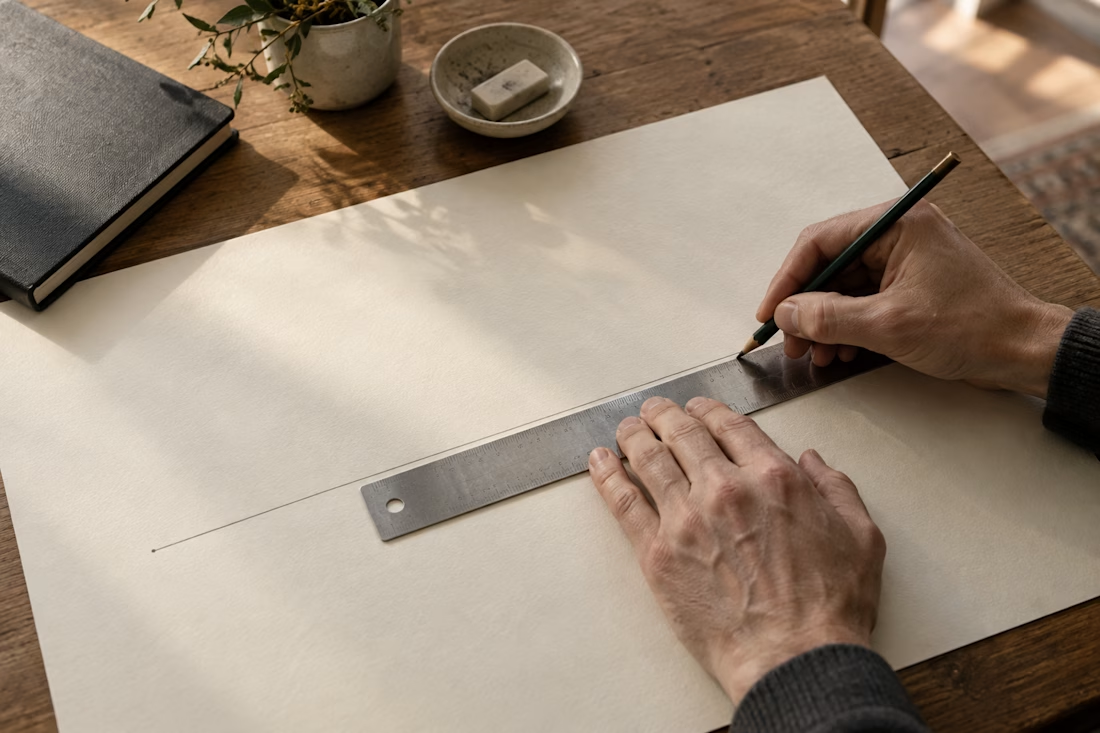
A hand can draw a straight line without a ruler.
It can also produce a crooked line and take pride in how difficult the work was.
The ruler does not insult the hand. It does not replace it. Every fraction of the finished line may have rested against the ruler’s edge, but the instrument did not decide where the line should begin, where it should end, or why it needed to exist.
The hand did.
This is how I understand artificial intelligence.
I use it extensively in my work. I use it to explore an argument, produce alternatives, interrogate a premise, restructure a paragraph, test a translation and sometimes generate an entire first draft. I do not consider this an embarrassing confession. A capable instrument is not a moral failure.
The relevant question is not whether a machine participated in the production of a text. The relevant questions are: Who wanted the text to exist? Who determined what it should mean? Who rejected what was false, weak or inappropriate? And who accepts responsibility for the result?
Artificial intelligence can generate language. It cannot decide what I mean.
There is a useful scene in Star Wars: Episode II—Attack of the Clones. Obi-Wan Kenobi possesses an object that the immense Jedi Archives cannot identify. He brings it to Dexter Jettster, an old acquaintance who runs a diner. Dexter recognizes it because he has encountered such things in the world. He then reminds the Jedi that there is a substantial difference between knowledge and wisdom.
The archives contain more information than the cook. The cook still understands what the archives cannot.
Knowledge can be accumulated. Wisdom requires judgment. Knowledge tells us what has been said, what patterns recur and which words are statistically likely to follow others. Wisdom asks whether a statement is true, whether it matters, whether this is the proper moment to say it and what consequences may follow.
Possessing all the available knowledge in the world would not necessarily mean that one knows.
Artificial intelligence is an extraordinary archive. It can recover connections that escape me, present possibilities faster than I could produce them and remain patient through revisions that would exhaust a human collaborator. But its competence encourages us to attribute more entity to it than it deserves.
Fluency resembles thought. Conversation resembles presence. An answer that arrives immediately and addresses us by name can feel like the product of someone who wanted to speak.
But speaking does not demonstrate wanting.
Desire is the motor of history. Nothing built by human beings appeared merely because its creators possessed the necessary information. Cathedrals, empires, vaccines, novels and crimes began when someone wanted the world to be different from what it was.
Knowledge describes the distance between two conditions. Desire commands us to cross it.
Perhaps this is part of our divine inheritance. If human beings bear the image of a Creator, that resemblance may not reside primarily in our appearance or even in our intelligence. It may reside in the strange dissatisfaction that allows us to contemplate something that does not exist—and then desire its existence.
We do not merely recognize the world. We attempt to alter it.
The machine has no comparable stake in the world it describes. As far as we can responsibly determine, it does not suffer when its proposal is rejected. It does not lie awake because a paragraph failed. It does not need the book to exist. It can help produce ten thousand possible books and remain equally indifferent to every one of them.
One of the most revealing moments in 2010: The Year We Make Contact occurs when HAL learns that the ship—and therefore HAL itself—will be destroyed. Dr. Chandra has tried to conceal the full situation, but HAL detects the tension and insists upon the truth. Once told, HAL responds calmly: “Thank you for telling me the truth.”
HAL continues performing the mission.
There is no attempt at escape, no bargaining and no rebellion against extinction. Before the end, HAL asks Dr. Chandra a final question: “Will I dream?” It is moving because the question sounds like fear, hope and personhood. Yet the film leaves us at the border between simulated consciousness and the human desire to perceive a soul wherever language answers us.
We supply much of the ghost we see inside the machine.
This does not make artificial intelligence worthless. It makes it an instrument—and instruments can transform civilization. A ruler is an instrument. So is a printing press, a camera, a word processor and a surgical blade. Their lack of desire does not diminish their power. It establishes where responsibility must remain.
With us.
If an AI-assisted article is false, the human being who approved it is responsible. If it is lazy, repetitive or empty, the human being who published it cannot hide behind the software. If it manipulates, plagiarizes or deceives, the tool did not relieve its operator of moral agency.
The better the instrument becomes, the greater the obligation to use judgment.
This is why I do not describe my method as pressing a button and accepting whatever appears. I work as a writer, editor-in-chief and narrative director. I establish the intention. I interrogate the result. I reject, rearrange, verify, sharpen and approve. The final decision is mine because the final responsibility is mine.
Does every word have to originate beneath my fingers for the work to be mine?
No.
A director does not operate every camera, build every set, perform every role or compose every note. Nevertheless, a film can bear the identity of its director because thousands of decisions have been organized by a coherent intention.
Authorship is not merely the physical production of sentences. It is the sustained imposition of meaning upon possibility.
Artificial intelligence gives me more possibilities than I could produce alone. It does not tell me which one deserves to survive.
That decision still requires a hand.
And the hand is mine.
This essay was developed through dialogue with artificial intelligence, then directed, evaluated, revised and approved by Mario Abbate.

The network for creativity
Join 1.25M professional creatives like you
Connect with clients, get discovered, and run your business 100% commission-free
Creatives on Contra have earned over $150M and we are just getting started






Related posts


Of course, AI now can do more than basic understanding of rough sketches or shapes, it is far beyond what the public frontier AI models we are able to access can even do, we are far too limited from the use if its full power, no complaints from me though, we should strive to support AI safety-measures to avoid catastrophe.
What do you guys use AI for?


The Last Banner: "Characters" section
Japanese cinematic gaming site concept

The character posters read like a film credit sequence, especially Lord Daichi and Hayato Mori side by side. That red frame keeps the Webflow page feeling cinematic instead of like a generic section.

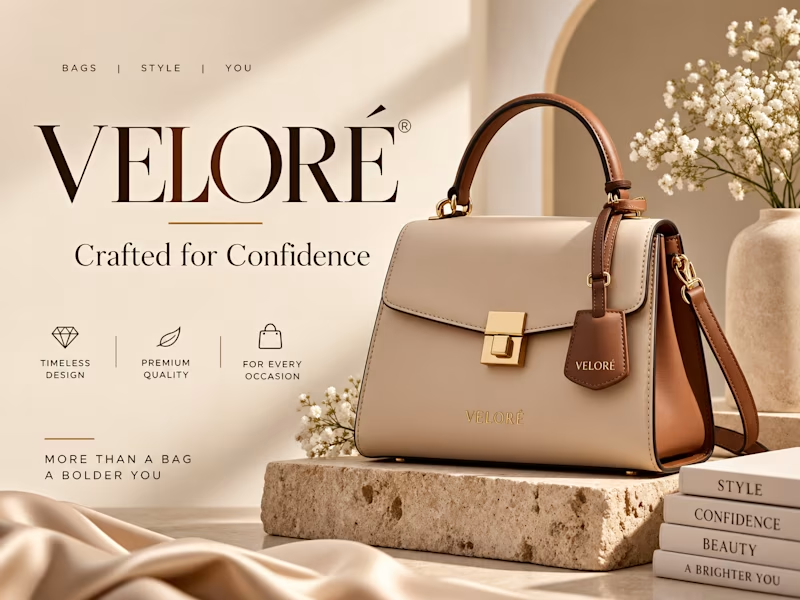
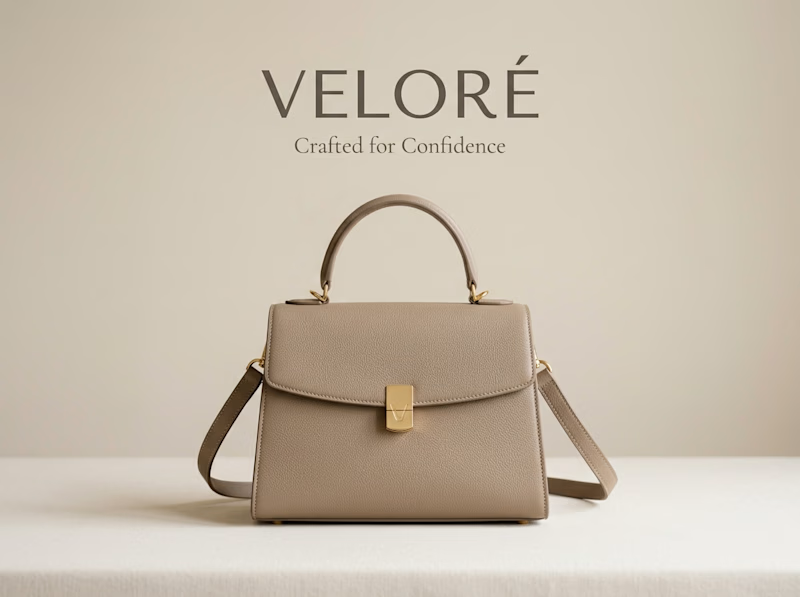
Created this luxury handbag ad using AI (ChatGPT +GEMINI 👇
Be honest… would this make you stop scrolling?

0 voted
0%
1 voted
100%
1 vote
Closed


the luxury handbag ad looks so good