The network for creativity
Join 1.25M professional creatives like you
Connect with clients, get discovered, and run your business 100% commission-free
Creatives on Contra have earned over $150M and we are just getting started
Back to feedPost

Many CEOs are overworked, not because they lack vision, but because they are holding on to tasks they should have delegated long ago.
If you want to grow, you must protect your time.
Here are 3 tasks every CEO should stop doing immediately:
Manual Scheduling:
If you are still going back and forth trying to fix meeting times, you are wasting valuable leadership hours. Scheduling tools and delegated support exist for a reason. Your time should be spent on strategy, partnerships, and revenue decisions, not calendar coordination.
Basic Customer Replies:
Answering every simple inquiry yourself may feel responsible, but it is not scalable. Frequently asked questions, confirmations, and routine responses can be handled efficiently by a trained support system. Your role is to oversee the experience, not manage every message.
Formatting Documents:
Adjusting fonts, aligning pages, and polishing presentation layouts should not be on your priority list. These are execution tasks.
A CEO should focus on content, direction, and decision making. The formatting can and should be delegated. No negotiation.
Delegation is not laziness. It is leadership.
Growth happens when you shift from doing everything to directing everything. When you free yourself from low leverage tasks, you create space for innovation, clarity, and expansion.
Smart CEOs delegate. If you're ready to, let's discuss.
The network for creativity
Join 1.25M professional creatives like you
Connect with clients, get discovered, and run your business 100% commission-free
Creatives on Contra have earned over $150M and we are just getting started





Related posts

Same industry, two jobs for the header.
A good header knows what the visitor should do next.
Which one makes you hungrier?👇




4 votes
Ends in 11h

nutriqo because when i look closely it is giving a very perfectly balanced section also the items below is has a perfect spacing and heirarchy compared to the other one

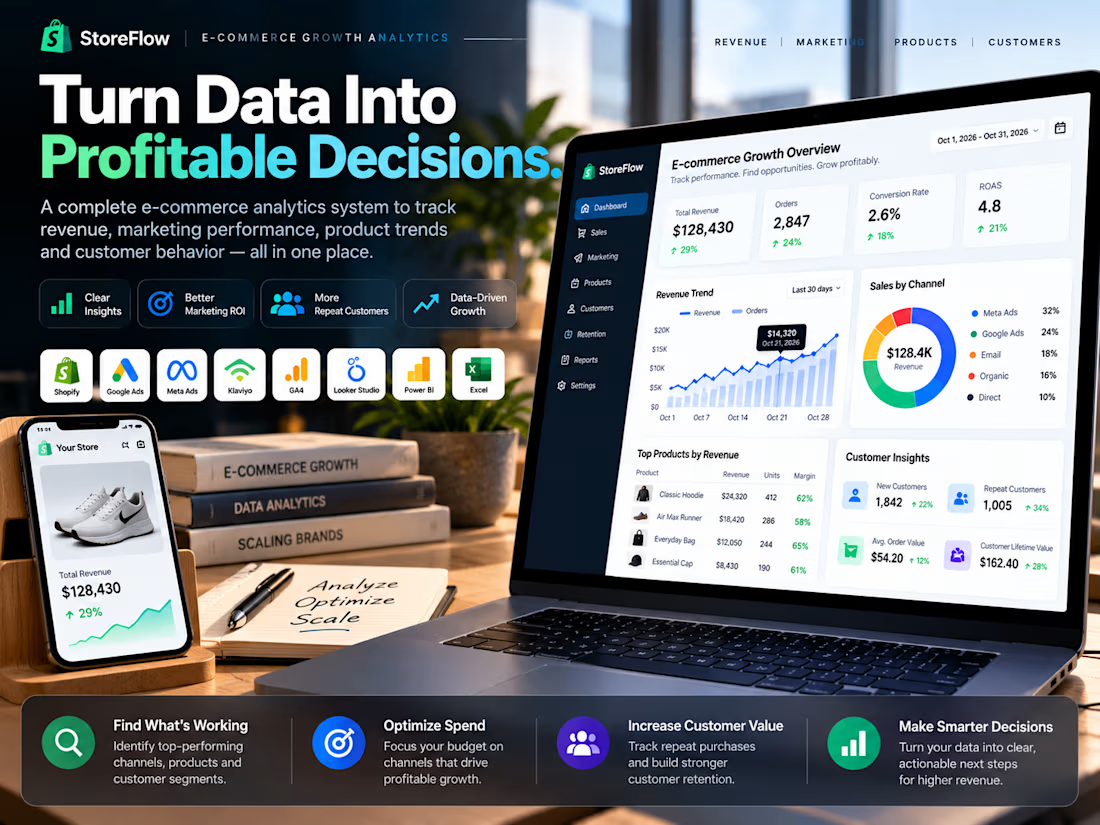
See exactly what’s driving revenue, where growth is leaking, and which products, channels, and customers deserve more investment.
I developed an e-commerce growth intelligence system around one question:
Where should the business invest next?
Most stores already have plenty of data. The harder problem is understanding what that data means for revenue, marketing spend, products, and customer growth.
So instead of building another dashboard full of charts, I’m structuring the system around decisions.
It brings together signals such as revenue, ROAS, CAC, conversion, product performance, repeat purchases, and retention to identify things like:
which channels deserve more budget, where acquisition is becoming inefficient, which products attract traffic but fail to convert, and where repeat customers are creating stronger value.
The goal isn’t just to answer:
“What happened?”
It’s to answer:
“What should we do next?”
Because the most useful analytics system isn’t the one with the most charts.
It’s the one that makes the next business decision clearer.
Tags: E-Commerce · Marketing Analytics · Data Analytics · Power BI · E-commerce Management
Marketing AnalyticsData AnalysisecommerceeCommerce ManagementMicrosoft ExcelMicrosoft Power BIShopify



Exactly. Analytics becomes much more valuable when it helps businesses make smarter decisions, not just track numbers.

Burying your traction on slide 28 is the fastest way to lose a venture partner.
Most founders assume volume equals expertise. They drop a massive rock of information onto venture partners, hoping the investor will dig through it to find a reason to write a check.
But reality works differently. Venture partners review materials on their phones in the back of a cab or between meetings.
If your core growth metric is hidden under a solid wall of text, nobody is going to see it. You lose their attention before they even understand your business model.
Your presentation should be a scalpel, not a sledgehammer.
Cut your deck in half. Leave empty space so your most critical numbers can actually breathe. One clean layout proving your unit economics closes rounds much faster than ten pages of technical documentation and product features.
Open your current pitch deck. How many slides can you delete today without losing the core narrative?




The phone-in-a-cab test is a good one. A quick way to check it is to shrink each slide to thumbnail size: if the key number still reads there, it will survive a phone screen. Do you set a minimum size for metric callouts in your decks?