The network for creativity
Join 1.25M professional creatives like you
Connect with clients, get discovered, and run your business 100% commission-free
Creatives on Contra have earned over $150M and we are just getting started
Back to feedPost
Nowadays, Everyone wants to use a Ferrari on an Agricultural Field👇
We're seeing this exact trend in software engineering - using AI agents for problems that are often better solved with robust systems programming and automation.
However, I'm not saying "never" use AI agents.
When we talk about open-ended reasoning, complex multi-step decision making, unstructured workflows, or tasks where human judgment must be approximated, the narrative changes. In these scenarios, AI agents can be transformative.
But many teams are now deploying agents to solve problems that are fundamentally deterministic.
Need to process millions of events reliably? Build better systems.
Need to reduce operational workload? Automate the workflow.
Need to eliminate repetitive manual tasks? Invest in tooling and infrastructure.
A well-engineered system can often eliminate 90% of the work that people are trying to solve with layers of prompts, agents, evaluators, and orchestration frameworks.
In these cases, the real leverage doesn't come from adding more intelligence—it comes from removing unnecessary complexity.
But the mistake is applying the "AI Agent" requirement to everything. When we reach for agents before understanding the underlying system, we trade →
Predictability for probabilistic behavior.
Operational simplicity for orchestration complexity.
Long-term reliability for short-term excitement.
Engineering fundamentals for prompt engineering.
True engineering isn't about using the trendiest technology—it's about identifying the root problem and applying the simplest tool that solves it effectively.
Sometimes the answer is an AI agent.
But surprisingly often, the answer is a better system.
Are we building AI because the problem genuinely requires intelligence, or because we've forgotten how much leverage good systems engineering can provide? I'd love to hear your thoughts.


The network for creativity
Join 1.25M professional creatives like you
Connect with clients, get discovered, and run your business 100% commission-free
Creatives on Contra have earned over $150M and we are just getting started
Related posts

🚀 Available for Freelance Web Development Projects
Hi everyone! I'm a web developer specializing in modern, responsive, and high-performance websites. I build business websites, portfolios, landing pages, e-commerce sites, and full-stack web applications using React, Node.js, JavaScript, HTML, CSS, and MongoDB.
I'm currently available for new projects and would love to help bring your ideas to life. If you're looking for a reliable developer who values clean code, clear communication, and on-time delivery, feel free to connect or message me. Let's build something amazing together! sample one
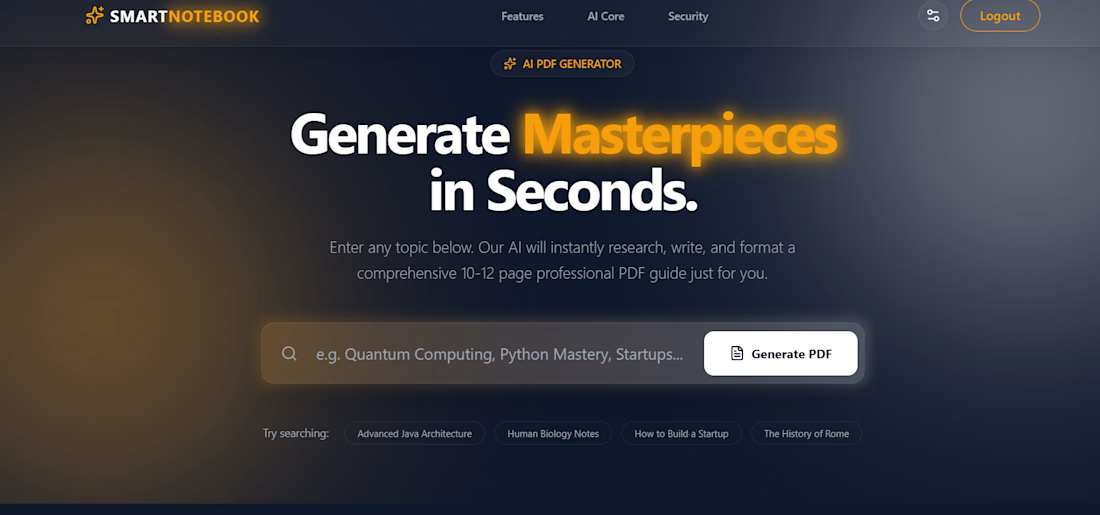

Keep growing, A reliable developer is always worth working with.

I built ShinePro Auto Spa with Base44 — a modern car detailing experience that makes booking premium detailing services simple and hassle-free.
I've experimented with a lot of AI app builders and coding agents over the past year, but Base44 genuinely surprised me. The speed, quality, and end-to-end workflow made it feel less like prompting an AI and more like collaborating with a skilled developer. It handled UI, data, and automations in a way I hadn't experienced before.
Before: customers typically had to call, send WhatsApp messages, or fill out basic contact forms just to ask about pricing, availability, or which detailing package was right for their vehicle.
After: I created a premium booking experience where customers can browse detailing packages, view before-and-after transformations, get an instant service recommendation, request a quote, and book an appointment in just a few minutes.
The automation helps the business capture qualified leads, organize bookings, send confirmation and reminder emails automatically, and answer common customer questions through an AI assistant.
This isn't just a car detailing website.
It's a complete customer booking and lead management system designed to save time, improve the customer experience, and help the business generate more bookings.
Built with Base44 for #GiveItAGlow.
From manual bookings to a premium digital detailing experience.

Cool!

A little web design break from building cross platform systems 💻
Here's a popup creative we designed for one of our clients.
We create HTML to cross platform applications with low CAPEX that help brands stand out. ✨
Which theme white or dark would you choose: 1 or 2? 👇
0 voted
0%
2 voted
100%
2 votes
Closed








Trending

Claude
Claude has entered the design space. How are you using Claude Design?

Contra University
Learn from expert creatives how to earn more using next-gen AI tools.
fifaworldcup2026
The World Cup is here and the whole world's watching. How are you designing for the world stage?
creativeaiflow
Creative AI workflows are evolving. What tools do you use, and what are their strengths and weaknesses?
freelancerlife
Freelancer life is wins, pivots, and everything in between. What’s yours right now?