
Carlos Molina
Experienced Business Consultant for transformation projects
New to Contra
Carlos is ready for their next project!
Case Study: Turning a Service Culture Program Into a Measurable NPS Gain — Twice
The Situation
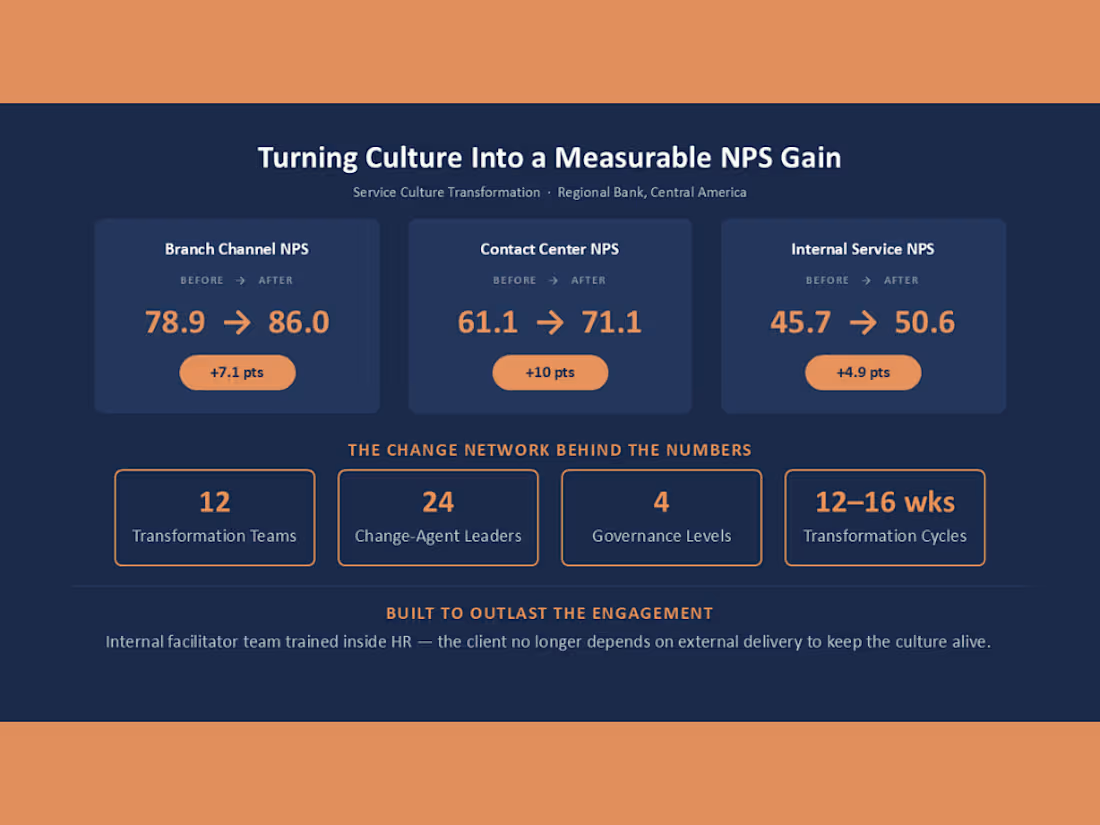
A regional bank in Central America needed to move beyond training slides and actually shift how service happened at every customer touchpoint, measured the only way that matters to leadership: NPS.
My Role
I led the culture transformation program end to end: designing the cultural framework, building the network that carries it, and installing the operating rhythm that keeps it alive after the engagement ends.
The Approach
Rather than a top-down campaign, we built a distributed change network: 12 transformation teams (10 in client-facing branch and contact-center operations, 2 in key support areas) led by high-influence employees, backed by executive sponsors and functional leaders across four governance levels. Each team ran the same operating model — a repeatable 12–16 week transformation cycle (Focus → Build → Execute → Consolidate) applying a four-behavior service framework in daily customer interactions, with weekly measurement and sponsor-level course correction built in.
Results
Branch channel NPS: 78.9 → 84.5 over two quarters (June close at 86.0), promoter share hitting 91.2% and detractors dropping from 8.5% to 5.3% — based on over 12,000 customer surveys
Contact center channel NPS: +10 points recovered from its December low, closing at 71.1 in June — its highest point in the measurement period — with detractors down from 14.2% to 9.8%, across more than 105,000 interactions
Internal service NPS (support functions): +4.9 points in 3 months, with the most-challenged sub-area improving fastest — an early signal the culture shift reaches internal service delivery, not just the customer-facing front line
What Gets Left Behind
The engagement didn't end at a report. It left the organization with a defined and measurable cultural framework, a trained internal facilitator team inside HR (so the client no longer depends on external delivery), 24 developed change-agent leaders, a documented change network with governance at every level, and a transformation methodology built to run as a permanent operating rhythm, not a one-time project with a closing date.
1
25
Case Study: Removing a Full Layer — $460K in Annual
Savings, With a Transition Plan That Actually Sticks
The Situation
A specialty manufacturing company was carrying too many management layers and uneven spans of control across its plants, with handoffs between Commercial, Planning, Production, and Quality creating rework and slow response times to customers.
My Role
I led the organizational structure redesign, spans & layers , and built the full change management plan to implement it, from org chart to the individual conversations that make a reorg land without chaos.
The Approach
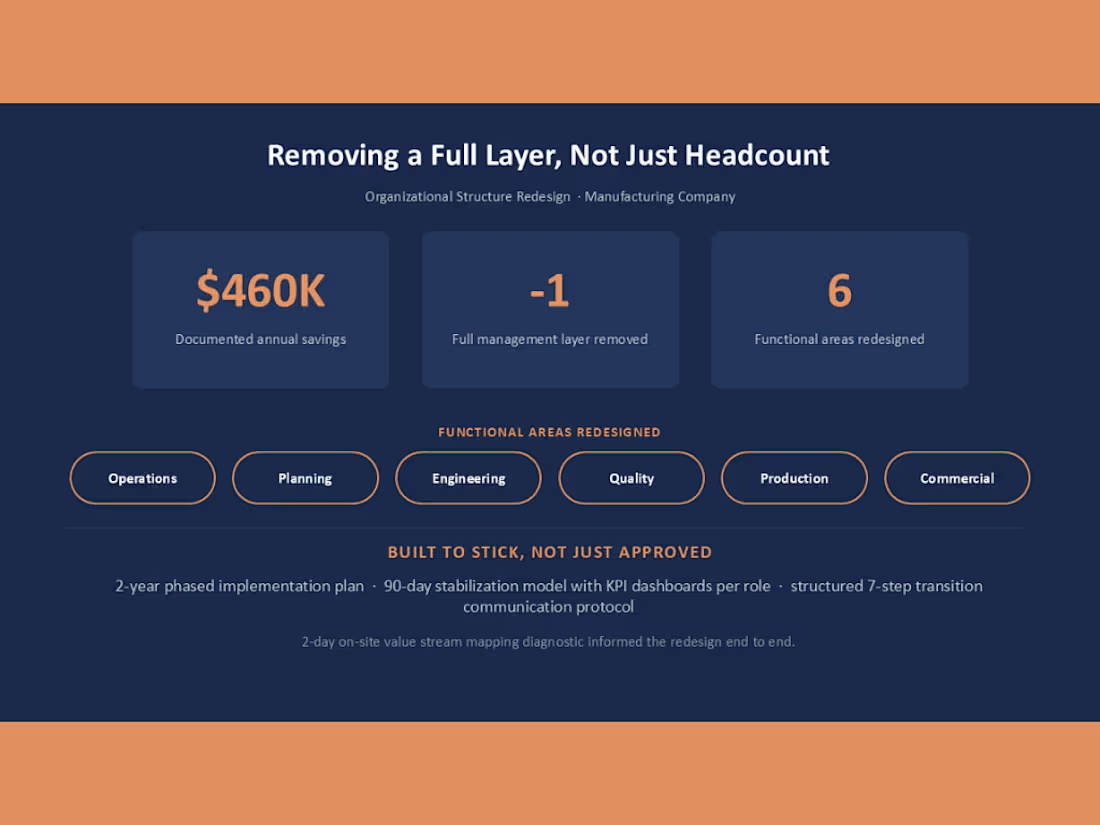
A 2-day on-site collaborative session mapped the complete customer-to-delivery value stream, giving us a real diagnostic of where time, rework, and quality impact were coming from, not assumptions. That diagnostic, combined with headcount and reporting-line analysis across 6 functional areas (Operations, Planning, Engineering, Quality, Production, and Commercial), produced a set of structural hypotheses that were tested and refined with leadership before finalizing the new design.
What Changed
Eliminated one full layer while improving spans of control, creating room for growth instead of just cutting.
Consolidated supervisor roles with thin direct-report counts across two plants.
Added a dedicated Quality Management System specialist.
Strengthened the production scheduler role and profile
Integrated Customer Service into the planning function to simplify communication and cut cross-functional rework
Results
~$460,000 in documented annual savings from the redesigned structure
A future-state value stream map targeting reduced lead time, less waste, and better quality outcomes across the full customer request-to-delivery flow.
Why the Redesign Sticks
Most org redesigns fail at the handoff between "new chart" and
"new reality." This one shipped with a 2-year (2025–2026) phased
implementation plan, a 90-day stabilization model with a KPI dashboard for
every transitioning role, and a structured 7-step communication protocol —
ensuring every affected person, from the outgoing manager to the new direct
reports, hears the change directly and in the right order before it becomes
public.
0
25
Case Study: Turning 14 Overlapping Meetings Into a Governance System Leadership Actually Uses
The Situation
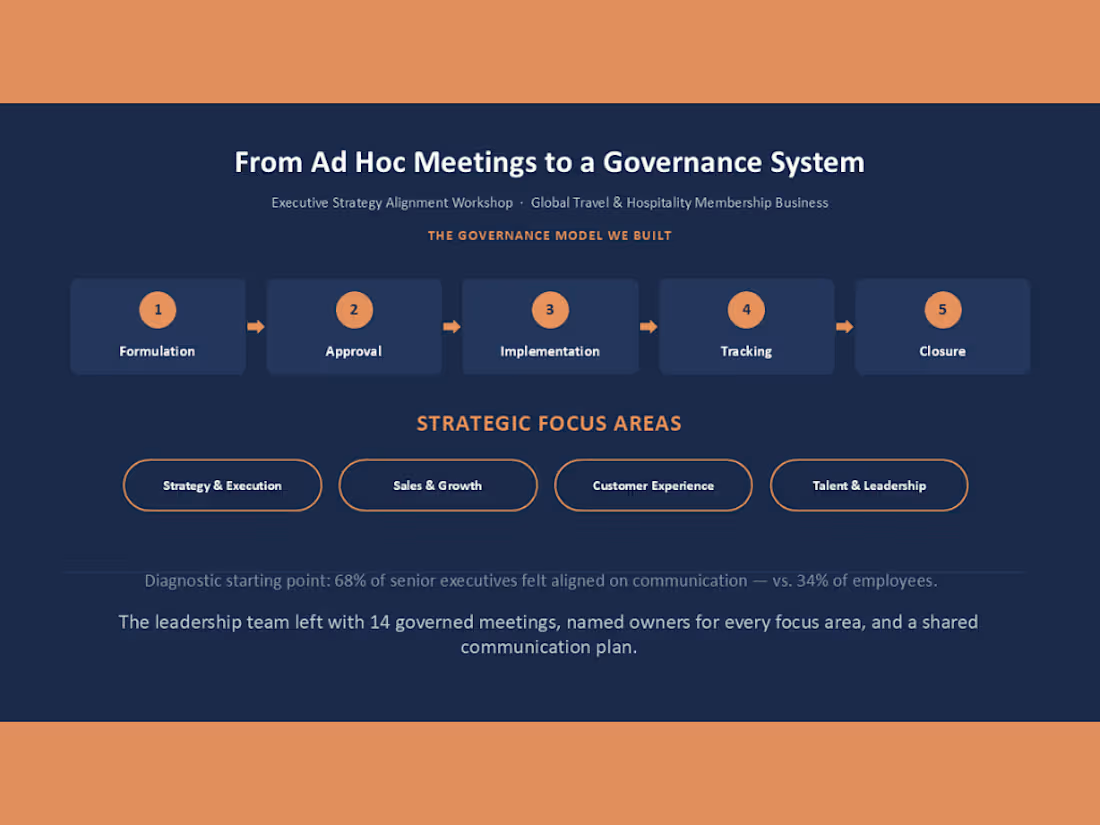
A global travel & hospitality membership business brought its executive leadership team together for a 3-day strategic alignment offsite. The starting diagnostic was blunt: communication effectiveness dropped sharply by level, 68% of senior executives felt informed and aligned, versus just 34% of frontline employees (Towers Watson benchmark cited in-session). Internally, teams described working in silos as one of the top blockers to execution, alongside short-term focus and unclear empowerment.
My Role
I facilitated the full offsite — from the leadership-behavior framing ("the strongest message about your culture is how you run your meetings") through to a working governance model the team left with.
What We Built
Meeting governance framework — catalogued all 14 recurring leadership meetings (staff meetings, monthly business reviews, quarterly business reviews, forecast reviews, CX reviews, town halls, and more), each with a defined owner, objective, required attendees, and cadence, replacing an ad hoc meeting culture with a designed one.
Meeting operating standards, a shared rulebook: 45–50 minute time-boxing, defined roles, a decision-making method, a "parking lot" for off-topic items, and mandatory pre-reads.
Project governance model , a 5-stage lifecycle (formulation → approval → implementation → tracking → closure) with a standardized intake form, feasibility criteria, and resource-approval gate, so projects stop competing informally for budget and headcount.
Strategic focus areas, leadership aligned on 4 pillars for the year (Strategy & Execution, Sales & Growth, Customer Experience, Talent & Leadership), each with named owners and success metrics.
Keep/Stop/Start action plan — diagnostic findings converted into committed actions: stop working in silos, start structured cross-functional task forces and technology/automation initiatives, keep the CX momentum already in motion.
Communication plan framework, mapped every audience, message, channel, and cadence needed to cascade decisions from the leadership team down to frontline colleagues.
Preliminary Outcome
The leadership team left the offsite with a governance system, not just intentions: a defined meeting cadence, a shared project intake standard, named owners for every strategic focus area, and a communication plan ready to execute in the following quarter.
0
35
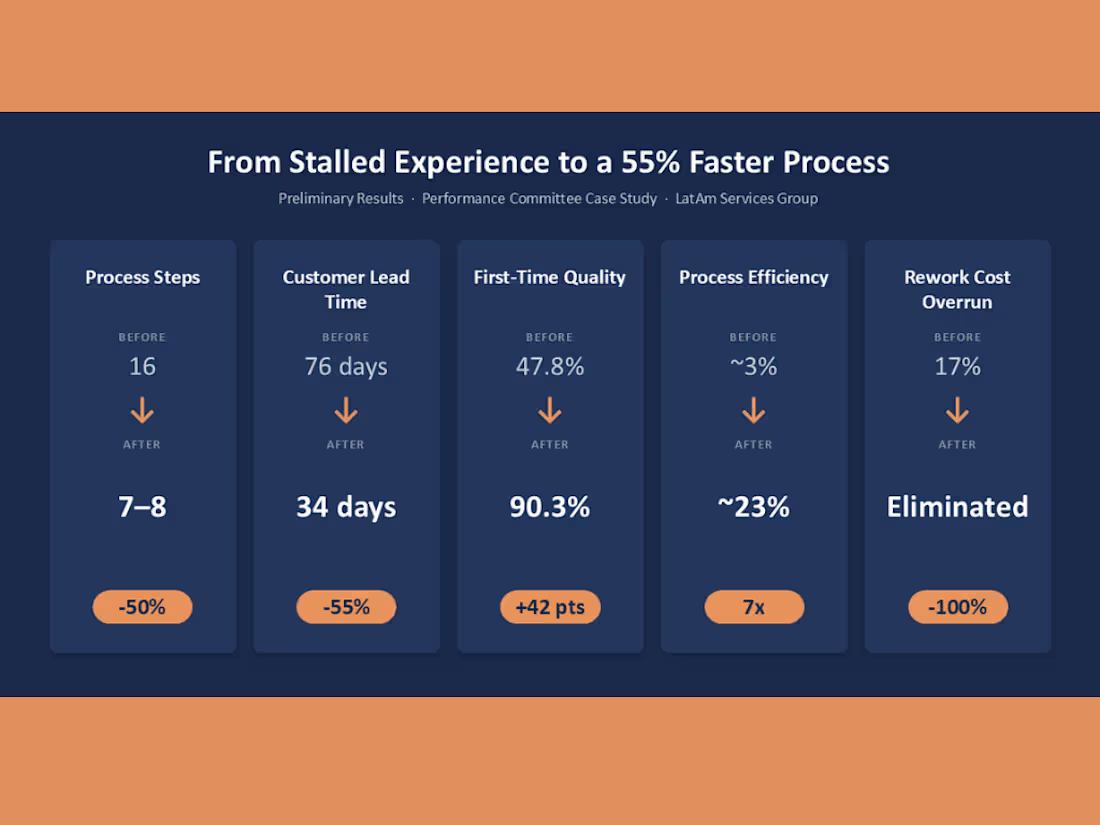
Case Study: Turning a Stalled Experience Into a 55%
Faster Process — In 90 Days
The Situation
A mid-sized LatAm memorial & cemetery services group (500+ employees) had
no function responsible for planning, measuring, and improving processes
end-to-end. Problems were identified, "solved," and measured by the
same team that owned them — with no line back to the company's four strategic
KPIs (operating profitability, NPS, eNPS, brand positioning). A performance
committee had been created on paper but needed activation.
My Role
I joined as the external member of the newly formed committee, not as an
outside auditor, but as the operator who runs the cadence: monthly sessions,
bi-weekly follow-up, and the discipline to turn diagnostics into decisions
Executive Direction can actually act on.
The Approach
Rather than mapping every process in the organization first , a path that risks
a year with no visible result , we picked one high-impact, cross-functional
process, solved it completely, and used it to install the method. The process
chosen: plaque fulfillment, selected because of its direct link to complaints
and NPS, its cross-departmental nature, and a scope small enough to resolve in one work cycle.
What the Diagnostic Found
35% of all company complaints traced back to this single process
First-Time Quality of 47.8% , meaning more than half of all cases required rework
76-day customer wait time on the fastest path, against a 30-day promise
17% cost overrun from rework and process loops
A quality control step that verified the vendor's paperwork, not the customer's actual request, a control that couldn't catch its own root cause
What's Next
The redesign cuts lead time in half without touching the vendor side, the remaining lever requires a leadership decision on sourcing. The committee is now taking three decisions to Executive Direction (sales channel redesign, vendor diversification, and a low-cost operational fix worth ~8x its investment in avoided losses), while queuing the next end-to-end process for the following cycle, proving the method scales, not just solves one problem.
0
44