
Banjit Kalita
Content Writer | Crafting stories that engage and convert
New to Contra
Banjit is ready for their next project!
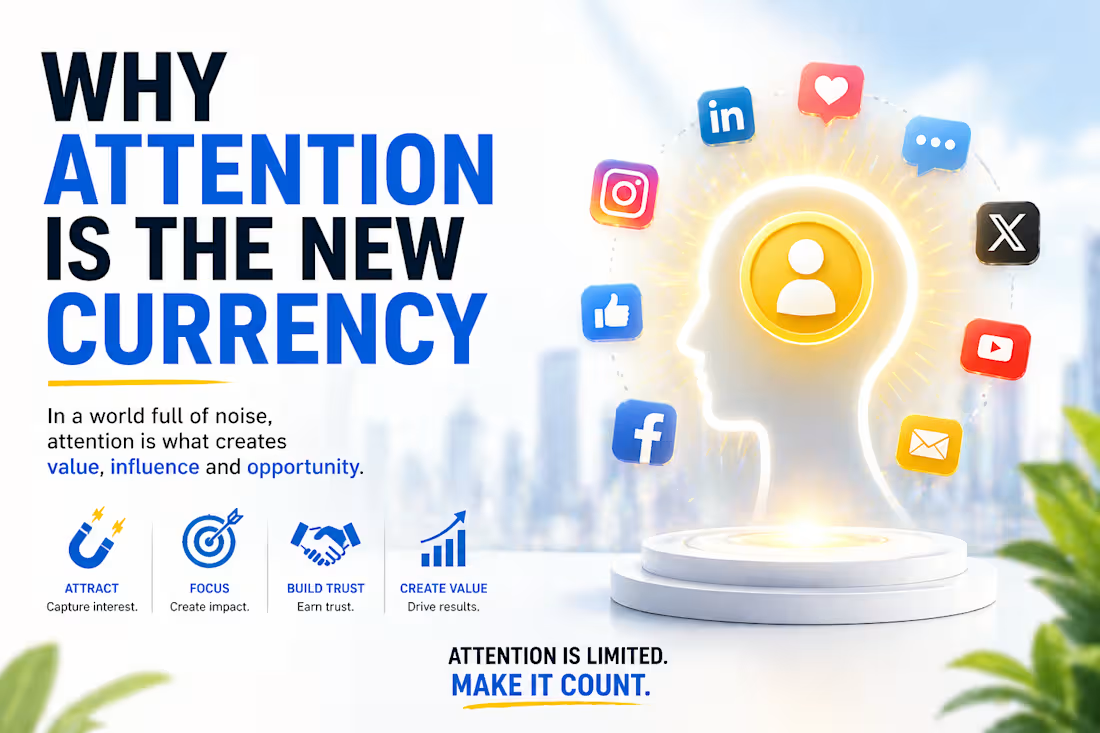
In the digital age, human attention has become one of the most valuable assets in the world. It determines who gets seen, who gets heard, and ultimately, who gets rewarded. Unlike money, which can be invested or saved, attention is limited. Every individual has only so much time and focus in a day. That scarcity is exactly what makes it powerful.
Today, companies and businesses place enormous value on attention because it directly impacts visibility, trust, and revenue. They spend heavily to ensure their products, services, and ideas are noticed by the right audience. In fact, global social media advertising spend in 2025 is projected to reach $239 billion, and that number continues to rise year after year. This proves one thing clearly: businesses are willing to invest billions just to earn a few seconds of human focus.
When companies spend such massive amounts to capture attention, it confirms that attention has become one of the most valuable resources in the modern economy. Brands that fail to secure attention often struggle to compete, while those that master it dominate their industries. In many cases, businesses decline not because their products are weak, but because they fail to stand out in a crowded digital marketplace.
This shift has also transformed the advertising and marketing industry. As attention becomes more valuable, the demand for professionals who know how to capture and sustain it continues to grow. The global advertising and marketing industry is projected to grow by 9.8% in 2026, marking one of its strongest years in recent times. At the same time, global ad spending is expected to reach $1.30 trillion in 2026, reflecting the rapid expansion of this sector.
For people working in advertising, marketing, branding, and digital media, this creates new opportunities. Businesses now rely on experts who can design campaigns, create engaging content, analyze audience behavior, and build strong brand presence online. These roles are becoming increasingly important as companies compete for consumer attention.
However, success in this field requires adaptability. The industry is evolving quickly with the rise of AI, data-driven strategies, and new digital platforms. Those who continue learning and adjusting to these changes will benefit the most.
The advertising industry is expanding, but it rewards adaptability more than ever. In a world where attention drives influence and revenue, the ability to capture focus is no longer optional—it is essential.
That is why, in today’s economy, attention is truly the new currency...
0
14
Overthinking Is Quietly Destroying Your Career — Here’s How to Break Free
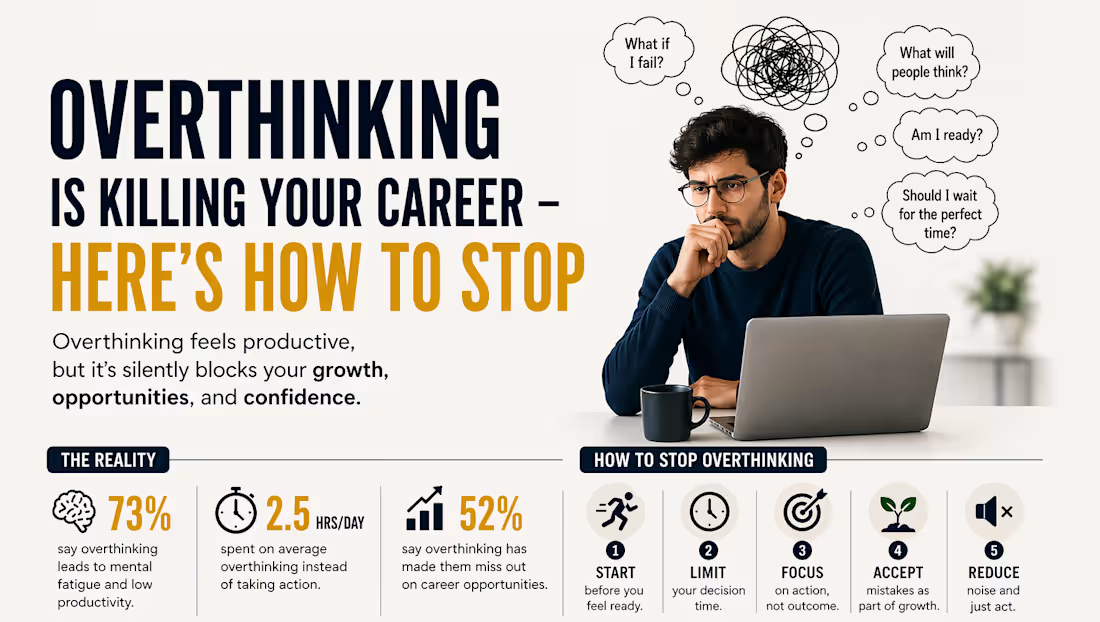
In today’s fast-paced world, success is no longer defined only by intelligence or skill—it is defined by the ability to take action. Yet many talented people find themselves trapped in a cycle of constant analysis, questioning every decision, fearing mistakes, and delaying progress. Overthinking often feels responsible, as if careful planning will guarantee success. But in reality, it becomes a silent barrier. While you are trying to make the perfect choice, others with less certainty but more courage are already moving forward.
This is not just a personal struggle—it is a growing professional challenge. Across industries, stress, anxiety, and burnout continue to affect millions of people, often reducing productivity and confidence. Many professionals are not held back by lack of ability, but by hesitation and mental overload. The pressure to always make the “right” decision creates a mindset where action is delayed in pursuit of perfection.
This often leads to what experts describe as decision paralysis. The more time spent searching for the perfect answer, the harder it becomes to make any choice at all. Opportunities pass, confidence weakens, and self-doubt grows stronger. What begins as a simple thought—“What if I fail?”—can slowly become a pattern of avoidance that limits growth.
The emotional impact of overthinking is significant. It creates constant comparison, fear of judgment, and the painful feeling of being stuck while others move ahead. Perhaps the greatest cost is regret—the realization that opportunities were available, but fear prevented action. Overthinking creates the illusion of control, but in truth, it only delays progress.
The reality is simple: clarity does not come from endless thinking. Clarity comes from action. Confidence is not built by waiting for certainty—it is built through experience. Every step forward, even if imperfect, creates momentum. And momentum is what leads to growth.
Breaking free from overthinking requires a deliberate shift in mindset. Start before you feel fully ready, because readiness is often an illusion. Set deadlines for decisions so analysis does not become endless. Focus on progress rather than perfection, and accept mistakes as part of learning. Each action, no matter how small, moves you closer to your goals.
In the end, your career will not be shaped by how much you thought about your ambitions, but by how many times you chose to act despite uncertainty. One year from now, you will either be proud that you moved forward—or regret that hesitation held you back. The difference is action.
What decision have you been postponing because you are waiting for certainty?
0
25
Understanding Dyslexia: When Struggle Turns into Strength
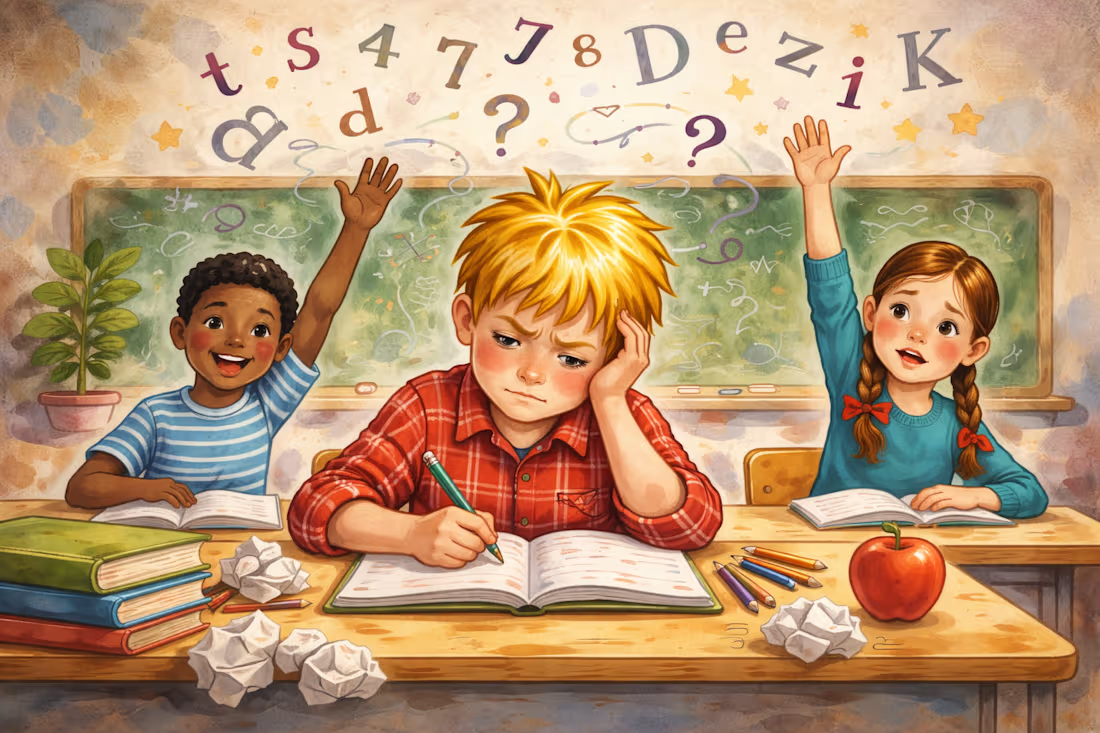
Difficulties with reading and writing often begin quietly in early childhood. A child may struggle to recognize letters, confuse sounds, or find it challenging to read simple words. At first, these signs can seem minor—easy to overlook or dismiss. But as formal education begins, the gap becomes more visible. While other children progress with ease, a child with Dyslexia may start to feel lost, confused, and increasingly unsure of themselves.
What begins as a learning challenge can gradually turn into an emotional burden.
Simple academic tasks—reading, writing, and spelling—become daily obstacles. Repeated mistakes chip away at confidence, making learning feel stressful rather than empowering. When these struggles go unrecognized, the impact deepens over time. Classrooms may begin to feel intimidating, words turn into barriers instead of tools, and anxiety around school can quietly take hold.
Yet dyslexia is not a limitation—it is a different way of learning.
With early recognition, the right support, and patient guidance, children with dyslexia can thrive. Many go on to develop remarkable strengths. Creativity, problem-solving, and resilience often emerge as defining qualities. Given the proper tools and encouragement, what once felt like a struggle can evolve into a powerful advantage.
The key lies in shifting perspective.
Rather than viewing dyslexia as a weakness, it must be understood as a difference—one that calls for a different approach, not lower expectations. With awareness, empathy, and supportive learning environments, every child has the potential to succeed.
A learning challenge should never define a child’s future.
Sometimes, it becomes the very foundation of their strength....
1
63

Google vs AI: How OpenAI and ChatGPT Are Changing Search Forever
Google isn’t dying—but the way we use it is.
For years, finding information followed a familiar pattern: open Google, type a query, scroll through results, click links, and repeat. It was efficient, reliable, and became second nature. But habits don’t survive disruption—and that disruption has already begun.
Today, more people are turning to ChatGPT from OpenAI. Once users experience direct, conversational answers, their behavior starts to shift. Instead of opening multiple tabs and filtering through pages of content, they receive structured, human-like responses in seconds. This transition—from searching to asking—may seem subtle, but it’s profoundly changing how we interact with information.
Here’s the reality: Google still dominates, holding around 90% of the global search market and processing billions of queries every day. But beneath that dominance, user behavior is evolving. Among students and young professionals, traditional search usage is quietly declining as AI tools become part of daily workflows. At the same time, ChatGPT has rapidly scaled to hundreds of millions of weekly users, signaling a major shift in how people access knowledge.
In the broader AI landscape, OpenAI is estimated to lead with roughly 50–60% usage share, followed by Google at 20–30%, with players like Microsoft and Anthropic making up the rest. Despite this growth, perception hasn’t fully caught up. Surveys suggest that most users still say they prefer Google, while a smaller percentage claim AI as their first choice.
But preference and behavior are no longer the same.
When people need quick explanations, summaries, or solutions, they increasingly turn to AI first. This is especially evident in education, coding, research, and content creation—areas where speed and clarity matter more than browsing multiple sources.
This shift isn’t just technological—it’s psychological.
Google trained us to search: to compare, evaluate, and navigate. AI is training us to interact: to ask better questions, refine our thinking, and receive guided responses. Search offers options; AI offers direction. And in an age of information overload, direction is becoming more valuable than choice.
This moment isn’t about replacement—it’s about evolution.
The real question isn’t who will win, but who will adapt faster. The future won’t belong to people who rely only on Google, nor to those who depend entirely on AI. It will belong to those who understand how to combine both effectively.
Google remains the world’s largest information ecosystem. AI is becoming a personal layer of intelligence built on top of it. Together, they are reshaping how we learn, work, and make decisions.
In the end, the advantage won’t go to companies—it will go to individuals. Because in this new era, power doesn’t come from access to information.
It comes from knowing how to use it better than everyone else.
So the real question is: are you still searching… or have you started asking?
0
31
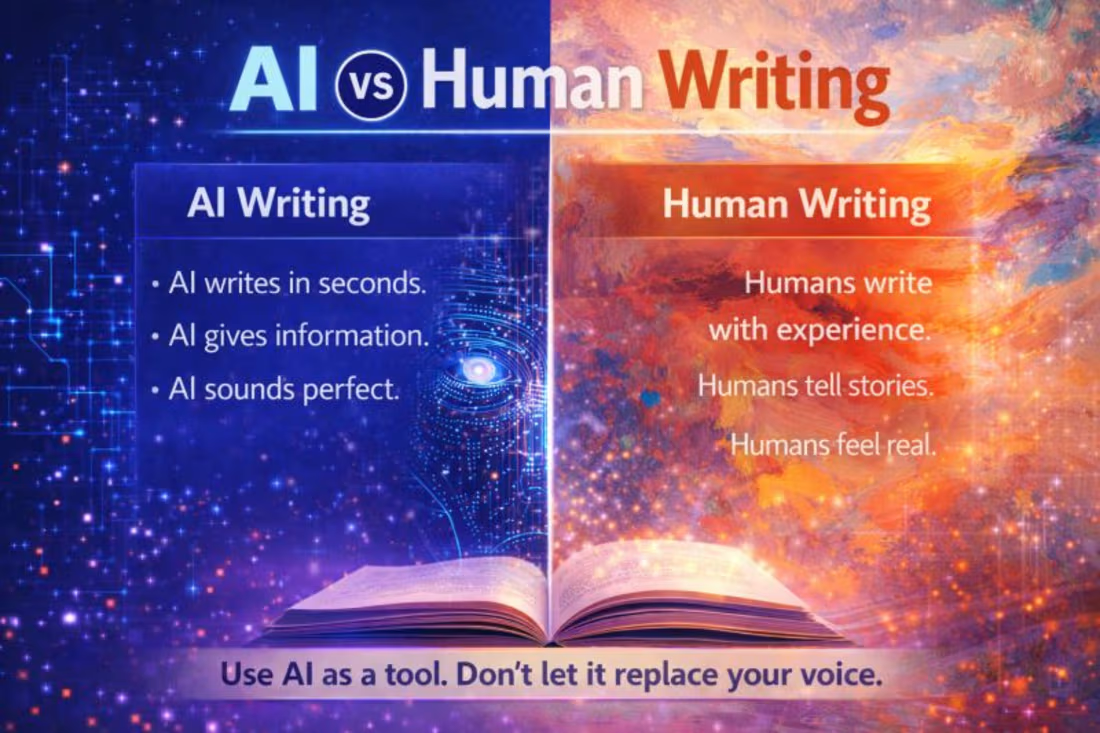
I tried something simple, I tested AI vs human writing on the same idea, and while AI was fast, clean, and almost perfect, something still felt missing when I read it back; then I looked at my version and even though it wasn’t perfect, it had emotion, a point of view, and it felt real that’s the difference, AI can help you write better, but it can’t replace your voice, so use it as a tool, not a shortcut. What do you think where does human creativity still win?
1
46

The Future of Work Is Flexible—Are Companies Ready?
By Banjit Kalita
Remote work, once considered a rare privilege, has evolved into a defining feature of the modern workplace. While the concept existed for years, it was the COVID-19 pandemic that accelerated its global adoption, forcing organizations to rethink how work truly gets done. What began as a temporary response has now become a long-term expectation.
Today, the numbers tell a clear story. Around 55% of employees prefer remote work, and nearly 98% would recommend it to others. Yet only 20–25% of jobs are fully remote. This gap reveals a critical reality: demand has far outpaced supply, making remote roles some of the most competitive opportunities in today’s job market.
The reasons behind this shift are both practical and deeply human. Remote work offers flexibility, allowing individuals to align their schedules with peak productivity. It removes long commutes, reduces daily stress, and opens access to global opportunities. More importantly, it supports a healthier work-life balance—something that is no longer optional, but essential.
Despite these advantages, many organizations remain hesitant. The challenge is no longer technology—it is mindset. A significant number of companies still equate productivity with physical presence, leading to a lack of trust in remote environments. This often results in excessive monitoring and unrealistic expectations, which can ultimately reduce motivation rather than improve performance.
This creates a growing disconnect. Employees are moving toward autonomy, flexibility, and results-driven work, while some organizations continue to rely on outdated models built on control and visibility. Hybrid work, often seen as a compromise, does not fully address the expectations of a workforce that has already experienced something better.
The future of work is not about choosing between office and remote—it is about redefining performance and rebuilding trust. Organizations that embrace this shift will attract stronger talent, improve retention, and stay competitive in a rapidly changing world. Those that resist risk falling behind.
In the end, remote work is more than a workplace policy—it reflects a broader transformation in how people live and work. And in a world defined by change, one truth is becoming impossible to ignore:
Adapt—or be left behind...
0
40