
Atharva Pande
An AI engineer building the systems
New to Contra
Atharva is building their profile!

POSIX Shell — Custom Unix Shell Implementation
I built a POSIX-compliant shell from scratch in C++ to understand how command-line shells actually work under the hood — process management, signal handling, and I/O at the systems level, without relying on any existing shell libraries.
The shell parses and tokenizes user input across semicolons, pipes, spaces, and I/O redirection operators, then dispatches to a set of built-in command implementations I wrote myself — including cd (with ~, -, and relative path handling), ls (with flag support and multi-directory input), pwd, and echo. I implemented background/foreground process control so the shell can manage job execution the way a real terminal does, plus a pinfo utility that reports PID, virtual memory usage, process status, and executable path by reading directly from the OS. It also handles POSIX signals (Ctrl+C, Ctrl+D, Ctrl+Z) correctly, supports recursive file/directory search, and includes a command history system with up/down arrow navigation and tab-based autosuggestion, built with raw character-level input handling.
Skills demonstrated: C++, POSIX system calls, process management, signal handling, systems-level I/O, shell/OS internals.
0
6

At Axtria, I work on a production Text-to-SQL system that lets pharma analytics clients query enterprise data using natural language instead of writing SQL. The stack is FastAPI and LangChain, with a natural-language-understanding layer over Excel-based schema definitions and PKL-based metadata, running against Snowflake. My work has centered on debugging the pipeline, verifying SQL correctness against real client data, and refining the NLU layer to improve how well the system maps ambiguous business language to the right columns and tables.
Skills demonstrated: LangChain, FastAPI, LLM-powered SQL generation, Snowflake, production debugging, NLU/prompt refinement in a live client-facing system.
0
35
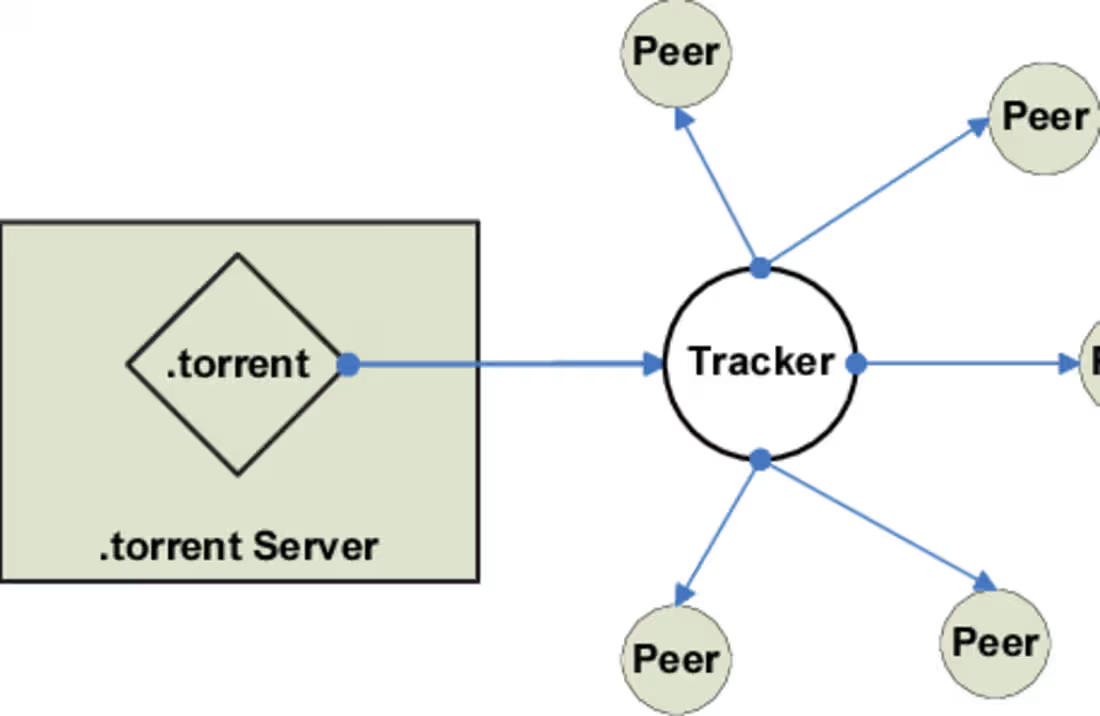
I built a BitTorrent-inspired distributed file sharing system in C++ to get hands-on with low-level networking and concurrency — a centralized tracker for peer discovery, with actual file transfers happening peer-to-peer over raw TCP sockets. Downloads are split into chunks and pulled in parallel across multiple peers using multithreading, with a rarest-first chunk selection strategy to keep transfers efficient even as peers come and go. I added SHA-1 integrity verification on every chunk and built user authentication with group-based sharing on top.
Skills demonstrated: C++, socket programming, POSIX APIs, multithreading/concurrency, distributed systems design, cryptographic integrity verification (SHA-1).
0
36
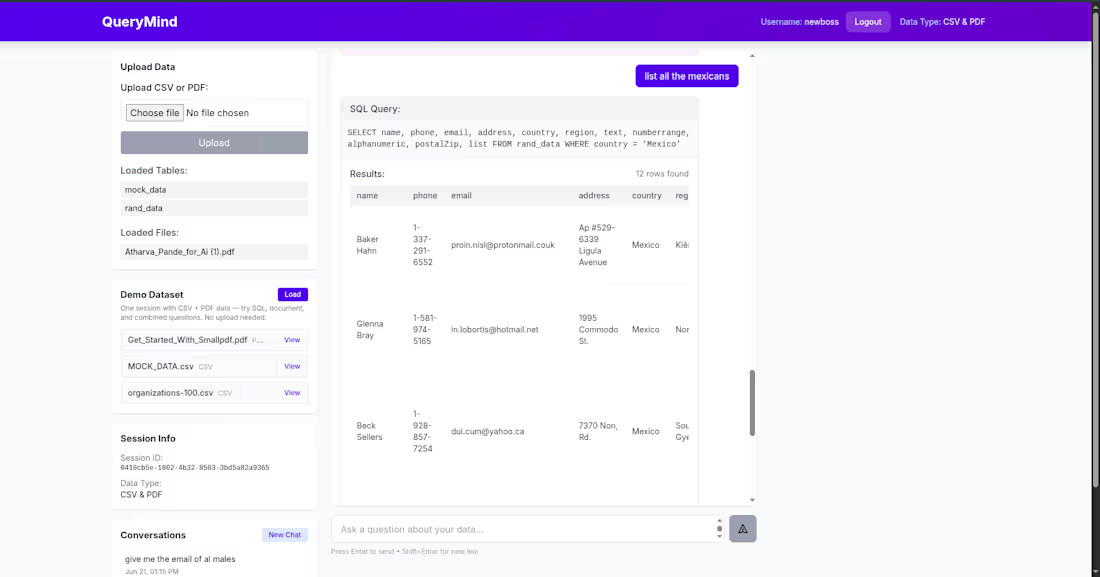
I built QueryMind, a multi-source agentic AI analytics platform that lets users query both structured databases and unstructured documents through natural language. It's powered by FastAPI and React on the app side, with LangGraph handling agent orchestration, ChromaDB for retrieval, and Gemini as the underlying LLM.
The core of the system is a five-route classification layer that decides, per query, whether to hit SQL, RAG, or some combination of both — including a reformulator node that rewrites queries for cross-source retrieval. I migrated the whole app from an early Streamlit prototype to a proper FastAPI + React architecture, and spent a good chunk of time on performance — trimming the SQL generation prompt from ~450 to ~180 tokens and getting response times down to ~1.5s.
It's deployed on Render, and I maintain two branches on GitHub — one showing a traditional pipeline, one showing the LangGraph agentic version — so people can compare both approaches directly.
0
44