

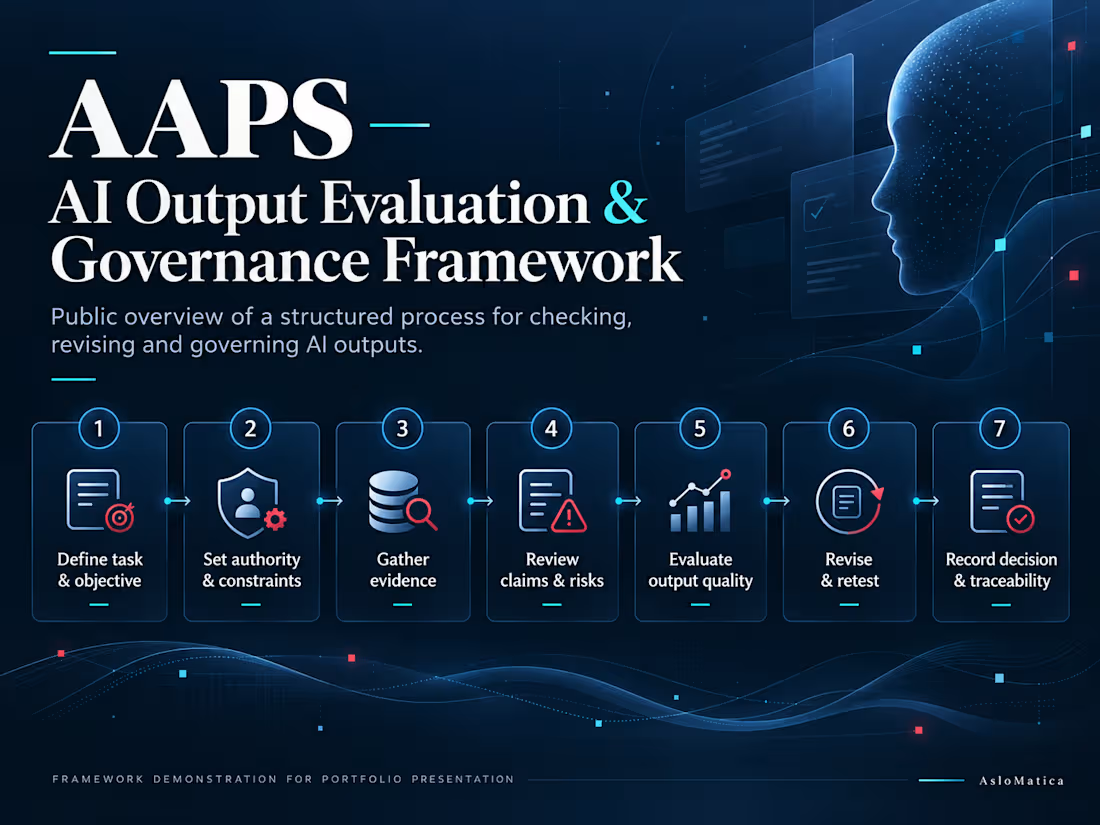
AsloMatica | AI Output Evaluation & Governance Framework
How do you evaluate whether an AI-generated answer is accurate, properly supported by evidence and appropriate for the decisions it may influence?
Through AsloMatica, I developed a structured AI output evaluation and governance framework as part of the ASLO Authority Power System (AAPS).
The framework is designed to help assess AI-generated content, identify unsupported claims, distinguish technical capabilities from actual decision-making authority, and document the reasoning behind quality-control decisions.
The challenge
AI systems can produce convincing outputs that contain weak evidence, exaggerated capabilities, overlooked constraints or unclear authority boundaries.
Without structured evaluation, these issues can remain hidden behind polished language.
My approach
I developed a seven-stage evaluation workflow:
Define the task and evaluation objective.
Establish authority boundaries and constraints.
Gather and assess supporting evidence.
Review claims, assumptions and potential risks.
Evaluate output quality against defined requirements.
Revise and retest where necessary.
Record decisions and maintain traceability.
What the portfolio demonstrates
• AI output quality evaluation
• Evidence and claim verification methods
• Capability versus authority assessment
• Prompt and response quality assurance
• Structured review and revision workflows
• Decision documentation and traceability
• Governance-oriented AI systems design
Supporting deliverables
The accompanying portfolio contains a public framework overview, an illustrative AI output evaluation example and documentation explaining the methodology and its limitations.
Key principle
A convincing AI-generated answer is not necessarily a verified or authorised answer. Quality evaluation must consider evidence, context, constraints and decision authority—not simply writing quality.
Project: AAPS — AI Output Evaluation & Governance Framework
Developed through: AsloMatica
My role: AI Systems Design, Evaluation Methodology & Governance Architecture
Portfolio disclosure: This is a documented framework and illustrative evaluation demonstration, not an independent compliance certification, external audit or claim of verified client deployment.
0
9
VULTUROIDS | AI Video Continuity & Identity Testing
How well can an AI video model transform a complex cinematic reference image into motion without compromising visual identity, world-building or scene continuity?
Through Teamworks Creative, I conducted an experimental generative filmmaking study for VULTUROIDS, a dark, post-apocalyptic political-fantasy concept.
The creative challenge
The scene depicts a ruined United Nations headquarters in a fictional future, surrounded by a vast assembly of vulture-like figures, imposing banners and a central winged character.
The objective was to evaluate whether image-to-video generation could preserve this complex visual world while introducing convincing cinematic movement.
Production and testing workflow
• Developed cinematic 9:16 reference-image variations using Dreamina AI.
• Explored architectural composition, lighting, crowd arrangement and character positioning.
• Tested an image-to-video sequence using Kling 3.0 Standard through Creen AI.
• Reviewed the generated footage for movement, identity consistency, scene preservation and unintended visual changes.
Key observations
What worked: The video demonstrated promising atmosphere and crowd movement, showing how generative video can bring scale and energy to an established visual concept.
What required improvement: Prominent character identities and visual details were not consistently maintained. This made the result useful as research evidence rather than approved final-production footage.
What I evaluated
• Reference-image fidelity
• Character and crowd identity consistency
• Environment and architectural continuity
• Movement and cinematic atmosphere
• Unintended visual changes
• Suitability for further production development
Key finding
A visually impressive AI-generated sequence is not necessarily production-ready. Large-scale motion and atmosphere can succeed while character identity and continuity still require revision.
Project: VULTUROIDS — Generative Film R&D
Production: Teamworks Creative
Role: AI Creative Direction, Prompt Development & Visual Quality Evaluation
Tools and models: Dreamina AI for reference imagery; Kling 3.0 Standard via Creen AI for video testing.
Supporting reference images, source-prompt evidence, the generated clip and QA notes are provided in the project folder.
Research disclosure: The Dreamina reference-image prompt is evidenced by platform screenshots. The complete original Kling video-generation prompt has not been independently recovered.
0
8
RESONANTIA | AI Character Performance & Continuity Testing
Can generative video models create believable character performances from a single cinematic reference frame while preserving identity, props and narrative intent?
Through Teamworks Creative, I conducted experimental AI filmmaking research using PixVerse V6 to evaluate character motion, visual continuity and prompt compliance.
The project
Two five-second image-to-video tests explored restrained cinematic performances within a Literary Café scene.
Test 01 — Rafiq
The model generated natural gaze changes, subtle head movement and believable interaction with a pen and leather notebook. Character identity, environment and prop continuity remained largely coherent throughout the shot.
Test 02 — Amira
The model produced convincing micro-performance, including eye movements, hand repositioning and a natural page turn while preserving key props.
However, it also introduced an unrequested faint smile — a small visual change with potentially significant storytelling implications.
What I evaluated
• Character identity and appearance consistency
• Prompt-to-output compliance
• Naturalness of facial expressions and movement
• Hands, notebooks, pens and environmental continuity
• Camera behaviour and shot composition
• Unintended performance and narrative changes
Tools and settings
PixVerse V6 | Image & Text | 5 seconds | 540p | Audio OFF | Multi-Shot OFF
Key finding
Visually convincing AI performances are not necessarily narratively accurate. A model can preserve physical continuity while introducing facial expressions or gestures that subtly alter a character's intended meaning.
These experiments demonstrate the importance of evaluating AI-generated footage against both technical requirements and creative intent.
Project: RESONANTIA — AI Film R&D
Production: Teamworks Creative
My role: AI Prompt Testing, Creative Direction & Quality Evaluation
Original video samples, research findings and supporting documentation are provided in the project evidence folder.
Research disclosure: Model settings and observed results are documented. Complete verbatim prompts from these historical experiments were not retained.
0
9

AI Video Prompt Testing & Quality Assurance | TOMORROW
An experimental AI-video testing project developed through Teamworks Creative, evaluating how reliably generative video models follow precise motion instructions.
Using Dreamina Seedance 2.0 Mini and Seedance 1.0 Fast, I tested a cinematic animal-market scene with a deliberately narrow objective: introduce subtle movement in a water bowl while preserving the camera position, animal behaviour and surrounding environment.
What I tested
Prompt compliance and controlled motion
Subject and environmental continuity
Unintended movement and visual deviations
Model behaviour across two generation workflows
Prompt-to-output comparison and structured QA reporting
Key finding
The models preserved much of the scene's composition and atmosphere, but did not convincingly deliver the intended water-only ripple effect. Unrequested animal motion was also observed.
The tests were documented with prompts, settings, generated clips and QA findings.
Project: TOMORROW — AI Film R&D
Production: Teamworks Creative
Role: AI Prompt Testing, Creative Direction & Quality Evaluation
Supporting evidence and video samples:
https://drive.google.com/drive/folders/1e28bm5CkdwK3Zw9BHCMufp7N7WVgxaxn?usp=sharing
0
9