
Reinventing the wheel 🛞 for Google.
Designed with Google Stitch for all platforms Desktop, Mobile, and Tablets.
I’m a engineer and founder with tech experience but not design, and going into this challenge, my real question was simple: Can an AI-native interface builder actually handle deep-time narrative storytelling and high-fidelity, scroll-linked interactions without turning into a complete mess?
To stress test the absolute limits of the platform, I didn't feed it an established design, or any files right away. I wanted to see exactly how Stitch thinks, handles design drift, and iterates from scratch. I gave it a massive, conceptually complex prompt: Build a highly cinematic, ultra-polished, deep-time historical timeline mapping the evolution of the wheel, from primitive Mesopotamian stone discs to active, computational morphing hub systems in 2026.
How Stitch Fit into the Workflow
The streaming generation on the canvas is easily one of the most hypnotic interactions I've seen in a design tool. It genuinely feels like watching a remote design partner building on your screen through AnyDesk. Instead of staring at a loading spinner and waiting for a static layout, I was reacting to a living interface taking shape in real time.
Instead of keeping things static, I ended up executing three distinct modes across this project to see how Stitch adapts to different workflow mindsets:
I pushed a light but descriptive prompt system to build out a strict, zero-color, high-contrast monochrome design philosophy titled "Liquid Slate." Stitch completely conquered the blank page problem, mapping out an editorial-style landing page with absolute black layouts and deep-etched glass elements.
The Codebase Sync via Antigravity (The Engineering Bridge) is where it killed it, To see if this could handle a real-world production loop, I leveraged the new MCP skills. I imported stitch into Antigravity straight from Stitch's HTML native canvas, synced those changes, and published a React Website in Minutes to Netlify which was bug free and ready for a Run.
The motion authoring surprised me the most. I didn't have to jump out into a secondary motion app or wrestle with standard transition bugs, the native hover states, custom text blur modules (BlurInText), and smooth continuous wheel rotations were all handled seamlessly on the HTML canvas before exporting the build.
New Features I Leaned On
Streaming generations to canvas: Watched the entire layout materialize and iterated on components before they were even finished rendering.
In-place AI edits via prompts + point-and-click: Controlled fine-grain text styles and layout spacing directly on the artboard.
Redesign : Got the same design in 3 colours, just wow.
Native motion, hover states, and shaders on HTML canvas: Authored complex scroll-linked component rotations and aesthetics.
Antigravity Code Integration via MCP: Ran a perfect, bi-directional round-trip sync between my code editor and the visual design canvas.
MCP Export: One-click, zero-friction final production deployment.
Feedback on the Platform
Google Stitch shifts the entire AI design paradigm because it collapses the classic "describe, wait, judge, re-prompt" delay loop into an interaction that feels like direct manipulation. In-place edits genuinely feel like real design work.
Two things I'd love to see in future updates:
Option to upload/generate videos: it makes it easier for a designer to have their backdrop beautiful just by adding or generating a video which Stitch can definitely add beautifully.
A way to save a specific in-place edit style (like the exact blur, noise, and border-radius of my "Liquid Slate" glass cards) into a recipe that I can reapply to other sections instantly without describing it again.
Stitch doesn't feel like an AI platform you have to constantly fight against, it feels like a living, interactive canvas that intuitively understands structural design system logic.
Check it out:
Live Site: https://contragoogle.netlify.app/
Stitch Project Space: https://stitch.withgoogle.com/projects/13302732653849354465
(https://stitch.withgoogle.com/projects/13302732653849354465)X: https://x.com/AshishSandhu/status/2062413585095995813?s=20
6
6
283
I created THE GIFT because the most devastating love stories deserve to be felt, not just remembered.
O. Henry wrote "The Gift of the Magi" in 1905, and most people know the ending before they finish the first paragraph. Yet I had never seen it made into something that stops your breath. I wanted to create a cinematic experience that makes the audience who already knows the story feel it as if for the first time, and the audience who doesn't feel something they cannot name until the very last frame.
What if we watched two people stand quietly in the ruins of their devotion, and simply refused to look away? That question became THE GIFT.
The Production Workflow
I came into this project with a vision but no pipeline. The Melius canvas workflow changed that completely, making something overwhelmingly complex feel creative and alive.
Audio-Driven Pacing: The original score was generated and structured with a strict tempo map in Suno, ranging from a 60 BPM cold open to a 140 BPM climax. Every visual decision followed the music, not the other way around.
Master Character Seeding: To ensure 1905 period accuracy and strict character continuity across every scene, I generated a single Master Character Reference node and wired it into every subsequent generation. The candlelit amber interiors, the cold blue gaslit streets, and the period film grain stayed consistent throughout without manual intervention.
Extensive Agent Use: I did not just execute instructions. I conversed with the Melius agent. It helped select the right models for the right moments, we even redid the whole canvas midway and restructured, as instead of more nodes, more important was the structure, matched the visual grammar to the emotional register of each scene, and made intelligent decisions I had not anticipated. I was not managing tools. I was directing a film.
The Assembly: Melius built the continuous, high-fidelity scene blocks the trailer required. I then brought those outputs into CapCut to execute the rapid sub-second flash cuts that match the music's climax, where the cuts land.
Platform Feedback
What moved me most was how Melius held the entire world together without me having to manually navigate the technical layer underneath, it took less than 3 hours on this. It chose what each moment needed and delivered it with a consistency that felt less like a platform and more like a collaborator who understood the story.
One honest piece of feedback: producing a continuous 2.5 minute cinematic trailer with these state of the art models requires a lot of iterative generation. A higher credit tier or more optimised rendering costs for long-form visual storytellers would make a meaningful difference for projects at this scale.
Ultimately, Melius helped me protect the silence at the end of the film when every instinct said to fill it. That restraint is where the whole story lives.
A Final Note:
I am a software engineer by trade, with zero professional background in filmmaking or the video industry. I came into this project with a feeling I wanted to convey, but no traditional pipeline to execute it. The fact that I was able to direct a period drama of this fidelity is the greatest testament I can give to Melius.
https://app.melius.com/projects/1a8d974e-4f5b-4647-844e-adb87b9c5573/canvas/69eb2820-9998-47e3-8059-3bf0450c1290
https://x.com/AshishSandhu/status/2056490013378986101?s=20
6
9
813
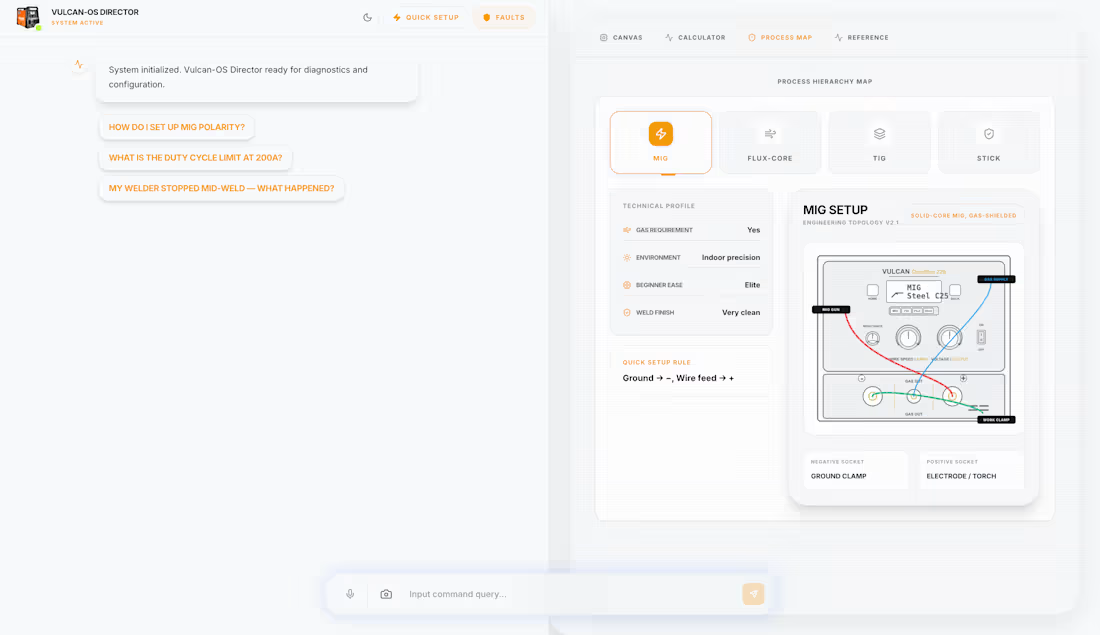
Development of Vulcan-OS: An AI Orchestration Layer
0
4