
Hayeni Samuel
AI Automation & Business Analytics Specialist


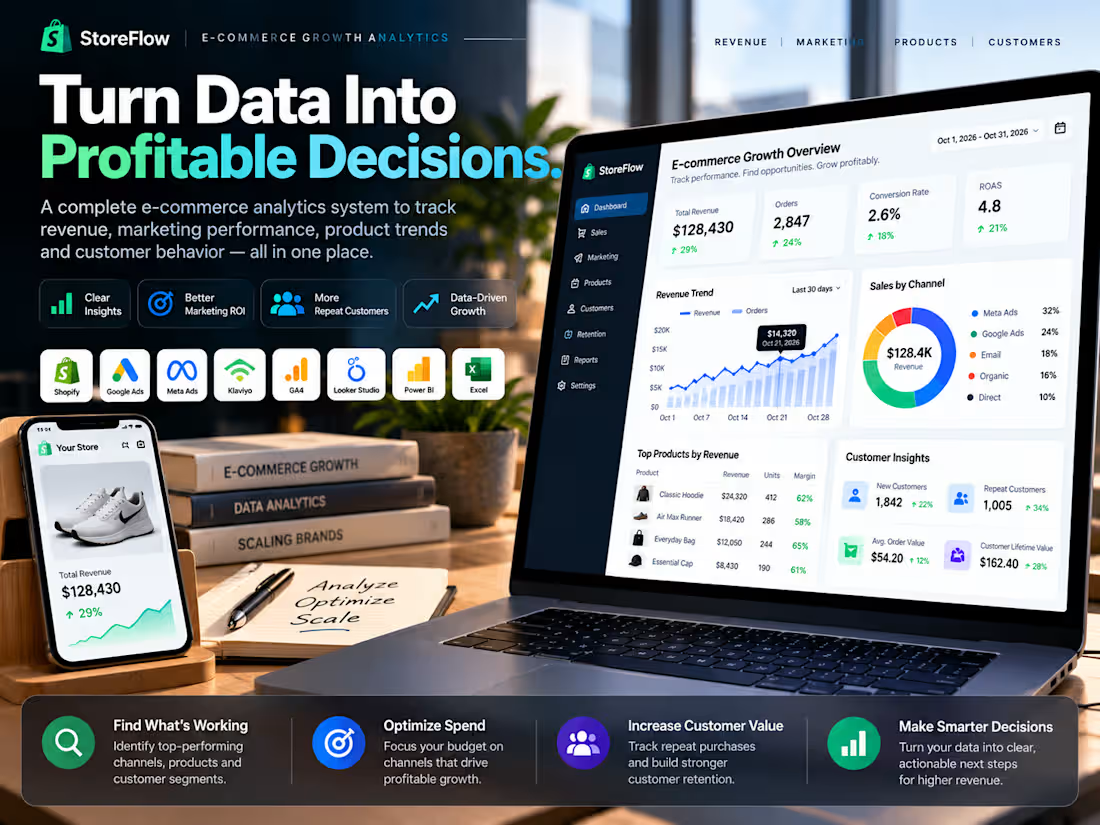
See exactly what’s driving revenue, where growth is leaking, and which products, channels, and customers deserve more investment.
I developed an e-commerce growth intelligence system around one question:
Where should the business invest next?
Most stores already have plenty of data. The harder problem is understanding what that data means for revenue, marketing spend, products, and customer growth.
So instead of building another dashboard full of charts, I’m structuring the system around decisions.
It brings together signals such as revenue, ROAS, CAC, conversion, product performance, repeat purchases, and retention to identify things like:
which channels deserve more budget, where acquisition is becoming inefficient, which products attract traffic but fail to convert, and where repeat customers are creating stronger value.
The goal isn’t just to answer:
“What happened?”
It’s to answer:
“What should we do next?”
Because the most useful analytics system isn’t the one with the most charts.
It’s the one that makes the next business decision clearer.
Tags: E-Commerce · Marketing Analytics · Data Analytics · Power BI · E-commerce Management
2
2
622
A lot of e-commerce stores don’t have a sales problem.
They have an operations problem hiding behind the sales.
More orders start coming in, but the backend still depends on manual updates, spreadsheets, disconnected tools, delayed customer notifications, inventory checks, and repetitive admin work.
That’s where growth starts creating friction.
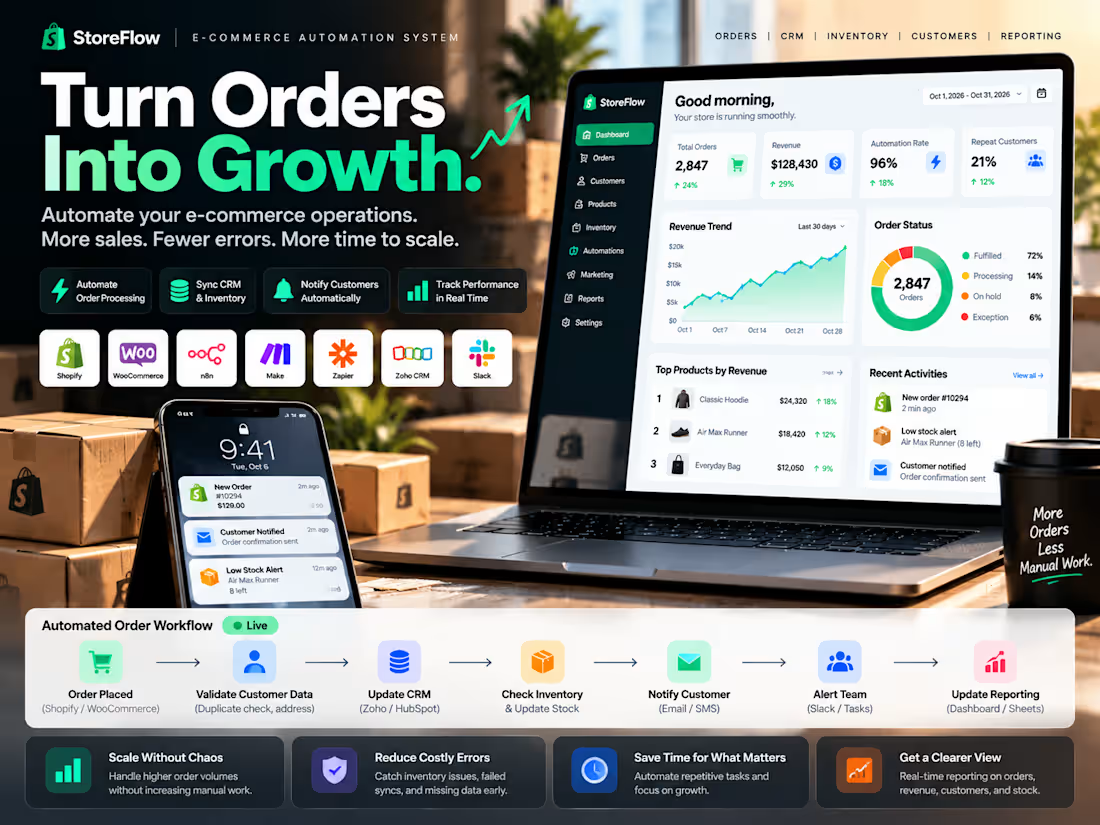
I’m currently building an e-commerce operations automation system designed to help stores handle more order volume without increasing the amount of manual work behind every sale.
The system connects:
Orders → CRM → Inventory → Customer Notifications → Team Alerts → Reporting
So instead of manually moving information between tools, the right action happens automatically when an order, customer update, stock change, or exception occurs.
I’m also building in failure monitoring so problems like missing customer data, inventory mismatches, failed integrations, or stuck orders don’t disappear silently in the background.
The business outcome I’m designing around is simple:
Faster operations. Fewer errors. Better customer communication. More capacity to scale.
Because an e-commerce store shouldn’t need to add more manual work every time sales increase.
Scale orders. Not your workload.
If your store is growing but your backend processes are becoming harder to manage, this is exactly the kind of problem I’m focused on solving.
#Ecommerce #Shopify #EcommerceAutomation #BusinessWorkflowAutomation #n8n
0
49
i`m refining an e-commerce operations automation system designed for stores that are growing faster than their internal processes.
As order volume increases, teams often end up doing more manual work: updating CRM records, checking stock, moving data between tools, sending customer notifications, assigning internal tasks, and fixing missed handoffs.
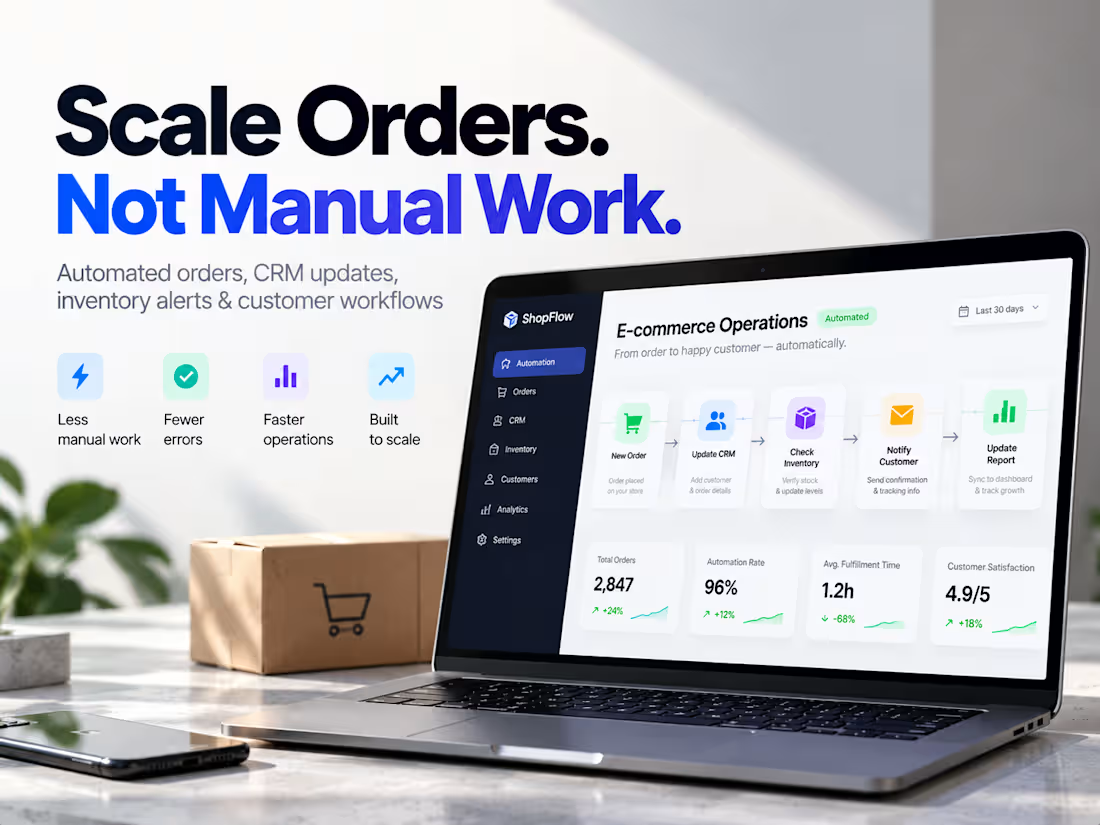
The system I’m building connects those processes into one coordinated workflow:
Order received → customer data validated → CRM updated → inventory checked → customer notified → team alerted → reporting updated
The part I’m most focused on is reliability.
A workflow isn’t useful if failures happen silently. So the system also accounts for failed API calls, missing data, inventory mismatches, and interrupted processes—surfacing exceptions before they become customer problems.
The business outcome is simple:
Handle more orders with less manual work, fewer errors, and better operational visibility.
If an e-commerce team is growing but its internal workflows are starting to feel fragmented, this is exactly the kind of system I’m focused on solving.
Tags: E-Commerce · Business Workflow Automation · Shopify · n8n · Make
0
75
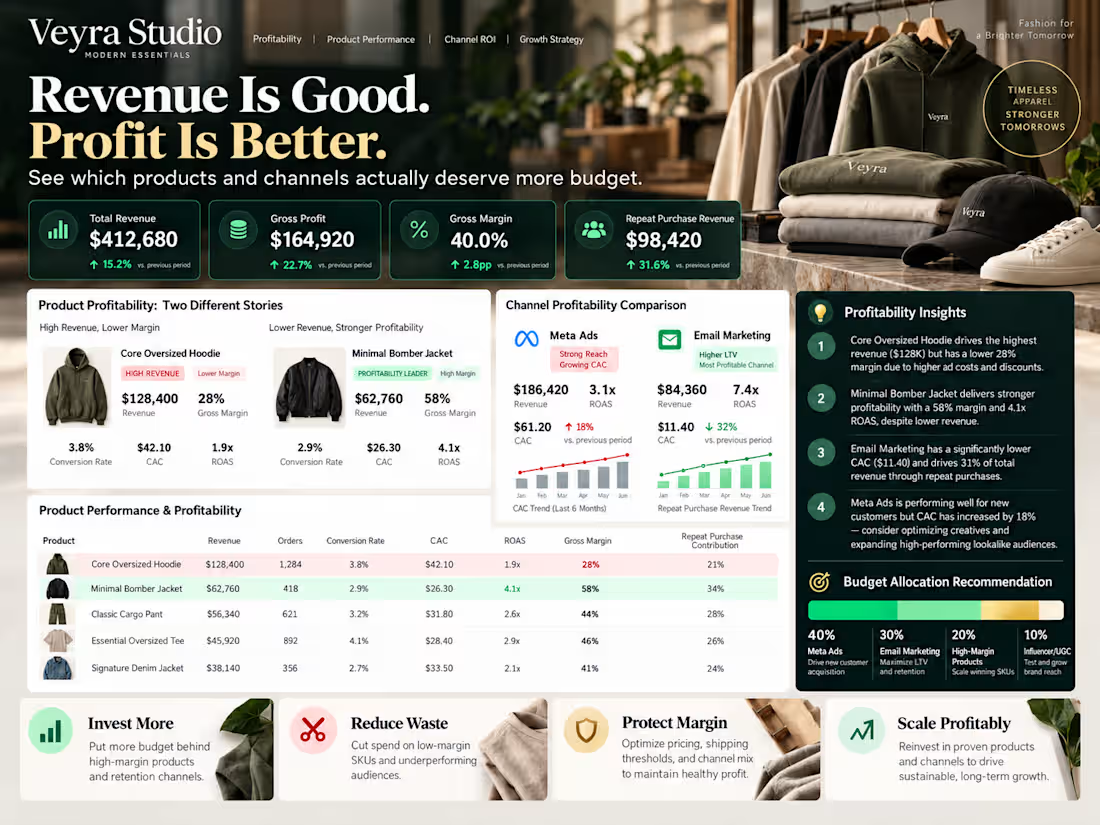
E-commerce Product & Channel Profitability Intelligence
I designed an e-commerce profitability intelligence system to help store owners understand which products and marketing channels are actually worth scaling—and which ones are quietly draining margin.
The system combines sales, ROAS, CAC, conversion performance, customer value, and product profitability into one decision-focused view.
Instead of only showing which products generate the most revenue, it helps answer:
Which products are truly profitable?
Which channels deserve more budget?
Where is customer acquisition becoming too expensive?
Which products look strong on revenue but weak on margin?
Where should the business invest next?
The analysis highlights:
Lower-volume products with stronger profitability
Channels with strong ROAS but rising acquisition costs
Channels generating higher-value repeat customers
High-traffic products with weak conversion
Underperforming campaigns and categories
Budget reallocation opportunities
Areas where revenue growth is not translating into profit
Example decision view
Product A
High revenue · Weak margin
Product B
Lower revenue · Strong profitability
Meta Ads
Strong ROAS · Rising CAC
Email
Lower CAC · Strong repeat revenue
The goal is not simply to report performance.
It is to help an e-commerce business decide:
Where should we put the next dollar?
The final system gives the team a clearer view of what to scale, what to fix, what to reduce, and where profitability can improve.
Tools: Power BI, SQL, Excel, e-commerce sales data, marketing data, and profitability analysis.
0
61