
Vimal Anand
Full Stack AI Engineer shipping fast SaaS MVPs
New to Contra
Vimal is ready for their next project!

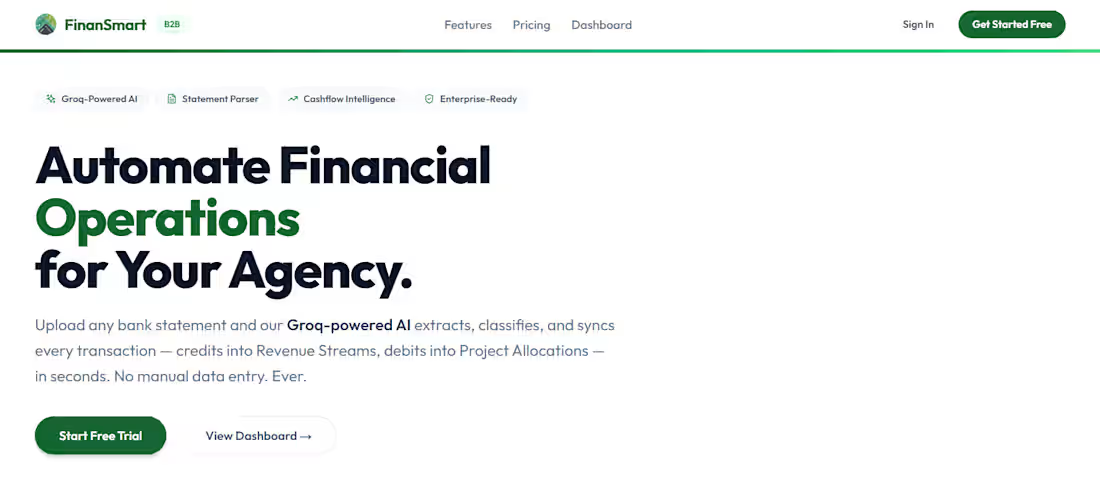
𝗛𝗲𝗮𝗱𝗹𝗶𝗻𝗲: What started as a simple B2C expense tracker has officially pivoted into a fully automated B2B Financial SaaS. Introducing 𝗙𝗶𝗻𝗮𝗻𝗦𝗺𝗮𝗿𝘁.
𝗕𝗼𝗱𝘆: I realized that startup founders and agency owners spend countless hours manually categorizing bank statements and tracking operational costs. I wanted to build a solution that entirely automates this bookkeeping process.
Building the core feature—an "𝐀𝐈 𝐁𝐚𝐧𝐤 𝐒𝐭𝐚𝐭𝐞𝐦𝐞𝐧𝐭 𝐏𝐚𝐫𝐬𝐞𝐫"—was one of the toughest technical challenges I’ve faced. I hit a massive roadblock when Next.js 14’s Webpack bundler kept breaking legacy PDF OCR libraries in serverless environments.
Instead of compromising on the feature, I completely re-architected the data pipeline:
• I bypassed Webpack issues by implementing pdf2json on a strict Node.js runtime for secure, server-side text extraction.
• I piped this raw text into Groq’s LLaMA-3.1-8b model using highly optimized system prompts.
• The result? Lightning-fast, deterministic extraction that converts raw PDF text into perfectly structured JSON arrays.
Now, users can drag-and-drop a PDF statement, and the AI instantly categorizes every transaction (Infrastructure, Payroll, Revenue) into a 'pending' staging area.
Once approved, the data flows securely via Drizzle ORM into a Neon PostgreSQL database, updating real-time Recharts dashboards.
𝑻𝒆𝒄𝒉 𝑺𝒕𝒂𝒄𝒌: Next.js App Router, Tailwind CSS, Shadcn UI, Clerk Auth, Drizzle ORM, Neon DB, and Groq SDK.
𝗪𝗵𝗮𝘁'𝘀 𝗡𝗲𝘅𝘁? I am currently looking for my next full-time opportunity as a Full Stack Developer (based in Bangalore or anywhere).
I am also actively taking on 𝗳𝗿𝗲𝗲𝗹𝗮𝗻𝗰𝗲 𝗽𝗿𝗼𝗷𝗲𝗰𝘁𝘀. If you are a founder or agency looking to build scalable, AI-integrated SaaS MVPs without the technical headache, let's connect.
Check out the demo video below to see the AI parser in action!
🔗 Live Project: https://lnkd.in/gSNu3cAK
(https://lnkd.in/gSNu3cAK)hashtag#BuildInPublic (https://www.linkedin.com/search/results/all/?keywords=%23buildinpublic&origin=HASH_TAG_FROM_FEED) hashtag#Nextjs (https://www.linkedin.com/search/results/all/?keywords=%23nextjs&origin=HASH_TAG_FROM_FEED) hashtag#FullStackDevelopment (https://www.linkedin.com/search/results/all/?keywords=%23fullstackdevelopment&origin=HASH_TAG_FROM_FEED) hashtag#SaaS (https://www.linkedin.com/search/results/all/?keywords=%23saas&origin=HASH_TAG_FROM_FEED) hashtag#AI (https://www.linkedin.com/search/results/all/?keywords=%23ai&origin=HASH_TAG_FROM_FEED) hashtag#Groq (https://www.linkedin.com/search/results/all/?keywords=%23groq&origin=HASH_TAG_FROM_FEED) hashtag#PostgreSQL (https://www.linkedin.com/search/results/all/?keywords=%23postgresql&origin=HASH_TAG_FROM_FEED) hashtag#WebDevelopment (https://www.linkedin.com/search/results/all/?keywords=%23webdevelopment&origin=HASH_TAG_FROM_FEED) hashtag#FreelanceDeveloper (https://www.linkedin.com/search/results/all/?keywords=%23freelancedeveloper&origin=HASH_TAG_FROM_FEED) hashtag#Hiring (https://www.linkedin.com/search/results/all/?keywords=%23hiring&origin=HASH_TAG_FROM_FEED)
1
54
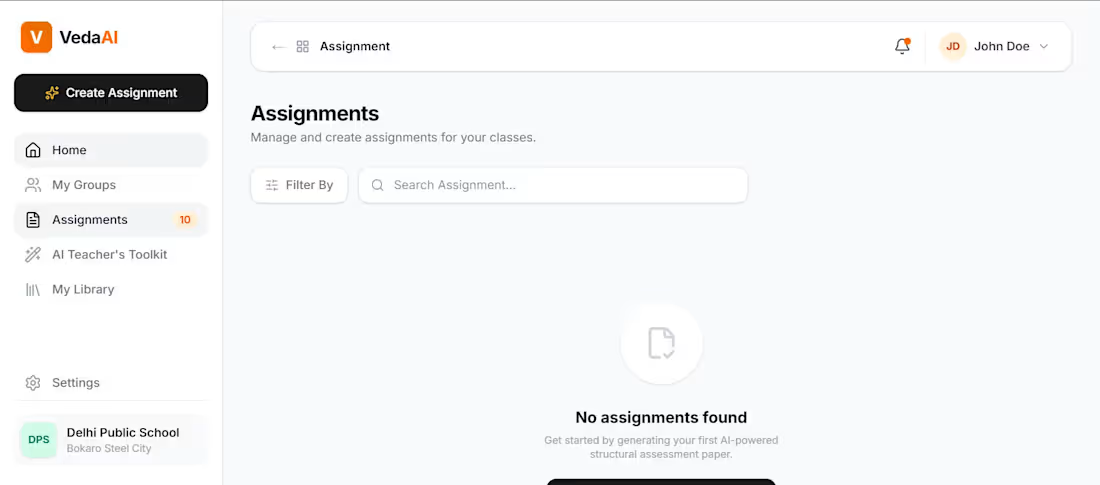
I recently architected and built VedaAI Assessment Creator, a personal project designed to transform unstructured notes and files (PDFs, DOCX) into highly structured, curriculum-aligned exam papers.
Building enterprise-grade applications at scale requires looking beyond simply making API calls. For this build, I wanted to focus entirely on non-blocking architectures and deterministic AI outputs.
Here is a breakdown of the technical decisions:
Asynchronous Workers: Instead of blocking the main HTTP thread during heavy file parsing and AI inference, I implemented a distributed task queue using BullMQ and Upstash Serverless Redis. The Express API responds in under 100ms, while background workers handle the heavy lifting.
Deterministic AI: I opted for Groq (Llama-3.3-70b) utilizing its JSON mode. The sub-500ms inference time and guaranteed schema compliance eliminated the need for complex post-processing validation.
Real-Time Synchronization: A WebSocket setup broadcasts job completion events, updating the Next.js frontend instantly without relying on inefficient polling.
Database & State: MongoDB Atlas handles ACID transactions for complex document updates, while Zustand manages lightweight, atomic state slices on the frontend.
I also built in granular question regeneration—allowing users to re-run isolated inference calls for single questions without replacing the entire paper—and print-ready A4 PDF exports.
Designing this kind of scalable infrastructure directly supports my ongoing deep dive into advanced AI and machine learning systems.
You can check out the Live Link here: https://lnkd.in/geAXUtHC .
I would love to hear how others are handling asynchronous AI tasks in production!
1
49
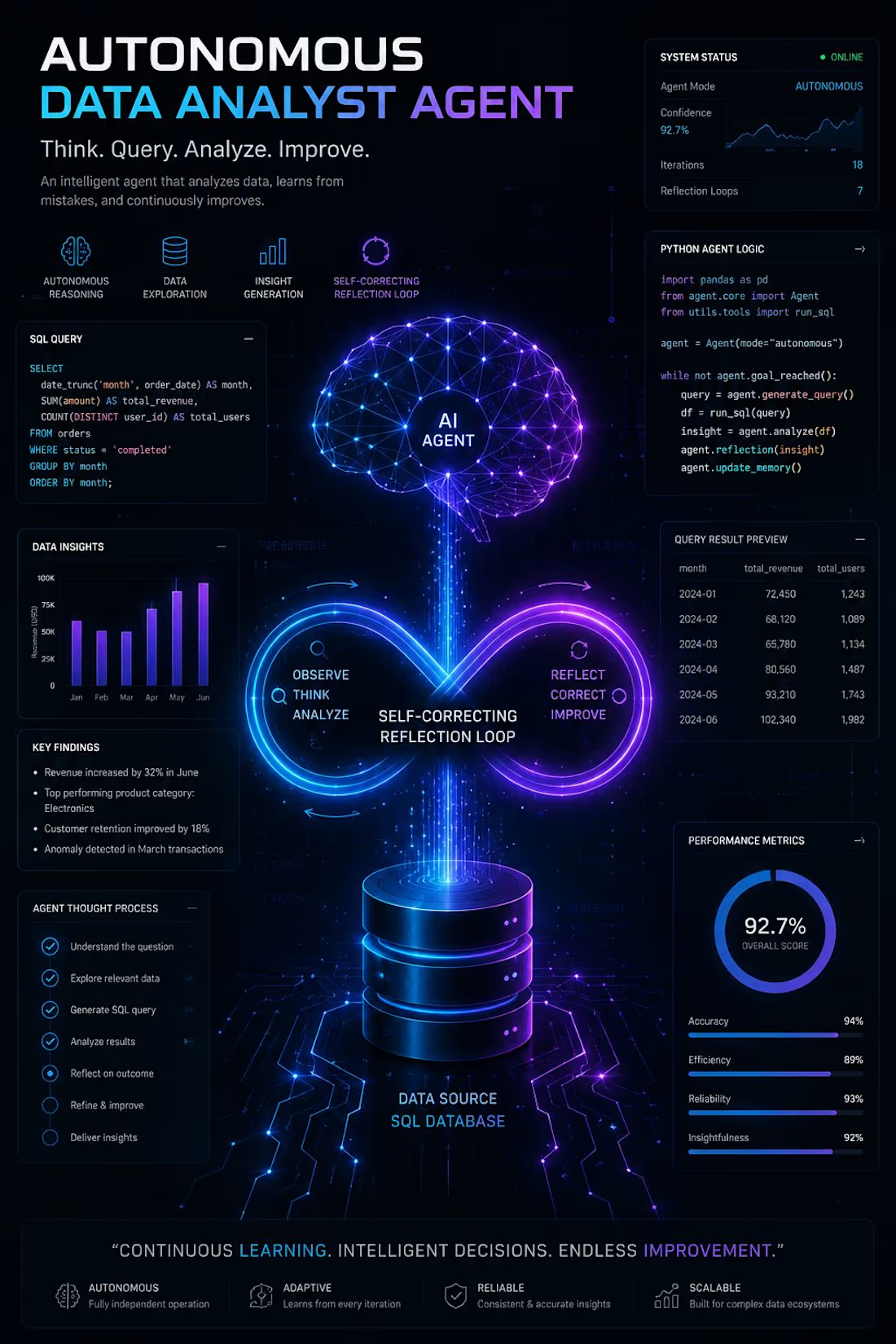
Ever watched an AI write bad SQL, instantly realize its mistake, and rewrite it perfectly—all without human intervention?
Over the weekend, I built the Autonomous Data Analyst Agent. It doesn’t just translate natural language to SQL; it actively debugs itself.
𝗧𝗵𝗲 𝗣𝗿𝗼𝗯𝗹𝗲𝗺: Enterprises want AI to query their proprietary databases, but LLMs often hallucinate columns or mess up syntax.
𝗧𝗵𝗲 𝗦𝗼𝗹𝘂𝘁𝗶𝗼𝗻: I engineered a Self-Correcting Reflection Loop using LangGraph.
Here’s what happens under the hood:
1️⃣ You ask a complex question in plain English.
2️⃣ The LLM generates DuckDB-flavored SQL.
3️⃣ The Executor node runs it securely in a local container.
4️⃣ 🔄 𝗧𝗵𝗲 𝗠𝗮𝗴𝗶𝗰: If DuckDB throws a parser error, the Reflection node catches it, feeds the error trace back to the LLM, and auto-corrects the query. 5️⃣ Once successful, a Python agent generates a Matplotlib visualization, streaming everything to a sleek Next.js dark-mode UI.
Plus, I integrated LangGraph MemorySaver, allowing the agent to retain context for human-like follow-up questions.
𝗧𝗲𝗰𝗵 𝗦𝘁𝗮𝗰𝗸: Next.js, FastAPI, LangGraph, DuckDB, Groq (Llama-3), Docker Compose.
Everything is fully containerized and open-source.
Drop a ⭐ on the repo and let me know what you think!
𝗚𝗶𝘁𝗛𝘂𝗯 𝗥𝗲𝗽𝗼: https://lnkd.in/ddnE9rgq
(https://lnkd.in/ddnE9rgq)hashtag#AI (https://www.linkedin.com/search/results/all/?keywords=%23ai&origin=HASH_TAG_FROM_FEED) hashtag#LangGraph (https://www.linkedin.com/search/results/all/?keywords=%23langgraph&origin=HASH_TAG_FROM_FEED) hashtag#DataEngineering (https://www.linkedin.com/search/results/all/?keywords=%23dataengineering&origin=HASH_TAG_FROM_FEED) hashtag#Nextjs (https://www.linkedin.com/search/results/all/?keywords=%23nextjs&origin=HASH_TAG_FROM_FEED) hashtag#FastAPI (https://www.linkedin.com/search/results/all/?keywords=%23fastapi&origin=HASH_TAG_FROM_FEED) hashtag#Docker (https://www.linkedin.com/search/results/all/?keywords=%23docker&origin=HASH_TAG_FROM_FEED) hashtag#MachineLearning (https://www.linkedin.com/search/results/all/?keywords=%23machinelearning&origin=HASH_TAG_FROM_FEED) hashtag#OpenSource (https://www.linkedin.com/search/results/all/?keywords=%23opensource&origin=HASH_TAG_FROM_FEED)
1
47
𝗛𝗲𝗮𝗱𝗹𝗶𝗻𝗲: Most Voice AI agents still feel like glorified walkie-talkies. So I built one that actually listens like a human.
Most voice bots today follow a rigid, linear loop: You speak ➔ Wait ➔ Bot speaks. If you dare interrupt them mid-sentence? They either completely ignore you or their context buffer gets totally mangled.
𝗧𝗼 𝘀𝗼𝗹𝘃𝗲 𝘁𝗵𝗶𝘀, I engineered Astra Duplex Agent — a sub-50ms, ultra-low latency, full-duplex conversational Voice AI built to handle natural human interruptions seamlessly.
Here is what went into building the architecture under the hood:
True Full-Duplex WebSockets: Built on FastAPI, allowing real-time bi-directional audio streaming instead of turn-based HTTP requests.
Edge Voice Activity Detection (VAD): Deployed Silero VAD using ONNX Runtime to catch user barge-ins at the edge with near-zero overhead.
LangGraph State Machine: Instead of a simple monolithic script, the conversation logic is modeled as a state graph, giving precise control over execution flow.
Partial State Tracking & Memory Persistence: This was the trickiest part. When an interruption happens, Astra doesn't just stop audio playback — an async kill-switch halts Groq's LLaMA-3.1 mid-token, calculates the exact partial sentence actually spoken by the TTS, and saves only that partial context to an Upstash Redis buffer.
Sub-50ms Inference & Streaming: Leveraged Groq LPU (LLaMA-3.1 + Whisper Large v3) paired with ElevenLabs Turbo v2.5 streaming.
The result? An agent that you can interrupt mid-thought, change topics with on the fly, and ask follow-up questions without it losing historical context.
Containerized with Docker and live on Render & Vercel.
Check out the full architecture & live demo below!
https://lnkd.in/eC6yak3i
(https://lnkd.in/eC6yak3i)https://lnkd.in/eN38HGZD
(https://lnkd.in/eN38HGZD)#VoiceAI (https://www.linkedin.com/search/results/all/?keywords=%23voiceai&origin=HASH_TAG_FROM_FEED) #GenerativeAI (https://www.linkedin.com/search/results/all/?keywords=%23generativeai&origin=HASH_TAG_FROM_FEED) #LangGraph (https://www.linkedin.com/search/results/all/?keywords=%23langgraph&origin=HASH_TAG_FROM_FEED) #SystemDesign (https://www.linkedin.com/search/results/all/?keywords=%23systemdesign&origin=HASH_TAG_FROM_FEED) #FastAPI (https://www.linkedin.com/search/results/all/?keywords=%23fastapi&origin=HASH_TAG_FROM_FEED) #MachineLearning (https://www.linkedin.com/search/results/all/?keywords=%23machinelearning&origin=HASH_TAG_FROM_FEED) #WebSockets (https://www.linkedin.com/search/results/all/?keywords=%23websockets&origin=HASH_TAG_FROM_FEED) #Python (https://www.linkedin.com/search/results/all/?keywords=%23python&origin=HASH_TAG_FROM_FEED) #AIENGINEERING (https://www.linkedin.com/search/results/all/?keywords=%23aiengineering&origin=HASH_TAG_FROM_FEED)
1
67