
Ștefan Lazar
Data Engineer & Operations Automation Specialist
New to Contra
Ștefan is building their profile!


An intelligent, high-performance automotive software ecosystem and data pipeline designed to automate vehicle logistics, synchronize real-time inventory, and streamline operations. Built to eliminate administrative bottlenecks, Mulberry replaces heavy, slow cloud dependencies with a lightweight, local-first backend that processes data with maximum execution speed.
Core Engineering & Architecture (The Stack-Flow)
The project is architected as an isolated, secure, and resource-optimized data pipeline running on a Linux/WSL environment:
High-Speed Data Synchronization: Built native Python ETL pipelines that automatically extract, clean, and map chaotic inventory data into optimized NumPy multidimensional arrays for fast relational operations.
Database Optimization: Engineered a relational database structure utilizing strict data modeling schemas. Implemented strategic B-Tree indexing and query optimization tactics (EXPLAIN ANALYZE), slashing data retrieval times and mitigating race conditions during peak inventory updates.
Edge-First Design: Developed the ecosystem to operate seamlessly under severe hardware constraints (CPU-only environments). By stripping away bloated cloud abstractions, the system achieves sub-millisecond execution times locally.
Robust Automation: Configured system-level task scheduling and daemon management (systemd) within Linux/WSL to ensure continuous, error-free background processing and stock reconciliation.
Impact & Deliverables
0% Data Mismatch: Successfully resolved critical data consistency issues between physical warehouse states and digital records by implementing rigid validation layers.
Hardware Independence: Designed a system capable of heavy analytics and data manipulation without requiring expensive GPU or multi-server scaling.
Production-Ready Automation: Delivered a reliable, script-driven tool architecture that replaces dozens of hours of manual logging with automated, programmatic tracking.
1
1
23
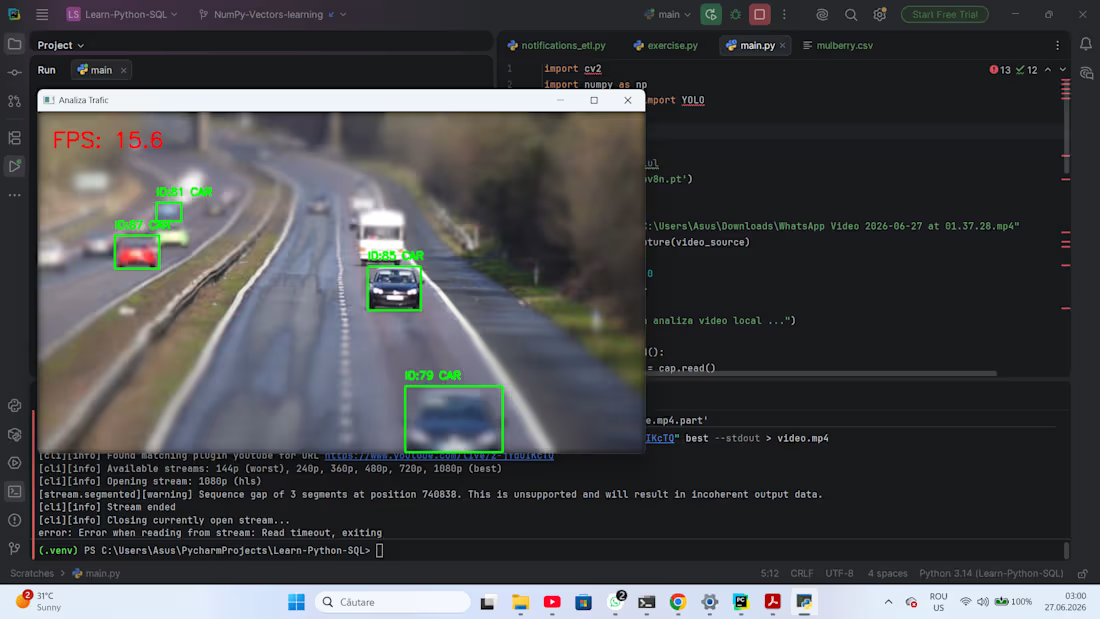
I developed a processing pipeline using YOLOv8 Architecture:OpenCV integration Vector Processing: I utilized NumPy to optimize mathematical calculations (speed, center-of-mass coordinates), ensuring minimal latency for real-time analysis. Scalability: The system generates structured logs (JSON) on a per-frame basis, facilitating predictive analysis of traffic density.
A solution capable of identifying vehicles and monitoring traffic flow at an optimized frame rate (FPS), providing raw data that can be translated into business decisions.📂 https://lnkd.in/dNJp9Zri
0
19