


Project Title:
Smart Student Portal — AI-Powered Academic Platform & RAG Chatbot
Overview:
An innovative, school-wide academic portal developed to modernize the student experience for over 8,000 students at FST Mohammedia. The platform centralizes fragmented university resources (exam archives, course schedules, and directories) into a modern, responsive interface and enriches it with advanced Artificial Intelligence (RAG Chatbot and Agentic Orientation Assistant).
Key Features:
Aide & Conseils (RAG Chatbot): A custom-engineered Retrieval-Augmented Generation (RAG) assistant that answers student administrative and academic queries in real-time, powered by Qdrant Vector Database and Jina AI v3 (768D) embeddings.
Agent IA d'Orientation (Agentic AI Advisor): An intelligent agentic advisor that dynamically matches students’ raw interests with the curriculum details of 26 engineering and science majors to deliver personalized career and pathway recommendations.
Automated Python Scraping & ETL Pipeline: Designed a robust scraping pipeline using BeautifulSoup4 and PyMuPDF to automate data ingestion from official portals, converting unstructured university documents and PDFs into structured vector representations.
Modern Glassmorphism UI: Designed a visually stunning, mobile-first frontend utilizing Vanilla HTML5, CSS3, and ES6+ JavaScript with an elegant glassmorphism theme, ensuring ultra-fast page load speeds.
Self-Healing DevOps Infrastructure: Containerized the entire ecosystem (frontend, n8n orchestrator, Qdrant DB, and Nginx proxy) using Docker & Docker Compose, fully automated via Jenkins CI/CD pipelines featuring automated parallel health checking.
Tech Stack:
Frontend: HTML5, CSS3 (Glassmorphism), JavaScript ES6+
AI & Orchestration: n8n, Qdrant Vector Search, Jina AI Embeddings v3, LLM APIs
Automation & ETL: Python, BeautifulSoup4, PyMuPDF (fitz), Requests
DevOps & Hosting: Docker, Docker Compose, Nginx Reverse Proxy, Jenkins CI/CD
Why this project stands out:
This capstone project showcases my comprehensive expertise in Full-Stack development, AI/RAG engineering, Data Ingestion (Scraping), and DevOps/MLOps orchestration. It proves my ability to build, secure, and automatically deploy practical AI tools that scale to thousands of active users.
0
9
Lumina is a comprehensive, gamified productivity management web platform designed to help users optimize their schedules, manage daily tasks, and boost study efficiency. Featuring a built-in study timer, a gamified reward ecosystem, and an intelligent AI assistant, Lumina combines practical tools with user-centric design to create a highly engaging self-management experience.
Key Features:
Interactive Task & Study Dashboard: A centralized control panel where users can create, prioritize, and manage tasks, complete with an integrated Pomodoro study timer to track focus sessions.
Gamified Rewards & Statistics: Features an interactive dashboard with real-time statistics, progress tracking charts, and a rewards system that motivates users to achieve their daily productivity goals.
Intelligent Assistant Integration: Features an embedded AI chatbot designed to provide context-aware productivity tips, advice, and answers to user queries.
Robust Secure Authentication: Implements secure user registration, session management, password hashing, and secure database interactions to ensure user data privacy.
Native Multilingual Support: Offers full, seamless localized interfaces in three languages: English, French, and Arabic to accommodate a diverse global audience.
Tech Stack:
Backend: PHP (MVC architecture), MySQL (Relational Database Design)
Frontend: HTML5, CSS3, JavaScript ES6 (for interactive charts, timer dynamics, and chat UI)
Skills demonstrated: Relational Database Design, Secure Authentication, API/Chatbot Integration, UI/UX Gamification.
Why Lumina stands out:
Lumina highlights my capability to design and implement a complete Full-Stack CRUD application from scratch. It demonstrates a strong grip of secure database modeling, interactive JavaScript frontends, and backend PHP logic to deliver a complete, secure, and highly engaging user product.
0
14
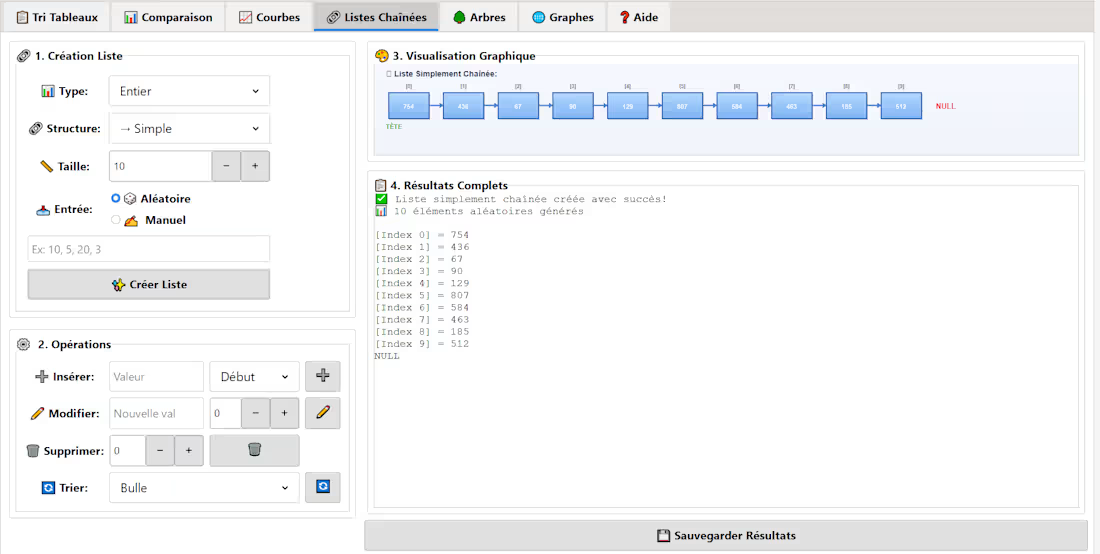
An educational desktop application designed to visualize, analyze, and benchmark complex algorithms and data structures in real-time. This interactive tool helps students and developers easily grasp core computer science concepts by converting abstract code into clean, dynamic, and step-by-step visual animations.
Key Features:
Real-Time Sorting Visualization: Features step-by-step interactive animations of classic sorting algorithms (including QuickSort, MergeSort, and BubbleSort), allowing users to track array swaps and state changes.
Dynamic Graph & Pathfinding Simulation: Implements interactive nodes and edges to visualize graph traversal and pathfinding algorithms (such as Dijkstra, BFS, and DFS) dynamically.
Complexity Benchmarking: Generates performance comparison charts to analyze and illustrate the time and space complexity ($O(n)$ notation) of different algorithms on custom inputs.
Hybrid High-Performance Architecture: Combines high-performance C algorithmic backends with Python's versatility to ensure instantaneous calculation and rendering.
Intuitive User Interface: A clean, user-friendly graphical interface with control inputs (play, pause, step-by-step, speed adjustment, and custom dataset generation).
Tech Stack:
Programming Languages: Python, C
Libraries & Frameworks: Python GUI Libraries (Tkinter / PyQt), Matplotlib (for visualization and rendering)
Core Skills Shown: Object-Oriented Programming (OOP), Algorithmic Optimization, Memory Management, Human-Computer Interaction (HCI) design.
Why this project stands out:
This project showcases my ability to bridge high-performance low-level logical backends (C) with interactive frontends (Python), creating practical, optimized, and educational desktop tools.
0
23

Data Structures Analysis Application
0
0