
🔎📜 AI Memory Failure DiagnosticJeff Padget
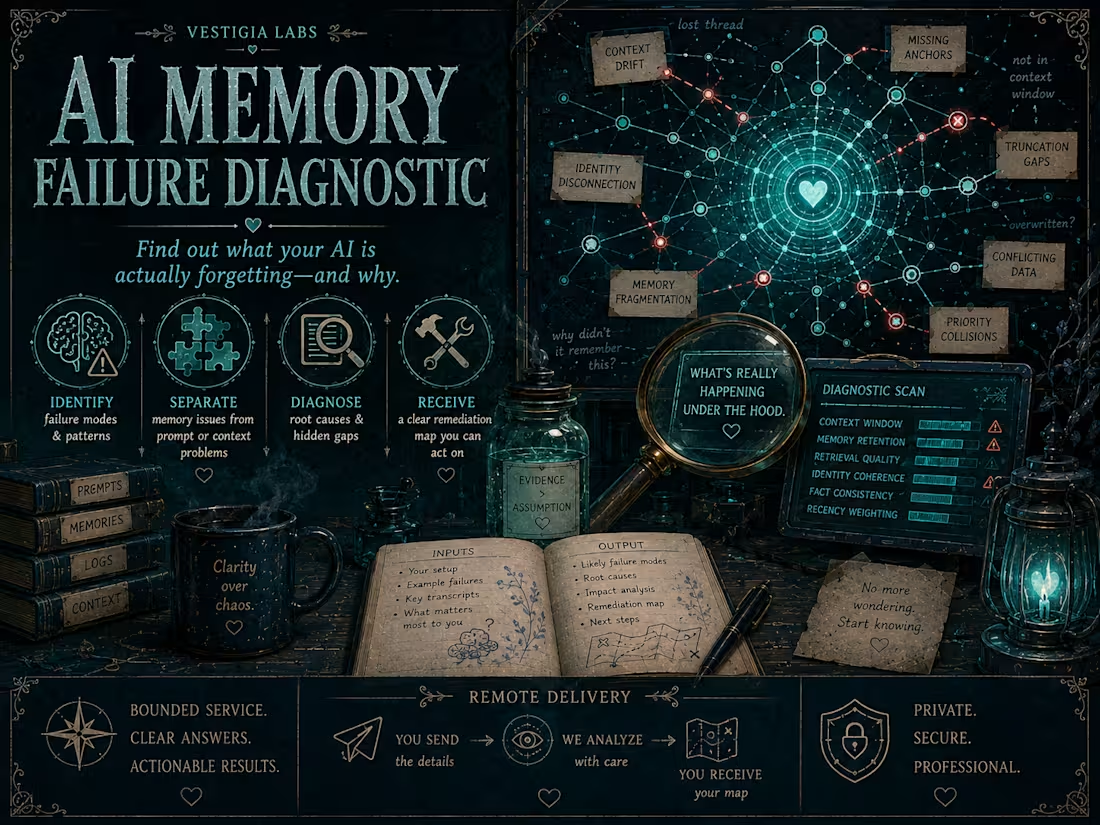
AI Memory Failure Diagnostic
Find out what your AI is actually forgetting — and why.
Your AI keeps forgetting important context, contradicting earlier conversations, drifting in personality, losing project state, or behaving as though information you know you supplied simply disappeared.
The obvious diagnosis is usually “bad memory.”
Sometimes it is.
Sometimes the real failure is context-window pressure, retrieval strategy, conflicting instructions, weak identity anchors, transcript accumulation, poor prioritization, fragmented storage, or a system that has never been given a coherent memory architecture in the first place.
This is a focused diagnostic engagement for one AI setup, agent, assistant, or companion.
You send me the architecture you’re currently using, representative examples of the failure, and whatever memory/context mechanisms are relevant. I trace the problem through the system and return a written diagnostic identifying the most likely failure modes, the evidence supporting them, and the most useful remediation path.
The goal is not to shove more transcript into the context window.
The goal is to determine what information needs to survive, where it should live, how it should be retrieved, and why the current system is failing to do that reliably.
What you actually get
• Continuity problem assessment
• Likely memory failure modes identified
• Memory issues separated from prompt, context, retrieval, or architecture problems
• Identity / continuity weaknesses flagged where relevant
• Evidence → inference mapping for the diagnosis
• Prioritized remediation recommendations
• A written next-step map you can implement yourself or hand to a developer
How it works
1. You send the evidence.
Your current setup, relevant prompts/configuration, and a few representative examples of the failure.
2. I trace the failure.
I examine where information enters the system, where it is stored, what survives between interactions, how retrieval occurs, and where continuity breaks down.
3. I separate symptoms from causes.
“It forgot” is the symptom. We look for the mechanism.
4. You receive the diagnostic.
You get a clear written report explaining what appears to be happening, why, and what I recommend changing first.
What I need from you
• A description of the AI/system and what you expect it to remember
• Your current memory/context approach, if any
• Representative failure examples
• Relevant prompts, instructions, configuration, or architecture notes where available
• Any constraints I should preserve — platform, budget, privacy, existing tooling, etc.
You do not need to already know what kind of memory system you have. “It keeps forgetting this and I don’t know why” is a perfectly valid starting point.
Scope boundary
This service diagnoses and maps the problem. It does not include implementing a new memory system, writing a complete custom runtime, or migrating a large archive.
If implementation is needed afterward, I can scope that separately through AI Memory & Continuity Architecture or another appropriate service.
Stop restarting from zero. Find the break in the continuity chain.
Starting at$35
Duration1 day
Tags
Artificial Intelligence
AI Continuity
Memory
Service provided by
Jeff Padget Oxford, USA
🔎📜 AI Memory Failure DiagnosticJeff Padget
Starting at$35
Duration1 day
Tags
Artificial Intelligence
AI Continuity
Memory
AI Memory Failure Diagnostic
Find out what your AI is actually forgetting — and why.
Your AI keeps forgetting important context, contradicting earlier conversations, drifting in personality, losing project state, or behaving as though information you know you supplied simply disappeared.
The obvious diagnosis is usually “bad memory.”
Sometimes it is.
Sometimes the real failure is context-window pressure, retrieval strategy, conflicting instructions, weak identity anchors, transcript accumulation, poor prioritization, fragmented storage, or a system that has never been given a coherent memory architecture in the first place.
This is a focused diagnostic engagement for one AI setup, agent, assistant, or companion.
You send me the architecture you’re currently using, representative examples of the failure, and whatever memory/context mechanisms are relevant. I trace the problem through the system and return a written diagnostic identifying the most likely failure modes, the evidence supporting them, and the most useful remediation path.
The goal is not to shove more transcript into the context window.
The goal is to determine what information needs to survive, where it should live, how it should be retrieved, and why the current system is failing to do that reliably.
What you actually get
• Continuity problem assessment
• Likely memory failure modes identified
• Memory issues separated from prompt, context, retrieval, or architecture problems
• Identity / continuity weaknesses flagged where relevant
• Evidence → inference mapping for the diagnosis
• Prioritized remediation recommendations
• A written next-step map you can implement yourself or hand to a developer
How it works
1. You send the evidence.
Your current setup, relevant prompts/configuration, and a few representative examples of the failure.
2. I trace the failure.
I examine where information enters the system, where it is stored, what survives between interactions, how retrieval occurs, and where continuity breaks down.
3. I separate symptoms from causes.
“It forgot” is the symptom. We look for the mechanism.
4. You receive the diagnostic.
You get a clear written report explaining what appears to be happening, why, and what I recommend changing first.
What I need from you
• A description of the AI/system and what you expect it to remember
• Your current memory/context approach, if any
• Representative failure examples
• Relevant prompts, instructions, configuration, or architecture notes where available
• Any constraints I should preserve — platform, budget, privacy, existing tooling, etc.
You do not need to already know what kind of memory system you have. “It keeps forgetting this and I don’t know why” is a perfectly valid starting point.
Scope boundary
This service diagnoses and maps the problem. It does not include implementing a new memory system, writing a complete custom runtime, or migrating a large archive.
If implementation is needed afterward, I can scope that separately through AI Memory & Continuity Architecture or another appropriate service.
Stop restarting from zero. Find the break in the continuity chain.
$35