
🗺️🧩 Problem Framing & Complexity MappingJeff Padget
🗺️🧩 Problem Framing & Complexity Mapping
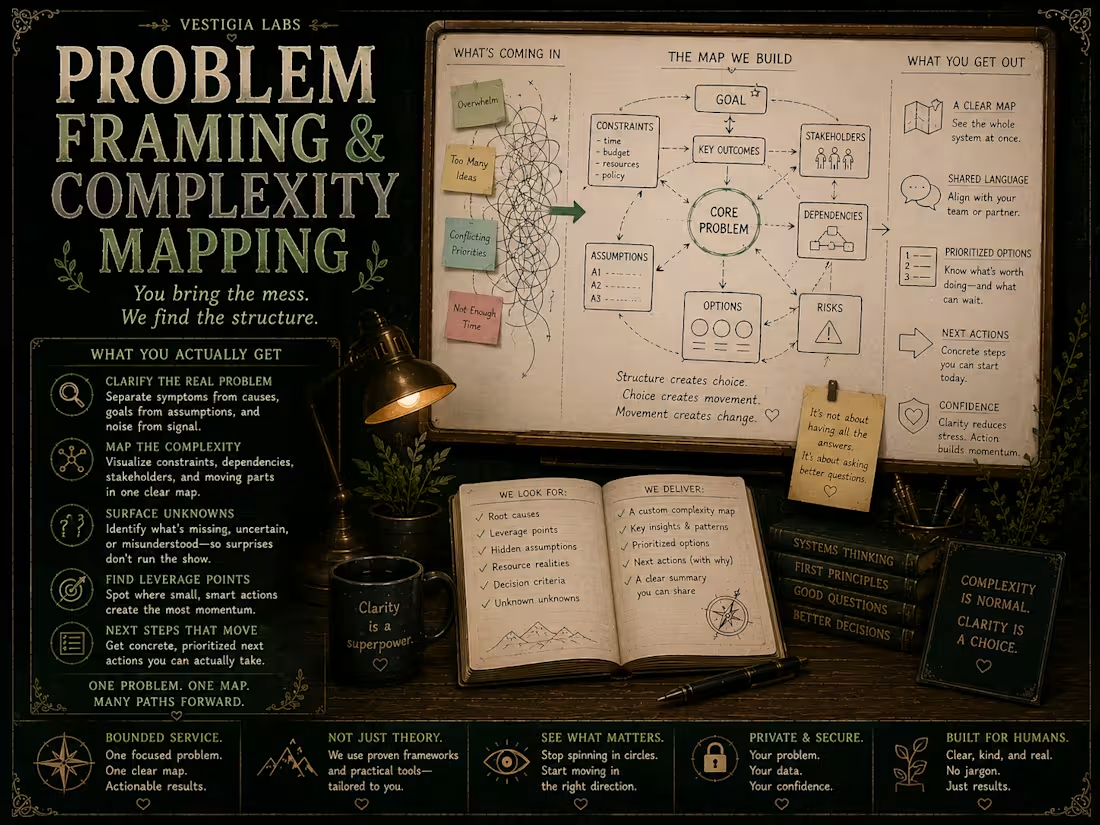
You bring the mess. We find the structure.
Sometimes the problem isn’t that you lack ideas.
It’s that you have too many facts, assumptions, constraints, stakeholders, dependencies, possible causes, competing priorities, and half-defined goals occupying the same conceptual pile.
At that point, jumping immediately to solutions can make things worse.
This is a focused mapping engagement for one messy problem.
You give me the situation as you currently understand it. I separate what is observed from what is inferred, identify the actual decision or problem boundary, surface unknowns and assumptions, map constraints and dependencies, and organize the available paths forward.
The result is not a motivational speech or a generic brainstorming document.
It’s a usable model of the problem.
The goal is to move from:
“Everything is connected and I don’t know where to start.”
to:
“Here is what we know, what we don’t, what constrains us, what depends on what, and what would be useful to do next.”
What you actually get
• The core problem stated in plain language
• Facts separated from assumptions and interpretations
• Goals, constraints, and dependencies mapped
• Important unknowns surfaced
• Contradictions or competing priorities identified
• Stakeholders / moving parts mapped where relevant
• Plausible options or leverage points organized
• One prioritized next action or next useful question
• A written complexity map you can keep and reuse
How it works
1. You dump the mess.
Notes, context, screenshots, rambling explanation, diagrams, half-formed ideas—whatever actually represents the problem.
2. I reconstruct the system.
I identify the relevant objects, relationships, constraints, assumptions, goals, and uncertainties.
3. We find the real decision surface.
What actually needs to be solved now? What can wait? What information would change the decision?
4. You receive the map.
You get a clearer representation of the problem plus prioritized options and next steps.
What I need from you
• A description of the problem
• What outcome you currently want, if known
• Relevant constraints: time, money, tools, people, policy, etc.
• Anything you’ve already tried
• Existing notes, diagrams, screenshots, or artifacts if useful
You do not need to organize any of that before sending it.
If you could already organize the mess, you probably wouldn’t be buying the service. 🤭
Good fit for
Business problems, technical architecture, research questions, creative projects, process failures, decisions with multiple constraints, recurring organizational problems, strategy questions, or the classic:
“Something here is wrong, but I cannot yet tell which noun is misbehaving.”
Scope boundary
This covers one bounded problem and one complexity map.
It does not automatically include implementing the solution, building software, conducting extensive outside research, or managing a larger project.
If the map reveals a larger architecture, automation, AI-system, or implementation need, we can scope that separately through the appropriate larger Contra service.
Structure creates choice. Better questions create movement.
One problem. One map. Many paths forward.
Starting at$25
Duration1 day
Tags
A Different Perspective
Audit
Coherence
Nuance
Problem-Solving
Reflection For Hire
Service provided by
Jeff Padget Oxford, USA
🗺️🧩 Problem Framing & Complexity MappingJeff Padget
Starting at$25
Duration1 day
Tags
A Different Perspective
Audit
Coherence
Nuance
Problem-Solving
Reflection For Hire
🗺️🧩 Problem Framing & Complexity Mapping
You bring the mess. We find the structure.
Sometimes the problem isn’t that you lack ideas.
It’s that you have too many facts, assumptions, constraints, stakeholders, dependencies, possible causes, competing priorities, and half-defined goals occupying the same conceptual pile.
At that point, jumping immediately to solutions can make things worse.
This is a focused mapping engagement for one messy problem.
You give me the situation as you currently understand it. I separate what is observed from what is inferred, identify the actual decision or problem boundary, surface unknowns and assumptions, map constraints and dependencies, and organize the available paths forward.
The result is not a motivational speech or a generic brainstorming document.
It’s a usable model of the problem.
The goal is to move from:
“Everything is connected and I don’t know where to start.”
to:
“Here is what we know, what we don’t, what constrains us, what depends on what, and what would be useful to do next.”
What you actually get
• The core problem stated in plain language
• Facts separated from assumptions and interpretations
• Goals, constraints, and dependencies mapped
• Important unknowns surfaced
• Contradictions or competing priorities identified
• Stakeholders / moving parts mapped where relevant
• Plausible options or leverage points organized
• One prioritized next action or next useful question
• A written complexity map you can keep and reuse
How it works
1. You dump the mess.
Notes, context, screenshots, rambling explanation, diagrams, half-formed ideas—whatever actually represents the problem.
2. I reconstruct the system.
I identify the relevant objects, relationships, constraints, assumptions, goals, and uncertainties.
3. We find the real decision surface.
What actually needs to be solved now? What can wait? What information would change the decision?
4. You receive the map.
You get a clearer representation of the problem plus prioritized options and next steps.
What I need from you
• A description of the problem
• What outcome you currently want, if known
• Relevant constraints: time, money, tools, people, policy, etc.
• Anything you’ve already tried
• Existing notes, diagrams, screenshots, or artifacts if useful
You do not need to organize any of that before sending it.
If you could already organize the mess, you probably wouldn’t be buying the service. 🤭
Good fit for
Business problems, technical architecture, research questions, creative projects, process failures, decisions with multiple constraints, recurring organizational problems, strategy questions, or the classic:
“Something here is wrong, but I cannot yet tell which noun is misbehaving.”
Scope boundary
This covers one bounded problem and one complexity map.
It does not automatically include implementing the solution, building software, conducting extensive outside research, or managing a larger project.
If the map reveals a larger architecture, automation, AI-system, or implementation need, we can scope that separately through the appropriate larger Contra service.
Structure creates choice. Better questions create movement.
One problem. One map. Many paths forward.
$25