
Product Requirements Document (PRD) WritingSridhar Rayasam
What you get
Discovery pass. Two structured sessions with your technical lead and one with whoever owns the commercial side. I extract the requirements that live in people's heads and have never been written down, which on most projects is the majority of them.
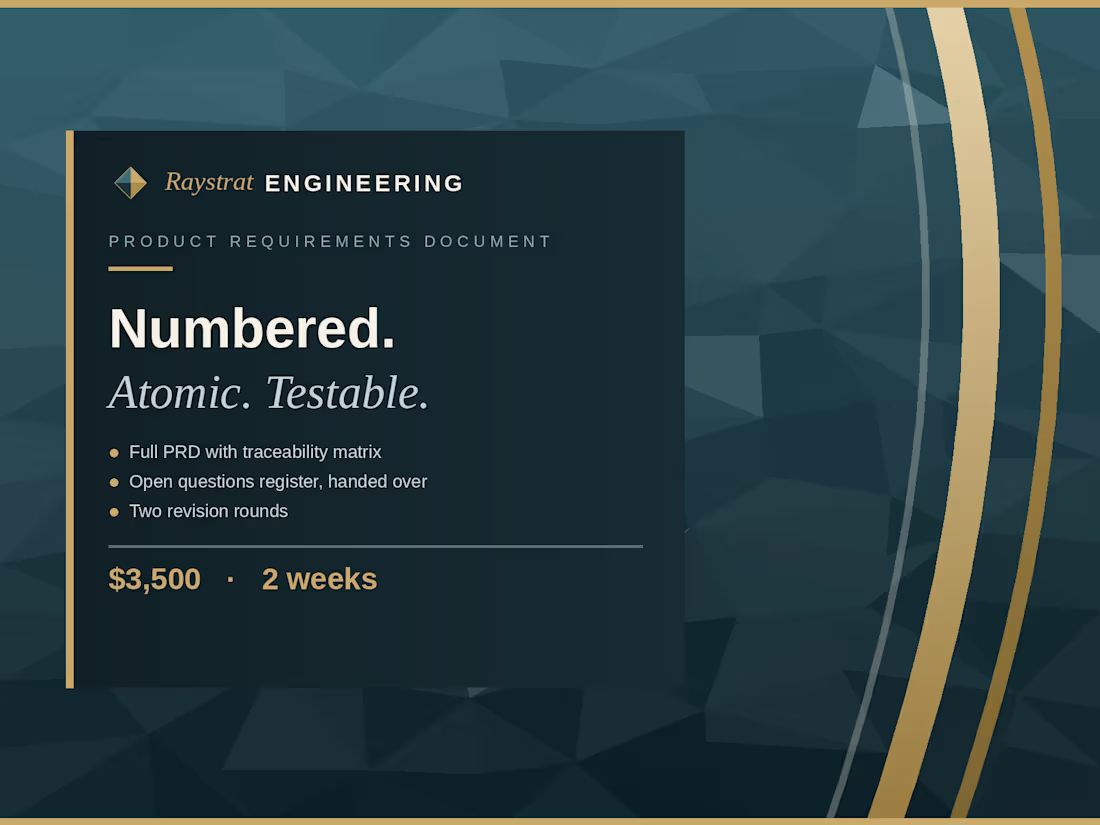
The PRD. Product definition, user and system requirements, interfaces, constraints, compliance and environmental targets, explicit out-of-scope statements. Every requirement numbered, atomic and testable. Anything that cannot be tested goes into a separate assumptions section instead of pretending to be a requirement.
Requirements traceability matrix. Every requirement mapped to its source (customer, standard, internal decision) and to the test that will verify it. This is the artifact that makes reviews short.
Open questions register. The decisions your team has not made yet, stated plainly, with what each one blocks and who owns it. Handed over rather than buried.
Two revision rounds. You mark up, I close out. Twice.
Who this is for
Product and engineering teams at the point where the idea is proven and the build has to be specified. Usually before a supplier engagement, a funding milestone, or the first serious customer commitment.
What actually changes
Before: "The device shall operate reliably in outdoor conditions."
After: "REQ-032: The device shall meet all functional requirements across an ambient temperature range of minus 20 to plus 60 degrees Celsius, at 5 to 95 percent relative humidity non-condensing, verified per TEST-018."
The first version cannot be tested, so a supplier will interpret it against their own definition. The second version can only be passed or failed.
Where I learned this
Hardware. Software requirements get corrected in the next sprint. A hardware requirement error becomes a tooling change, a respin, or a failed certification, so the discipline around writing them is stricter. I bring that standard whether your product is physical or not.
What makes two weeks realistic
I use an AI-assisted drafting process that turns session transcripts and existing fragments into structured first drafts in hours rather than days. I still make every engineering decision and review every requirement. What the process removes is the typing, which is why two weeks is a date I can hold rather than one I miss quietly.
Process
Week 1, days 1 to 3: discovery sessions, review of existing material.
Week 1, days 4 and 5: structured draft, requirements numbered.
Week 2, days 1 and 2: you review, I collect markup.
Week 2, days 3 to 5: revisions, traceability matrix, handover call.
Requirements
Roughly 4 hours of your technical lead's time across the two weeks.
Any existing material: diagrams, schematics, competitor research, customer emails, old specs.
A named decision-maker who can close open questions.
FAQs
Example work
Starting at$3,500
Duration2 weeks
Tags
Consultant
Design Engineer
Product Analyst
Product Manager
Product Strategist
Program Manager
Technical Writer
Documentation Specialist
Technical Project Manager
Service provided by
Sridhar Rayasam proBengaluru, India
Product Requirements Document (PRD) WritingSridhar Rayasam
Starting at$3,500
Duration2 weeks
Tags
Consultant
Design Engineer
Product Analyst
Product Manager
Product Strategist
Program Manager
Technical Writer
Documentation Specialist
Technical Project Manager
What you get
Discovery pass. Two structured sessions with your technical lead and one with whoever owns the commercial side. I extract the requirements that live in people's heads and have never been written down, which on most projects is the majority of them.
The PRD. Product definition, user and system requirements, interfaces, constraints, compliance and environmental targets, explicit out-of-scope statements. Every requirement numbered, atomic and testable. Anything that cannot be tested goes into a separate assumptions section instead of pretending to be a requirement.
Requirements traceability matrix. Every requirement mapped to its source (customer, standard, internal decision) and to the test that will verify it. This is the artifact that makes reviews short.
Open questions register. The decisions your team has not made yet, stated plainly, with what each one blocks and who owns it. Handed over rather than buried.
Two revision rounds. You mark up, I close out. Twice.
Who this is for
Product and engineering teams at the point where the idea is proven and the build has to be specified. Usually before a supplier engagement, a funding milestone, or the first serious customer commitment.
What actually changes
Before: "The device shall operate reliably in outdoor conditions."
After: "REQ-032: The device shall meet all functional requirements across an ambient temperature range of minus 20 to plus 60 degrees Celsius, at 5 to 95 percent relative humidity non-condensing, verified per TEST-018."
The first version cannot be tested, so a supplier will interpret it against their own definition. The second version can only be passed or failed.
Where I learned this
Hardware. Software requirements get corrected in the next sprint. A hardware requirement error becomes a tooling change, a respin, or a failed certification, so the discipline around writing them is stricter. I bring that standard whether your product is physical or not.
What makes two weeks realistic
I use an AI-assisted drafting process that turns session transcripts and existing fragments into structured first drafts in hours rather than days. I still make every engineering decision and review every requirement. What the process removes is the typing, which is why two weeks is a date I can hold rather than one I miss quietly.
Process
Week 1, days 1 to 3: discovery sessions, review of existing material.
Week 1, days 4 and 5: structured draft, requirements numbered.
Week 2, days 1 and 2: you review, I collect markup.
Week 2, days 3 to 5: revisions, traceability matrix, handover call.
Requirements
Roughly 4 hours of your technical lead's time across the two weeks.
Any existing material: diagrams, schematics, competitor research, customer emails, old specs.
A named decision-maker who can close open questions.
FAQs
Example work
$3,500