
Documentation System Setup for Product TeamsSridhar Rayasam
What you get
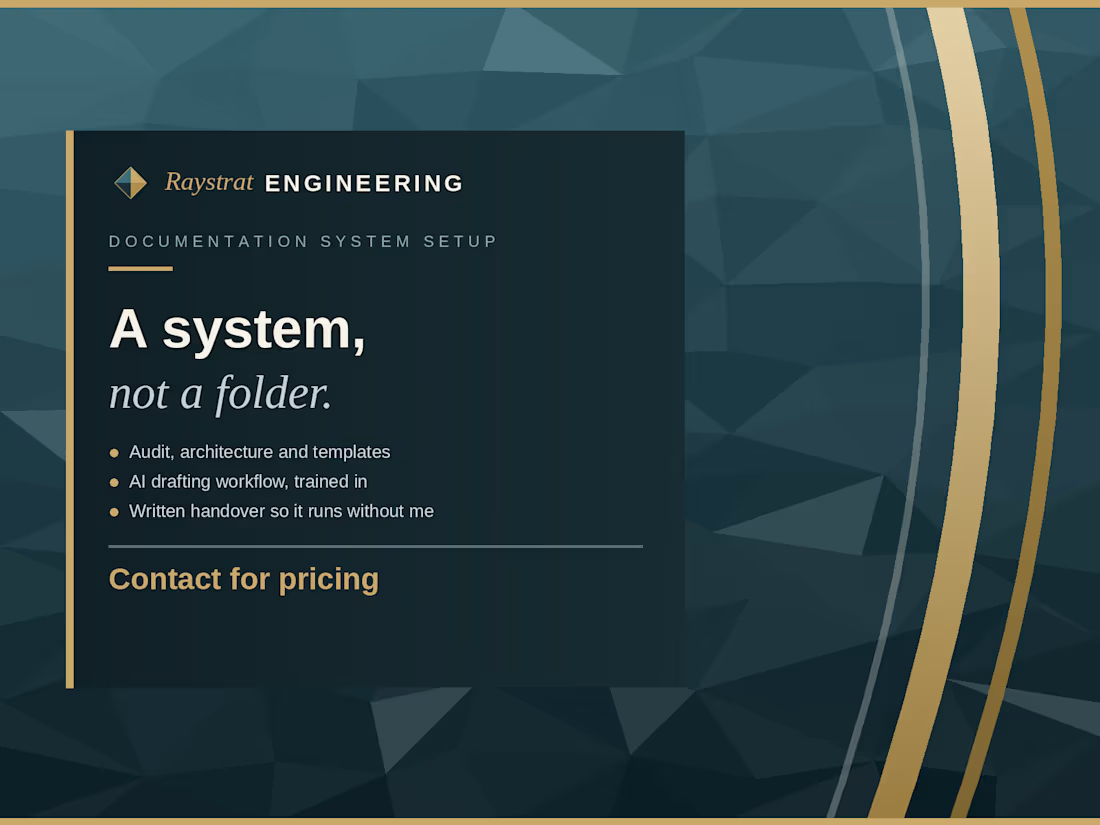
Documentation audit. What exists, what is stale, what is missing, and what is duplicated across three tools with three different version numbers. You get it as a map you can act on, with an owner and a next step against each gap.
Document architecture. The set of documents your team actually needs, how they relate, who owns each one, and when each gets updated. Sized to your team, not to an aerospace programme.
Templates and standards. Working templates for each document type, with the house rules written into the template, so the standard travels without me.
AI-assisted drafting workflow. The process and prompt library your team uses to turn a conversation into a structured draft. Set up in your tools, loaded with your terminology, taught in working sessions rather than a slide deck.
Backfill of priority documents. The two or three documents blocking something right now, written properly during the engagement.
Handover. A written operating guide so the system runs after I leave. If your team needs me permanently for this to work, I built it wrong.
Who this is for
Product and engineering teams between roughly 5 and 50 people where documentation has become the bottleneck. Symptoms: onboarding takes months, the same question appears in Slack every week, suppliers and customers work from outdated files, and one senior person is the single source of truth for everything.
What this is not
Not a documentation-as-a-service retainer where I write your documents forever. The engagement has an end. Success is your team producing good documentation without me.
Why documentation rots, and what actually fixes it
It rots because writing it costs a senior person's time and returns nothing they can feel that week. The workflow I build cuts drafting cost far enough that keeping documents current stops competing with shipping. The review stays human, because that is the part carrying the risk.
Proof that this works
I built a 23-manual technical curriculum in a single semester using this approach: 20 embedded systems lab exercises and 3 FPGA and edge AI exercises, each with a full instructor manual covering objectives, setup, expected results, failure modes and grading. That volume is normally a multi-quarter programme. Content and technical accuracy stayed under my review throughout. Formatting, branding and consistency ran automatically.
Process
Weeks 1 and 2: audit and architecture. You get the map, the gap list, and the document architecture.
Weeks 3 and 4: templates built into your tools, workflow trained with your team.
Month 2 onward: backfill. Priority documents written, your team writing alongside me.
Final two weeks: handover. Operating guide, final training, exit.
Requirements
An executive sponsor who can mandate the new process, because documentation systems die without one.
Access to your current tooling.
Roughly 3 hours per week of your team's time for sessions and review.
FAQs
Example work
Sridhar's other services
Contact for pricing
Duration1 week
Tags
Consultant
Content Strategist
Product Analyst
Product Manager
Product Strategist
Technical Writer
Documentation Specialist
Technical Project Manager
Service provided by
Sridhar Rayasam proBengaluru, India
Documentation System Setup for Product TeamsSridhar Rayasam
Contact for pricing
Duration1 week
Tags
Consultant
Content Strategist
Product Analyst
Product Manager
Product Strategist
Technical Writer
Documentation Specialist
Technical Project Manager
What you get
Documentation audit. What exists, what is stale, what is missing, and what is duplicated across three tools with three different version numbers. You get it as a map you can act on, with an owner and a next step against each gap.
Document architecture. The set of documents your team actually needs, how they relate, who owns each one, and when each gets updated. Sized to your team, not to an aerospace programme.
Templates and standards. Working templates for each document type, with the house rules written into the template, so the standard travels without me.
AI-assisted drafting workflow. The process and prompt library your team uses to turn a conversation into a structured draft. Set up in your tools, loaded with your terminology, taught in working sessions rather than a slide deck.
Backfill of priority documents. The two or three documents blocking something right now, written properly during the engagement.
Handover. A written operating guide so the system runs after I leave. If your team needs me permanently for this to work, I built it wrong.
Who this is for
Product and engineering teams between roughly 5 and 50 people where documentation has become the bottleneck. Symptoms: onboarding takes months, the same question appears in Slack every week, suppliers and customers work from outdated files, and one senior person is the single source of truth for everything.
What this is not
Not a documentation-as-a-service retainer where I write your documents forever. The engagement has an end. Success is your team producing good documentation without me.
Why documentation rots, and what actually fixes it
It rots because writing it costs a senior person's time and returns nothing they can feel that week. The workflow I build cuts drafting cost far enough that keeping documents current stops competing with shipping. The review stays human, because that is the part carrying the risk.
Proof that this works
I built a 23-manual technical curriculum in a single semester using this approach: 20 embedded systems lab exercises and 3 FPGA and edge AI exercises, each with a full instructor manual covering objectives, setup, expected results, failure modes and grading. That volume is normally a multi-quarter programme. Content and technical accuracy stayed under my review throughout. Formatting, branding and consistency ran automatically.
Process
Weeks 1 and 2: audit and architecture. You get the map, the gap list, and the document architecture.
Weeks 3 and 4: templates built into your tools, workflow trained with your team.
Month 2 onward: backfill. Priority documents written, your team writing alongside me.
Final two weeks: handover. Operating guide, final training, exit.
Requirements
An executive sponsor who can mandate the new process, because documentation systems die without one.
Access to your current tooling.
Roughly 3 hours per week of your team's time for sessions and review.
FAQs
Example work
Sridhar's other services
Contact for pricing