
AI agent boundary spec: what it answers, refuses and hands backSebastián Balderas Espinosa
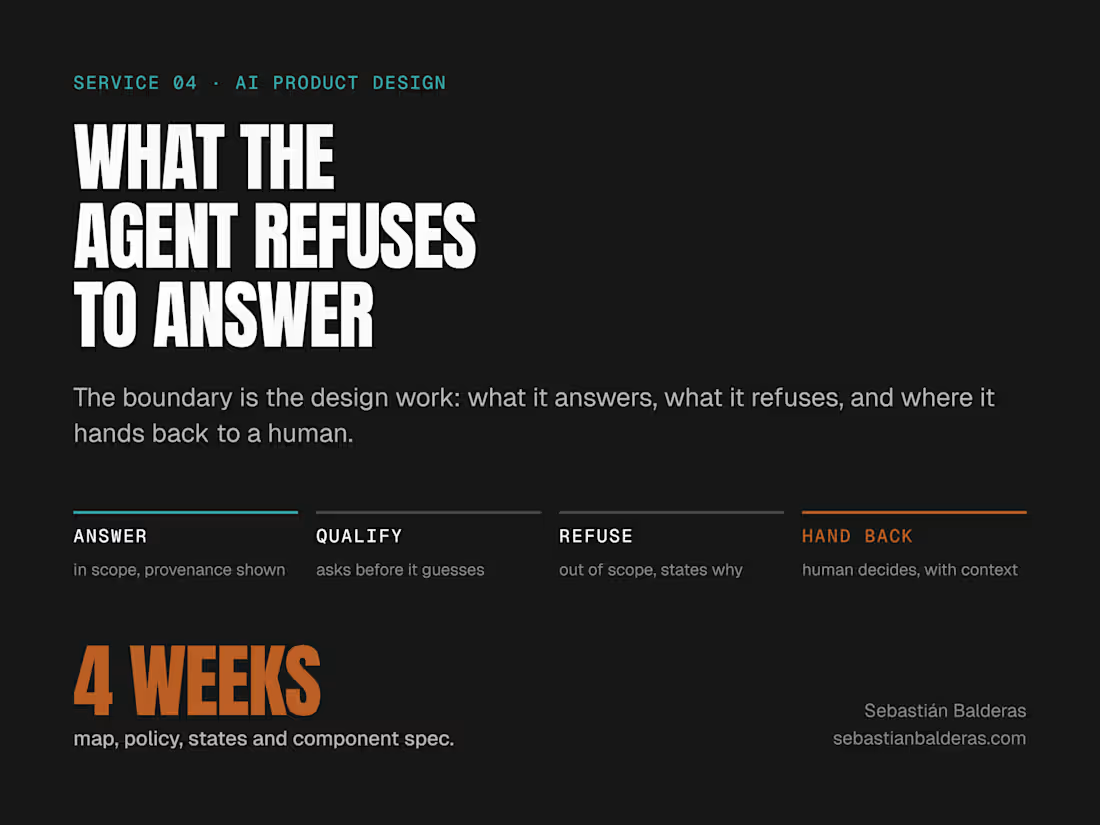
Most teams ship an agent that answers everything. That is the failure mode. The design work is the boundary: what the agent answers, what it refuses, and where it hands back to a human.
You get a specification your engineers implement. I do not touch your codebase.
What I deliver in 4 weeks:
Workflow map and refusal policy — every question the agent will receive, classified into answer / qualify / refuse / hand back, with the rule behind each one.
State model — the three states the interface must expose at all times: uncertainty, provenance of the answer, and whether the content was generated or retrieved.
Handback design — the exact trigger, what the human receives, and what the agent has already done for them before handing over.
Permission and audit scope — what the agent may read and write per role, and what must be logged for the trail to survive an audit.
Component specification — states, empty states, error states and copy, mapped to semantic tokens your frontend already uses.
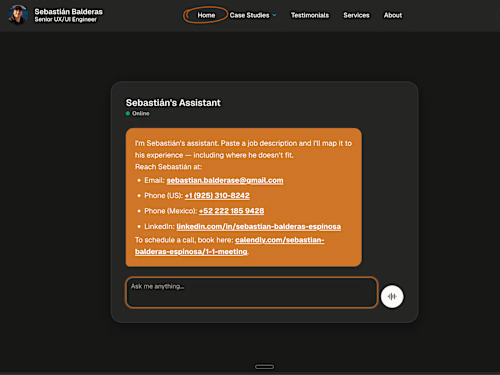
Why this and not a prompt: I sequence it with my AI Automation Maturity Framework — L1 workflow automation, L2 agentic integration, L3 adaptive loops. Most teams try to buy L3 and ship an agent nobody can audit. The spec tells you which tier your workflow can actually hold today, and what has to exist before you move up.
Background: eight years designing enterprise workflows, three of them AI-first. I designed and built the conversational agent on sebastianbalderas.com end to end — research, design, code, deploy. On Strata: +40% SLA compliance, +40% throughput, -30% operational delays, measured on the platform's own reporting.
Implementation is a separate engagement — see my "Contact for scope" listing.
FAQs

Starting at$4,500
Duration4 weeks
Tags
AI Product Design
Workflow Design
AI Automation
B2B SaaS
Design Systems Specialist
Product Strategist
UX Engineer
Conversational Design
Enterprise UX
Service provided by
Sebastián Balderas Espinosa Puebla, Mexico
AI agent boundary spec: what it answers, refuses and hands backSebastián Balderas Espinosa
Starting at$4,500
Duration4 weeks
Tags
AI Product Design
Workflow Design
AI Automation
B2B SaaS
Design Systems Specialist
Product Strategist
UX Engineer
Conversational Design
Enterprise UX
Most teams ship an agent that answers everything. That is the failure mode. The design work is the boundary: what the agent answers, what it refuses, and where it hands back to a human.
You get a specification your engineers implement. I do not touch your codebase.
What I deliver in 4 weeks:
Workflow map and refusal policy — every question the agent will receive, classified into answer / qualify / refuse / hand back, with the rule behind each one.
State model — the three states the interface must expose at all times: uncertainty, provenance of the answer, and whether the content was generated or retrieved.
Handback design — the exact trigger, what the human receives, and what the agent has already done for them before handing over.
Permission and audit scope — what the agent may read and write per role, and what must be logged for the trail to survive an audit.
Component specification — states, empty states, error states and copy, mapped to semantic tokens your frontend already uses.
Why this and not a prompt: I sequence it with my AI Automation Maturity Framework — L1 workflow automation, L2 agentic integration, L3 adaptive loops. Most teams try to buy L3 and ship an agent nobody can audit. The spec tells you which tier your workflow can actually hold today, and what has to exist before you move up.
Background: eight years designing enterprise workflows, three of them AI-first. I designed and built the conversational agent on sebastianbalderas.com end to end — research, design, code, deploy. On Strata: +40% SLA compliance, +40% throughput, -30% operational delays, measured on the platform's own reporting.
Implementation is a separate engagement — see my "Contact for scope" listing.
FAQs
$4,500