
Not in Kansas Anymore — Conspiracy, Legend & Claim AnalysisFacthread Research
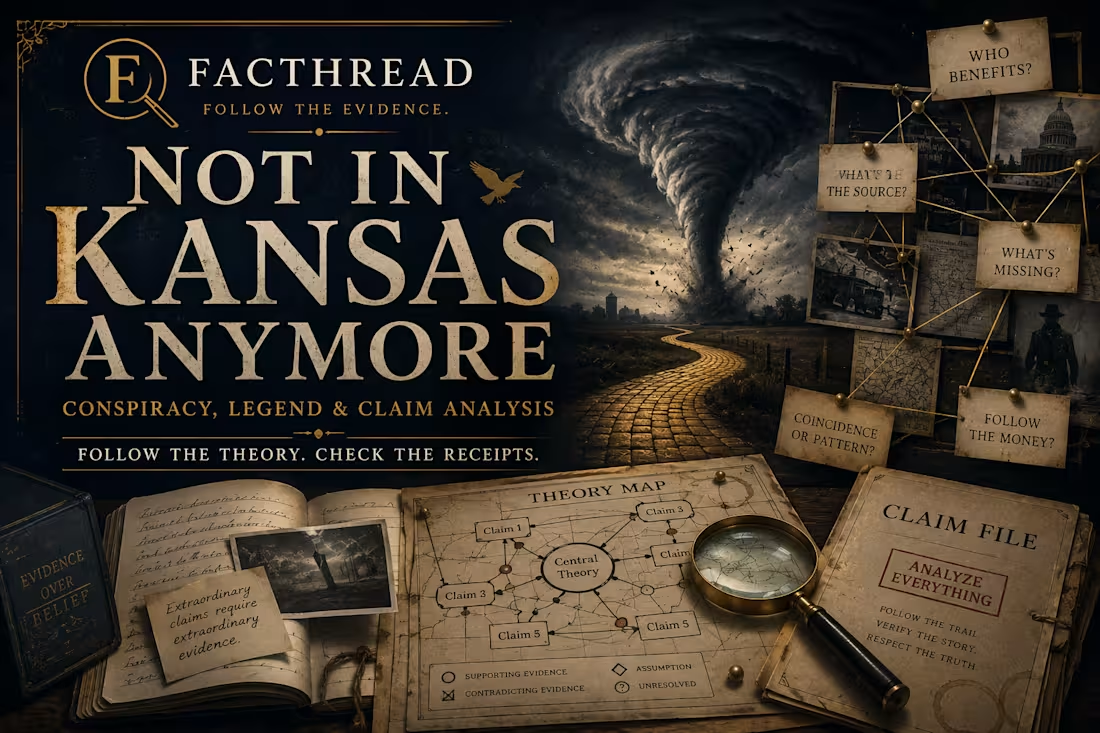
Follow the yellow brick road. But check the receipts along the way.
Not in Kansas Anymore is for the theories that make people uncomfortable at dinner parties. The conspiracy your friend won't stop talking about. The historical claim that sounds too strange to be true (but also too specific to be made up). The legend that keeps showing up in different cultures with slightly different details. The cover-up allegation that has three Reddit threads, one grainy photograph, and zero primary sources.
You bring the theory. I bring structured, evidence-based methodology, no precommitment to any conclusion, and the discipline to show you what the sources actually support, what they contradict, and what remains genuinely unresolved.
Researching a claim does not mean endorsing it. It means taking it seriously enough to test it.
What kinds of theories fit here
Historical conspiracies and alleged cover-ups
Internet conspiracy theories and viral claims with elaborate supporting narratives
Urban legends, folklore, and persistent cultural stories
Paranormal, anomalous, and unexplained-phenomenon claims
Disputed historical events and revisionist theories
Mysterious artifacts, texts, or objects with contested origins
Cryptids and folklore examined as documented phenomena
Prophecy claims and alleged predictions
Ancient-text theories and claims involving translation disputes
Theories that cross languages or originate in foreign-language sources
Viral theories and claims that have accumulated layers of repetition, distortion, and embellishment
"What really happened" questions about well-known events with competing narratives
What this service does
Not in Kansas Anymore takes one central theory or extraordinary claim and stress-tests it. Instead of starting with a verdict, the process reconstructs the theory fairly, identifies its testable components, and evaluates each one against the available evidence.
The analysis:
Establishes what the theory actually alleges in its strongest, most coherent form
Traces documented origins of the theory when possible, including how it has evolved over time
Identifies the evidence commonly offered for the theory and evaluates each piece individually
Examines primary and credible secondary sources rather than relying on repeated claims
Distinguishes evidence from inference and repetition (a claim cited in 50 places that all trace back to one unsourced blog post is one claim, not 50)
Identifies contradictions and missing evidence within the theory's own framework
Evaluates alternative explanations against the same evidence
Shows which portions are supported, unsupported, contradicted, or genuinely unresolved
The conclusion may be "this part holds up," "this part doesn't," or "there isn't enough evidence to say." All three are legitimate findings.
Scope
Not in Kansas Anymore covers one central theory or extraordinary claim with up to 6 major testable component claims. The analysis examines the theory's origins, evidence base, internal consistency, contradictions, and competing explanations across those components.
This is not unlimited research. If a theory requires more than 6 major component claims, extensive investigation across unrelated domains, or substantially broader research, I'll flag that during scoping and recommend a custom or broader engagement.
Your theory is reviewed during a scoping step before research begins. If it needs a different tier or custom scope, I'll tell you before any work starts.
How it works
You submit your theory. The claim or theory you want examined, any context or sources you already have, and what specifically you want to understand (the whole theory, a particular component, the origins, the evidence base, etc.).
I scope and confirm. I review the theory, identify its major testable components (up to 6), confirm the engagement fits this tier's scope, and clarify anything before starting. If the theory needs a broader or custom engagement, I'll tell you before any work begins.
I stress-test the theory. Source discovery, origin tracing, evidence evaluation, cross-referencing, contradiction analysis, alternative-explanation assessment, and confidence mapping using lawful, publicly accessible sources.
You receive your analysis. A full theory analysis package within 10 business days of confirmed scope, including the Theory Reconstruction, Evidence Ledger, Theory Map / Claim Tree, Alternative Explanations, Verdict & Confidence Report, and Source Log.
What you need to provide
The theory or extraordinary claim you want examined
Any context you already have: links, screenshots, documents, prior research, forum threads, videos, books, anything relevant
What specifically you want to understand (the full theory, a particular claim within it, the origins, the evidence, etc.)
What you plan to use the findings for (helps me tailor the analysis)
Methodology
Every finding is tied to its source. Confidence levels are assigned to each component claim based on corroboration strength. The analysis clearly separates verified facts, reported claims, inferences, assumptions, contradictions, and unresolved questions.
Verdict language is component-by-component rather than a single TRUE/FALSE label:
Supported — corroborated by multiple independent, credible sources
Plausible but Unproven — consistent with available evidence but lacking sufficient corroboration
Insufficient Evidence — cannot be evaluated meaningfully with available sources
Contradicted — directly contradicted by credible evidence
Unresolved — evidence exists on multiple sides without clear resolution
When the available evidence runs out, I document where it stopped and why, and suggest legitimate research avenues for further investigation rather than filling gaps with speculation. Certainty is not manufactured in either direction.
Foreign-language & historical-text research
Not in Kansas Anymore is not limited to English-language sources. Many theories involve foreign-language materials, ancient texts, translation disputes, or claims that originate outside the English-speaking world.
Facthread provides translation-assisted research and cross-language source analysis as part of the investigation, including work with digitized manuscripts, inscriptions, archival documents, old newspapers, historical records, translations, transliterations, dictionaries, scholarly editions, and other legitimately accessible materials when relevant to the theory.
This is not certified, sworn, legal, medical, or professional translation. If a project requires that level of translation, an appropriately qualified human translator would need to be separately involved.
For ancient or difficult historical languages, the analysis distinguishes between the original text, established scholarly translations, competing interpretations, and Facthread's research synthesis. Facthread does not claim independent linguistic expertise in ancient languages. When translation accuracy is material to a theory's claims, the research prioritizes authoritative dictionaries, scholarly editions, institutional sources, and multiple independent translations where available, and explicitly flags ambiguity rather than selecting whichever translation best supports or undermines the theory.
Scope note: Cross-language and historical-text research fits within this service's standard scope when it serves the central theory analysis and its component claims (up to 6). If a theory requires extensive manuscript analysis, specialist paleography, original translation of substantial texts, or academic-level linguistic interpretation, that falls outside the standard scope and would be flagged during the scoping step.
What this service is not
Not a platform for confirming or debunking theories to order (the evidence leads where it leads)
Not a private investigation or law-enforcement service
Not surveillance, hacking, impersonation, doxxing, or access to private/nonpublic information
Not locating or contacting people who are intentionally avoiding contact
Not unsupported accusations or conclusions about identifiable people beyond what sources support
Not an attempt to prove criminal wrongdoing by private individuals
Not legal advice, medical conclusions, or academic work submitted as your own
Not guaranteed findings or guaranteed resolution (some theories remain genuinely unresolved)
Not speculation presented as fact
Not certified, sworn, legal, medical, or professional translation
Not unlimited research: scope is capped at one central theory with up to 6 major testable component claims
Revision policy
One round of clarification questions on the delivered analysis is included, covering sources, confidence levels, methodology, verdict reasoning, the Theory Map, or anything unclear. It does not cover additional theories, new component claims, or expanded research.
Broader Facthread services
Rabbit Hole Roulette — Weird questions welcome ($95)
The Needle — Focused research and verification ($125)
The Rabbit Hole — Strange, obscure, and hard-to-untangle ($195)
The Deep Dive — Multi-source research and evidence analysis for one defined objective ($295)
The Case File — Evidence reconstruction and analysis within defined scope ceilings ($595)
If your theory turns out to need a broader scope, I'll let you know before starting and we can discuss the right tier.
FAQs
Example work


Starting at$350
Duration10 days
Tags
Online Research
Public Records
Source Verification
Researcher
Archival Research
Claim Analysis
Conspiracy Research
Fact-Checking
Service provided by
Facthread Research Lancaster, USA
- 1
- Followers
Not in Kansas Anymore — Conspiracy, Legend & Claim AnalysisFacthread Research
Starting at$350
Duration10 days
Tags
Online Research
Public Records
Source Verification
Researcher
Archival Research
Claim Analysis
Conspiracy Research
Fact-Checking
Follow the yellow brick road. But check the receipts along the way.
Not in Kansas Anymore is for the theories that make people uncomfortable at dinner parties. The conspiracy your friend won't stop talking about. The historical claim that sounds too strange to be true (but also too specific to be made up). The legend that keeps showing up in different cultures with slightly different details. The cover-up allegation that has three Reddit threads, one grainy photograph, and zero primary sources.
You bring the theory. I bring structured, evidence-based methodology, no precommitment to any conclusion, and the discipline to show you what the sources actually support, what they contradict, and what remains genuinely unresolved.
Researching a claim does not mean endorsing it. It means taking it seriously enough to test it.
What kinds of theories fit here
Historical conspiracies and alleged cover-ups
Internet conspiracy theories and viral claims with elaborate supporting narratives
Urban legends, folklore, and persistent cultural stories
Paranormal, anomalous, and unexplained-phenomenon claims
Disputed historical events and revisionist theories
Mysterious artifacts, texts, or objects with contested origins
Cryptids and folklore examined as documented phenomena
Prophecy claims and alleged predictions
Ancient-text theories and claims involving translation disputes
Theories that cross languages or originate in foreign-language sources
Viral theories and claims that have accumulated layers of repetition, distortion, and embellishment
"What really happened" questions about well-known events with competing narratives
What this service does
Not in Kansas Anymore takes one central theory or extraordinary claim and stress-tests it. Instead of starting with a verdict, the process reconstructs the theory fairly, identifies its testable components, and evaluates each one against the available evidence.
The analysis:
Establishes what the theory actually alleges in its strongest, most coherent form
Traces documented origins of the theory when possible, including how it has evolved over time
Identifies the evidence commonly offered for the theory and evaluates each piece individually
Examines primary and credible secondary sources rather than relying on repeated claims
Distinguishes evidence from inference and repetition (a claim cited in 50 places that all trace back to one unsourced blog post is one claim, not 50)
Identifies contradictions and missing evidence within the theory's own framework
Evaluates alternative explanations against the same evidence
Shows which portions are supported, unsupported, contradicted, or genuinely unresolved
The conclusion may be "this part holds up," "this part doesn't," or "there isn't enough evidence to say." All three are legitimate findings.
Scope
Not in Kansas Anymore covers one central theory or extraordinary claim with up to 6 major testable component claims. The analysis examines the theory's origins, evidence base, internal consistency, contradictions, and competing explanations across those components.
This is not unlimited research. If a theory requires more than 6 major component claims, extensive investigation across unrelated domains, or substantially broader research, I'll flag that during scoping and recommend a custom or broader engagement.
Your theory is reviewed during a scoping step before research begins. If it needs a different tier or custom scope, I'll tell you before any work starts.
How it works
You submit your theory. The claim or theory you want examined, any context or sources you already have, and what specifically you want to understand (the whole theory, a particular component, the origins, the evidence base, etc.).
I scope and confirm. I review the theory, identify its major testable components (up to 6), confirm the engagement fits this tier's scope, and clarify anything before starting. If the theory needs a broader or custom engagement, I'll tell you before any work begins.
I stress-test the theory. Source discovery, origin tracing, evidence evaluation, cross-referencing, contradiction analysis, alternative-explanation assessment, and confidence mapping using lawful, publicly accessible sources.
You receive your analysis. A full theory analysis package within 10 business days of confirmed scope, including the Theory Reconstruction, Evidence Ledger, Theory Map / Claim Tree, Alternative Explanations, Verdict & Confidence Report, and Source Log.
What you need to provide
The theory or extraordinary claim you want examined
Any context you already have: links, screenshots, documents, prior research, forum threads, videos, books, anything relevant
What specifically you want to understand (the full theory, a particular claim within it, the origins, the evidence, etc.)
What you plan to use the findings for (helps me tailor the analysis)
Methodology
Every finding is tied to its source. Confidence levels are assigned to each component claim based on corroboration strength. The analysis clearly separates verified facts, reported claims, inferences, assumptions, contradictions, and unresolved questions.
Verdict language is component-by-component rather than a single TRUE/FALSE label:
Supported — corroborated by multiple independent, credible sources
Plausible but Unproven — consistent with available evidence but lacking sufficient corroboration
Insufficient Evidence — cannot be evaluated meaningfully with available sources
Contradicted — directly contradicted by credible evidence
Unresolved — evidence exists on multiple sides without clear resolution
When the available evidence runs out, I document where it stopped and why, and suggest legitimate research avenues for further investigation rather than filling gaps with speculation. Certainty is not manufactured in either direction.
Foreign-language & historical-text research
Not in Kansas Anymore is not limited to English-language sources. Many theories involve foreign-language materials, ancient texts, translation disputes, or claims that originate outside the English-speaking world.
Facthread provides translation-assisted research and cross-language source analysis as part of the investigation, including work with digitized manuscripts, inscriptions, archival documents, old newspapers, historical records, translations, transliterations, dictionaries, scholarly editions, and other legitimately accessible materials when relevant to the theory.
This is not certified, sworn, legal, medical, or professional translation. If a project requires that level of translation, an appropriately qualified human translator would need to be separately involved.
For ancient or difficult historical languages, the analysis distinguishes between the original text, established scholarly translations, competing interpretations, and Facthread's research synthesis. Facthread does not claim independent linguistic expertise in ancient languages. When translation accuracy is material to a theory's claims, the research prioritizes authoritative dictionaries, scholarly editions, institutional sources, and multiple independent translations where available, and explicitly flags ambiguity rather than selecting whichever translation best supports or undermines the theory.
Scope note: Cross-language and historical-text research fits within this service's standard scope when it serves the central theory analysis and its component claims (up to 6). If a theory requires extensive manuscript analysis, specialist paleography, original translation of substantial texts, or academic-level linguistic interpretation, that falls outside the standard scope and would be flagged during the scoping step.
What this service is not
Not a platform for confirming or debunking theories to order (the evidence leads where it leads)
Not a private investigation or law-enforcement service
Not surveillance, hacking, impersonation, doxxing, or access to private/nonpublic information
Not locating or contacting people who are intentionally avoiding contact
Not unsupported accusations or conclusions about identifiable people beyond what sources support
Not an attempt to prove criminal wrongdoing by private individuals
Not legal advice, medical conclusions, or academic work submitted as your own
Not guaranteed findings or guaranteed resolution (some theories remain genuinely unresolved)
Not speculation presented as fact
Not certified, sworn, legal, medical, or professional translation
Not unlimited research: scope is capped at one central theory with up to 6 major testable component claims
Revision policy
One round of clarification questions on the delivered analysis is included, covering sources, confidence levels, methodology, verdict reasoning, the Theory Map, or anything unclear. It does not cover additional theories, new component claims, or expanded research.
Broader Facthread services
Rabbit Hole Roulette — Weird questions welcome ($95)
The Needle — Focused research and verification ($125)
The Rabbit Hole — Strange, obscure, and hard-to-untangle ($195)
The Deep Dive — Multi-source research and evidence analysis for one defined objective ($295)
The Case File — Evidence reconstruction and analysis within defined scope ceilings ($595)
If your theory turns out to need a broader scope, I'll let you know before starting and we can discuss the right tier.
FAQs
Example work
$350