
Ship an LLM feature to production, not a demoAbdulhamid Sonaike
Most AI features demo beautifully and then quietly lose their users. Mine are built the other way round: I assume the model will be confidently wrong, and I build the instruments to catch it before your customers do.What you get, in four weeks😍
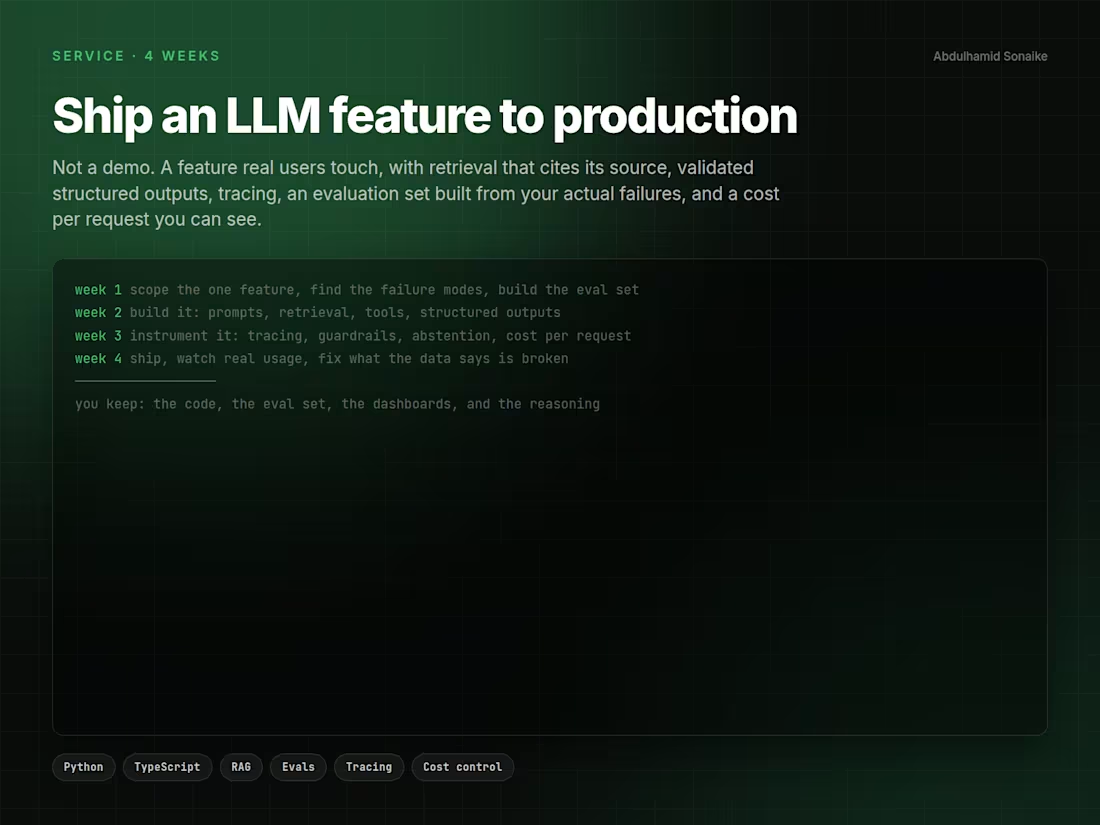
Week 1. We pick one feature and scope it properly. I go looking for the ways it will fail, and turn those into an evaluation set built from your real cases rather than invented ones.
Week 2. I build it. Model selection and routing by task, prompt and context engineering, retrieval with chunking that respects your documents, validated structured outputs, and an agent tool layer where it earns its place.
Week 3. I instrument it. Tracing that separates a retrieval bug from a model bug. Guardrails and a considered abstention path, so the system says it does not know instead of inventing. Token cost tracked per feature.
Week 4. We ship it to real users, watch what they actually do, and fix what the data says is broken rather than what is fun to fix.
You keep all of it: the code, the evaluation set, the tracing, and the written reasoning behind each decision, so your team can carry it forward without me.
Why me. I am co-founding PulsePM, where I own the AI layer end to end including its MCP server, so the tradeoffs here are ones I live with rather than advise on. At Genie AI I held 99.7% reliability across production services and cut API response time from 420ms to 190ms. At OPSIS AI I learned the lesson that shapes this whole offer: an assistant used by 25 people quietly lost its users over several weeks with nothing in the metrics saying broken, because it answered confidently where it should have declined. The fix was a less capable version that knew when to stop.
Stack: Python, FastAPI, TypeScript, Next.js, React, PostgreSQL, AWS, Docker.

Starting at$7,500
Duration4 weeks
Tags
Python

TypeScript

AI Automation
AI Developer
AI Engineer
Backend Engineer
Fullstack Engineer
Prompt Engineer
Software Engineer
Service provided by
Abdulhamid Sonaike proLondon, UK
- 5.00
- Rating
- 18
- Followers
Ship an LLM feature to production, not a demoAbdulhamid Sonaike
Starting at$7,500
Duration4 weeks
Tags
Python
TypeScript
AI Automation
AI Developer
AI Engineer
Backend Engineer
Fullstack Engineer
Prompt Engineer
Software Engineer
Most AI features demo beautifully and then quietly lose their users. Mine are built the other way round: I assume the model will be confidently wrong, and I build the instruments to catch it before your customers do.What you get, in four weeks😍
Week 1. We pick one feature and scope it properly. I go looking for the ways it will fail, and turn those into an evaluation set built from your real cases rather than invented ones.
Week 2. I build it. Model selection and routing by task, prompt and context engineering, retrieval with chunking that respects your documents, validated structured outputs, and an agent tool layer where it earns its place.
Week 3. I instrument it. Tracing that separates a retrieval bug from a model bug. Guardrails and a considered abstention path, so the system says it does not know instead of inventing. Token cost tracked per feature.
Week 4. We ship it to real users, watch what they actually do, and fix what the data says is broken rather than what is fun to fix.
You keep all of it: the code, the evaluation set, the tracing, and the written reasoning behind each decision, so your team can carry it forward without me.
Why me. I am co-founding PulsePM, where I own the AI layer end to end including its MCP server, so the tradeoffs here are ones I live with rather than advise on. At Genie AI I held 99.7% reliability across production services and cut API response time from 420ms to 190ms. At OPSIS AI I learned the lesson that shapes this whole offer: an assistant used by 25 people quietly lost its users over several weeks with nothing in the metrics saying broken, because it answered confidently where it should have declined. The fix was a less capable version that knew when to stop.
Stack: Python, FastAPI, TypeScript, Next.js, React, PostgreSQL, AWS, Docker.
$7,500