
AI reliability audit: evals, tracing and cost controlAbdulhamid Sonaike
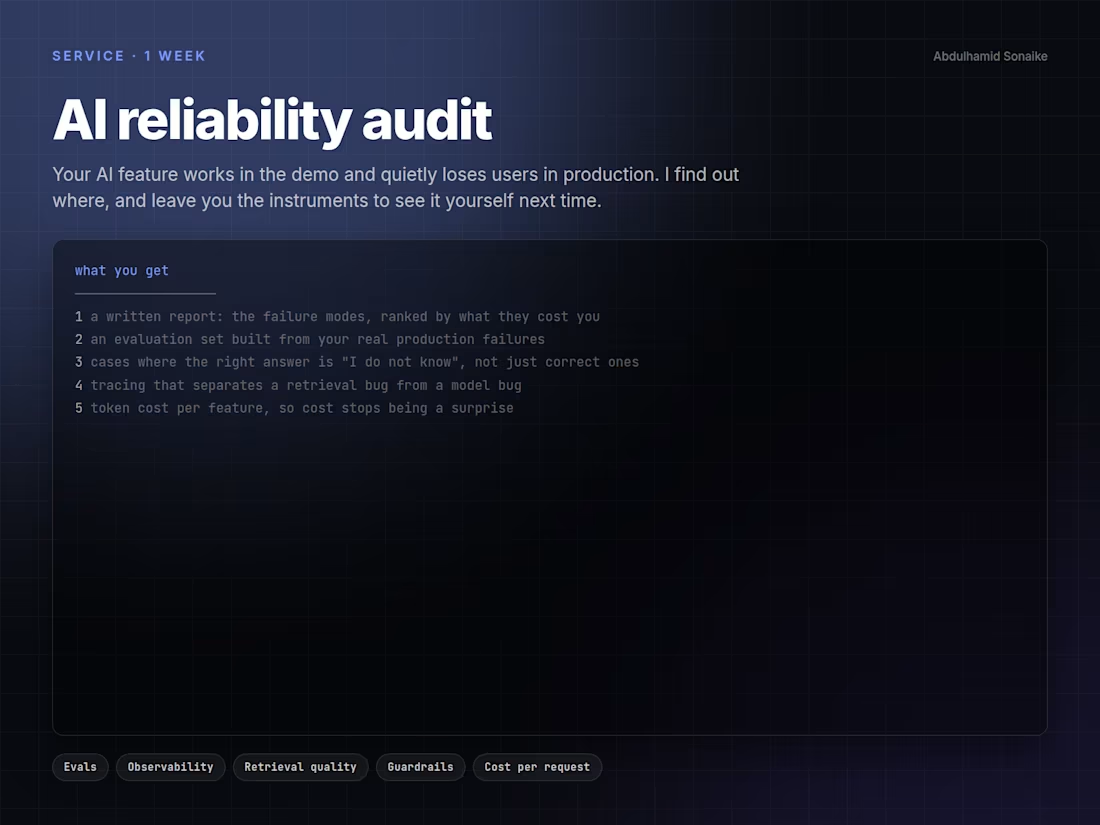
Your AI feature works in the demo and something is wrong in production, but nothing in your metrics says broken. No errors, no complaints, no tickets, just usage drifting down. That failure mode produces no signal at all, and it is the one I go looking for.
One week. Five things you keep😍
A written report of the failure modes I found, ranked by what each one costs you in trust rather than by how interesting it is.
An evaluation set built from your real production failures, not invented cases. Most eval sets only measure capability. Yours will also measure abstention, because a confidently wrong answer and a confidently right one look identical to a capability metric.
Retrieval quality reviewed properly. Most of the quality gain I have seen comes from chunking that respects a document's own structure rather than from swapping the embedding model, and the fix for a bad result is more often the chunk boundary than the prompt.
Tracing wired up so you can tell a retrieval bug from a model bug without guessing, and monitoring that catches silent degradation rather than only outages.
Token cost per feature, so cost stops being a surprise at the end of the month.
Why me. At OPSIS AI I built an assistant into a pipeline used by 25 or more people that saved four to five hours per project, then watched usage decay over several weeks with nothing in the metrics saying broken. It had answered confidently where it had no business answering, and one wrong confident answer cost more trust than ten useful ones earned. The version people kept was deliberately less capable and said plainly when it could not help. This audit is that lesson turned into a week of work, so you do not have to learn it the expensive way.
Good fit if your AI feature is already live or close to it. If you are starting from nothing, the four week build service is the better place to begin.
Abdulhamid's other services
Starting at$2,200
Duration1 week
Tags
Python

TypeScript

AI Automation
AI Developer
AI Engineer
Backend Engineer
Fullstack Engineer
Prompt Engineer
Software Engineer
Service provided by
Abdulhamid Sonaike proLondon, UK
- 5.00
- Rating
- 18
- Followers
AI reliability audit: evals, tracing and cost controlAbdulhamid Sonaike
Starting at$2,200
Duration1 week
Tags
Python
TypeScript
AI Automation
AI Developer
AI Engineer
Backend Engineer
Fullstack Engineer
Prompt Engineer
Software Engineer
Your AI feature works in the demo and something is wrong in production, but nothing in your metrics says broken. No errors, no complaints, no tickets, just usage drifting down. That failure mode produces no signal at all, and it is the one I go looking for.
One week. Five things you keep😍
A written report of the failure modes I found, ranked by what each one costs you in trust rather than by how interesting it is.
An evaluation set built from your real production failures, not invented cases. Most eval sets only measure capability. Yours will also measure abstention, because a confidently wrong answer and a confidently right one look identical to a capability metric.
Retrieval quality reviewed properly. Most of the quality gain I have seen comes from chunking that respects a document's own structure rather than from swapping the embedding model, and the fix for a bad result is more often the chunk boundary than the prompt.
Tracing wired up so you can tell a retrieval bug from a model bug without guessing, and monitoring that catches silent degradation rather than only outages.
Token cost per feature, so cost stops being a surprise at the end of the month.
Why me. At OPSIS AI I built an assistant into a pipeline used by 25 or more people that saved four to five hours per project, then watched usage decay over several weeks with nothing in the metrics saying broken. It had answered confidently where it had no business answering, and one wrong confident answer cost more trust than ten useful ones earned. The version people kept was deliberately less capable and said plainly when it could not help. This audit is that lesson turned into a week of work, so you do not have to learn it the expensive way.
Good fit if your AI feature is already live or close to it. If you are starting from nothing, the four week build service is the better place to begin.
Abdulhamid's other services
$2,200