
Brand + Commerce Transformation | Strategy, Identity & Launch Ash Ome
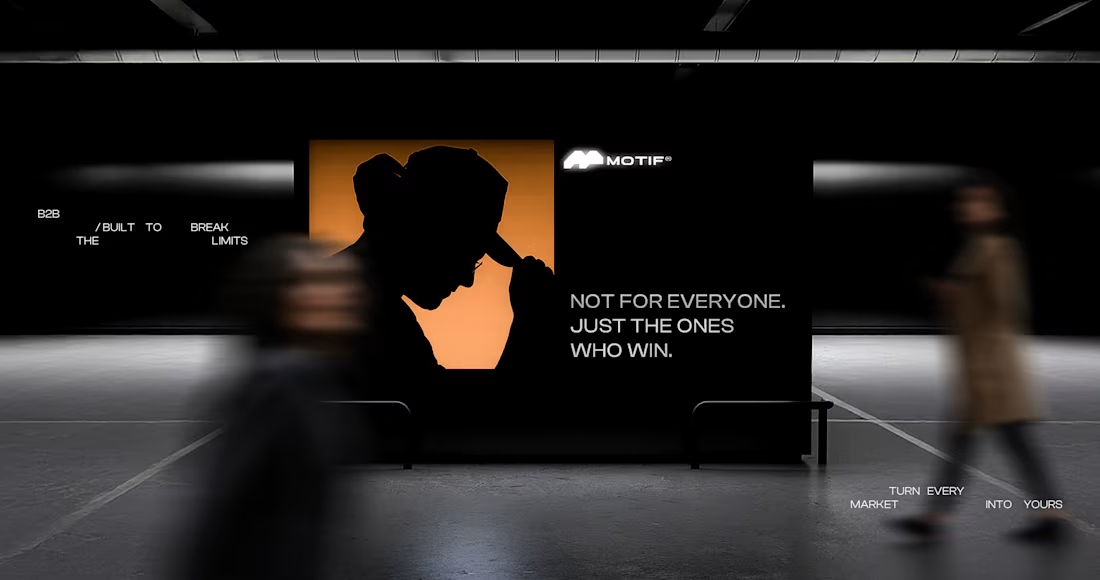
FROM IDENTITY TO PURCHASE
One creative direction across your brand, store and launch.
Overview
Your brand should not become a different company every time someone moves from Instagram to your website, from a product page to an ad, or from desire to checkout.
I connect the whole experience.
This engagement brings brand strategy, identity, creative direction and ecommerce together under one idea, so what makes the brand worth noticing is also what makes it easier to understand, want and buy.
It is designed for consumer brands that are launching, repositioning, or have simply outgrown the identity and store they started with.
I lead the strategy and creative direction personally. My team at MOTIF carries that direction through design, Shopify or BigCommerce and implementation, so the thinking does not get lost between the deck and the finished experience.
What we solve
This is a good fit when:
Your products have become better than the brand around them.
The identity looks fine individually, but nothing feels unmistakably yours.
Your campaigns look stronger than your website.
Your website works, but feels like a dressed-up Shopify theme.
Your messaging, design, product presentation and advertising feel disconnected.
Customers have to work too hard to understand why they should choose you.
You are launching a new brand and want to build the commercial experience properly from the beginning.
Or you are tired of coordinating a strategist, designer, developer and marketer who are all solving different versions of the same problem.
What’s included
01. Direction
We begin with the business before touching the visuals.
Brand and business diagnosis
Customer and buying-context review
Category and competitor review
Current brand and storefront assessment
Positioning direction
Value proposition
Commercial priorities
Brand opportunity
Key customer objections and decision drivers
Strategic direction for the transformation
The objective is to establish what the brand needs to mean before deciding what it should look like.
02. Brand
We turn the direction into a brand system people can recognize.
Creative direction
Two initial creative territories
Visual identity system
Logo refinement or redesign where required
Typography system
Colour system
Graphic language
Composition principles
Photography and product-image direction
Art direction
Core messaging
Verbal direction
Brand application examples
We also define your Recognition System:
The repeatable visual and verbal behaviours customers should see often enough that the brand becomes recognizable without needing the logo.
That can include:
Typography behaviour
Composition
Photography
Colour behaviour
Product framing
Language patterns
Graphic devices
Motion direction
The objective is not another guideline PDF nobody opens.
It is a usable identity people can actually recognize.
03. Commerce
Then we take that brand into the buying experience.
Depending on the platform and agreed scope:
Ecommerce creative direction
Information architecture
Navigation
Homepage
Collection experience
Product page system
Product storytelling
Cart experience
Mobile experience
Core supporting page direction
Design system
Responsive behaviour
Shopify or BigCommerce implementation
Every major page has two jobs:
Make the brand feel more distinct.
Make the buying decision easier.
Neither should come at the expense of the other.
04. Product & Conversion
We look beyond page design into how the products are actually being sold.
Product hierarchy
Merchandising direction
Product value hierarchy
Trust architecture
Education modules
Comparison modules where relevant
Product bundles
Upsell and cross-sell direction
Offer presentation
Customer-objection handling
Conversion hypotheses
CRO priorities
I am not interested in making something beautiful that quietly hurts the business.
The commercial experience matters just as much as the visual one.
05. Implementation
The approved direction is carried into the live commerce experience within the agreed technical scope.
This can include:
Shopify theme development or customization
BigCommerce implementation where agreed
Responsive build
Design-system implementation
Core storefront functionality
Content population within agreed limits
QA
Cross-device review
Launch preparation
Custom applications or unusually complex integrations are scoped separately.
06. Launch
A rebrand or commerce rebuild should not quietly appear on Tuesday morning.
We define how the new world enters the market.
Included:
Launch concept
Launch creative direction
Campaign narrative
Key campaign visual direction
Homepage launch treatment
Social launch direction
Paid-social creative direction
Email launch direction
Channel handoff kit
Full campaign production can be added separately when required.
07. Handoff
At the end of the project, you receive the system behind the work, not just a folder of files.
Brand system
Commerce design system
Final source files
Implementation handoff
Creative usage rules
Recorded walkthrough
Priority CRO opportunities
60-day post-launch measurement plan & optimization
How the project works
Phase 1 — Diagnose
We look at the business, customer, category, current brand, store and commercial friction.
Phase 2 — Decide
I define the strategic and creative direction before we begin producing hundreds of things.
Phase 3 — Build the Brand
We establish the identity, messaging, art direction and Recognition System.
Phase 4 — Build the Store
We translate that direction into the ecommerce experience and buying journey.
Phase 5 — Implement
The approved experience is built, tested and prepared for launch.
Phase 6 — Launch
We give the transformation a proper entrance and define what happens after it goes live.
Timeline
Typical timeline: 8–10 weeks
A normal project runs approximately:
Weeks 1–2
Diagnosis, category, customer and positioning.
Weeks 2–4
Creative direction and identity.
Weeks 4–7
Commerce UX and design.
Weeks 6–8
Development and implementation.
Weeks 9
QA, launch direction and handoff.
Weeks 9-12
Assuming you will run marketing so we will have data to look at how’s actual potential customers and users are behaving on site and based on that we will suggest customer experience optimization, if you approve we will directly implement.
Timing can change depending on technical scope, stakeholder availability and content readiness.
Scope
The $32,000 fixed scope assumes:
One brand
One ecommerce storefront
Shopify or BigCommerce
One agreed core page/template set
Existing product catalog within agreed migration limits
Two initial strategic/creative routes
Two refinement rounds for each major approved phase
Existing standard ecommerce functionality unless otherwise agreed
One primary market/language
The project scope is defined before kickoff so neither side enters an open-ended engagement.
Not included in the base price
These can be added when needed:
Photography production
Video production
Talent
Location and production costs
Large-scale copywriting
Major catalog/data migration
Custom applications
ERP/PIM/custom backend development
Complex third-party integrations
Additional international storefronts
Translation/localisation
Media spend
Ongoing paid-media management
Ongoing CRO
Ongoing email/retention management
If something falls outside the agreed scope, I will flag it before work begins rather than surprise you halfway through the project.
What I need from you
Before kickoff, I’ll need access to the relevant parts of the business, which may include:
Current website/storefront/If not we will create one on behalf of you Either on Shopify or BigCommercex
Analytics (If you’ve)
Existing brand files
Product information
Customer research or reviews
Existing photography/content
Current marketing creative
Relevant performance data
Key competitors
Internal stakeholders
Upcoming launch or commercial priorities
You do not need to arrive with the answers.
Finding the answer is part of the engagement.
Best fit
This project is built primarily for design-led consumer brands in categories such as:
Fashion
Beauty
Jewelry
Wellness
Lifestyle
Consumer goods
Luxury and premium products
DTC and retail brands
It works particularly well for brands with a strong product or story or cause but a disconnected brand, store and marketing experience.
Probably not a fit if
You only need a logo.
You only need a Shopify theme installed.
You already have approved strategy, identity, UX and art direction and simply need production support.
You are looking for the lowest-cost implementation option.
Or the project requires unlimited rounds and continuously changing scope.
There are smaller services on my profile for more focused problems.
Add-ons
Campaign Production
+$5,000–$15,000+
Full execution of the launch world across agreed campaign assets.
Additional Storefront / Market
Scoped separately depending on localization, platform and catalog requirements.
Growth + CRO Continuation
$5,000–$8,000/month
Post-launch creative testing, CRO, paid growth and commercial iteration.
Product Story / Additional PDP Systems
Scoped according to the number and type of products.
FAQs
Starting at$37,000
Duration9 weeks
Tags
BigCommerce

Shopify

Brand Strategist
Creative Director
Paid Marketing Specialist
Beauty
Fashion & Apparel
Marketing
Service provided by
Ash Ome proNew York, USA
- 5.00
- Rating
- 12
- Followers
Brand + Commerce Transformation | Strategy, Identity & Launch Ash Ome
Starting at$37,000
Duration9 weeks
Tags
BigCommerce
Shopify
Brand Strategist
Creative Director
Paid Marketing Specialist
Beauty
Fashion & Apparel
Marketing
FROM IDENTITY TO PURCHASE
One creative direction across your brand, store and launch.
Overview
Your brand should not become a different company every time someone moves from Instagram to your website, from a product page to an ad, or from desire to checkout.
I connect the whole experience.
This engagement brings brand strategy, identity, creative direction and ecommerce together under one idea, so what makes the brand worth noticing is also what makes it easier to understand, want and buy.
It is designed for consumer brands that are launching, repositioning, or have simply outgrown the identity and store they started with.
I lead the strategy and creative direction personally. My team at MOTIF carries that direction through design, Shopify or BigCommerce and implementation, so the thinking does not get lost between the deck and the finished experience.
What we solve
This is a good fit when:
Your products have become better than the brand around them.
The identity looks fine individually, but nothing feels unmistakably yours.
Your campaigns look stronger than your website.
Your website works, but feels like a dressed-up Shopify theme.
Your messaging, design, product presentation and advertising feel disconnected.
Customers have to work too hard to understand why they should choose you.
You are launching a new brand and want to build the commercial experience properly from the beginning.
Or you are tired of coordinating a strategist, designer, developer and marketer who are all solving different versions of the same problem.
What’s included
01. Direction
We begin with the business before touching the visuals.
Brand and business diagnosis
Customer and buying-context review
Category and competitor review
Current brand and storefront assessment
Positioning direction
Value proposition
Commercial priorities
Brand opportunity
Key customer objections and decision drivers
Strategic direction for the transformation
The objective is to establish what the brand needs to mean before deciding what it should look like.
02. Brand
We turn the direction into a brand system people can recognize.
Creative direction
Two initial creative territories
Visual identity system
Logo refinement or redesign where required
Typography system
Colour system
Graphic language
Composition principles
Photography and product-image direction
Art direction
Core messaging
Verbal direction
Brand application examples
We also define your Recognition System:
The repeatable visual and verbal behaviours customers should see often enough that the brand becomes recognizable without needing the logo.
That can include:
Typography behaviour
Composition
Photography
Colour behaviour
Product framing
Language patterns
Graphic devices
Motion direction
The objective is not another guideline PDF nobody opens.
It is a usable identity people can actually recognize.
03. Commerce
Then we take that brand into the buying experience.
Depending on the platform and agreed scope:
Ecommerce creative direction
Information architecture
Navigation
Homepage
Collection experience
Product page system
Product storytelling
Cart experience
Mobile experience
Core supporting page direction
Design system
Responsive behaviour
Shopify or BigCommerce implementation
Every major page has two jobs:
Make the brand feel more distinct.
Make the buying decision easier.
Neither should come at the expense of the other.
04. Product & Conversion
We look beyond page design into how the products are actually being sold.
Product hierarchy
Merchandising direction
Product value hierarchy
Trust architecture
Education modules
Comparison modules where relevant
Product bundles
Upsell and cross-sell direction
Offer presentation
Customer-objection handling
Conversion hypotheses
CRO priorities
I am not interested in making something beautiful that quietly hurts the business.
The commercial experience matters just as much as the visual one.
05. Implementation
The approved direction is carried into the live commerce experience within the agreed technical scope.
This can include:
Shopify theme development or customization
BigCommerce implementation where agreed
Responsive build
Design-system implementation
Core storefront functionality
Content population within agreed limits
QA
Cross-device review
Launch preparation
Custom applications or unusually complex integrations are scoped separately.
06. Launch
A rebrand or commerce rebuild should not quietly appear on Tuesday morning.
We define how the new world enters the market.
Included:
Launch concept
Launch creative direction
Campaign narrative
Key campaign visual direction
Homepage launch treatment
Social launch direction
Paid-social creative direction
Email launch direction
Channel handoff kit
Full campaign production can be added separately when required.
07. Handoff
At the end of the project, you receive the system behind the work, not just a folder of files.
Brand system
Commerce design system
Final source files
Implementation handoff
Creative usage rules
Recorded walkthrough
Priority CRO opportunities
60-day post-launch measurement plan & optimization
How the project works
Phase 1 — Diagnose
We look at the business, customer, category, current brand, store and commercial friction.
Phase 2 — Decide
I define the strategic and creative direction before we begin producing hundreds of things.
Phase 3 — Build the Brand
We establish the identity, messaging, art direction and Recognition System.
Phase 4 — Build the Store
We translate that direction into the ecommerce experience and buying journey.
Phase 5 — Implement
The approved experience is built, tested and prepared for launch.
Phase 6 — Launch
We give the transformation a proper entrance and define what happens after it goes live.
Timeline
Typical timeline: 8–10 weeks
A normal project runs approximately:
Weeks 1–2
Diagnosis, category, customer and positioning.
Weeks 2–4
Creative direction and identity.
Weeks 4–7
Commerce UX and design.
Weeks 6–8
Development and implementation.
Weeks 9
QA, launch direction and handoff.
Weeks 9-12
Assuming you will run marketing so we will have data to look at how’s actual potential customers and users are behaving on site and based on that we will suggest customer experience optimization, if you approve we will directly implement.
Timing can change depending on technical scope, stakeholder availability and content readiness.
Scope
The $32,000 fixed scope assumes:
One brand
One ecommerce storefront
Shopify or BigCommerce
One agreed core page/template set
Existing product catalog within agreed migration limits
Two initial strategic/creative routes
Two refinement rounds for each major approved phase
Existing standard ecommerce functionality unless otherwise agreed
One primary market/language
The project scope is defined before kickoff so neither side enters an open-ended engagement.
Not included in the base price
These can be added when needed:
Photography production
Video production
Talent
Location and production costs
Large-scale copywriting
Major catalog/data migration
Custom applications
ERP/PIM/custom backend development
Complex third-party integrations
Additional international storefronts
Translation/localisation
Media spend
Ongoing paid-media management
Ongoing CRO
Ongoing email/retention management
If something falls outside the agreed scope, I will flag it before work begins rather than surprise you halfway through the project.
What I need from you
Before kickoff, I’ll need access to the relevant parts of the business, which may include:
Current website/storefront/If not we will create one on behalf of you Either on Shopify or BigCommercex
Analytics (If you’ve)
Existing brand files
Product information
Customer research or reviews
Existing photography/content
Current marketing creative
Relevant performance data
Key competitors
Internal stakeholders
Upcoming launch or commercial priorities
You do not need to arrive with the answers.
Finding the answer is part of the engagement.
Best fit
This project is built primarily for design-led consumer brands in categories such as:
Fashion
Beauty
Jewelry
Wellness
Lifestyle
Consumer goods
Luxury and premium products
DTC and retail brands
It works particularly well for brands with a strong product or story or cause but a disconnected brand, store and marketing experience.
Probably not a fit if
You only need a logo.
You only need a Shopify theme installed.
You already have approved strategy, identity, UX and art direction and simply need production support.
You are looking for the lowest-cost implementation option.
Or the project requires unlimited rounds and continuously changing scope.
There are smaller services on my profile for more focused problems.
Add-ons
Campaign Production
+$5,000–$15,000+
Full execution of the launch world across agreed campaign assets.
Additional Storefront / Market
Scoped separately depending on localization, platform and catalog requirements.
Growth + CRO Continuation
$5,000–$8,000/month
Post-launch creative testing, CRO, paid growth and commercial iteration.
Product Story / Additional PDP Systems
Scoped according to the number and type of products.
FAQs
$37,000