
AI Automation + Commerce Systems for Consumer BrandsAsh Ome
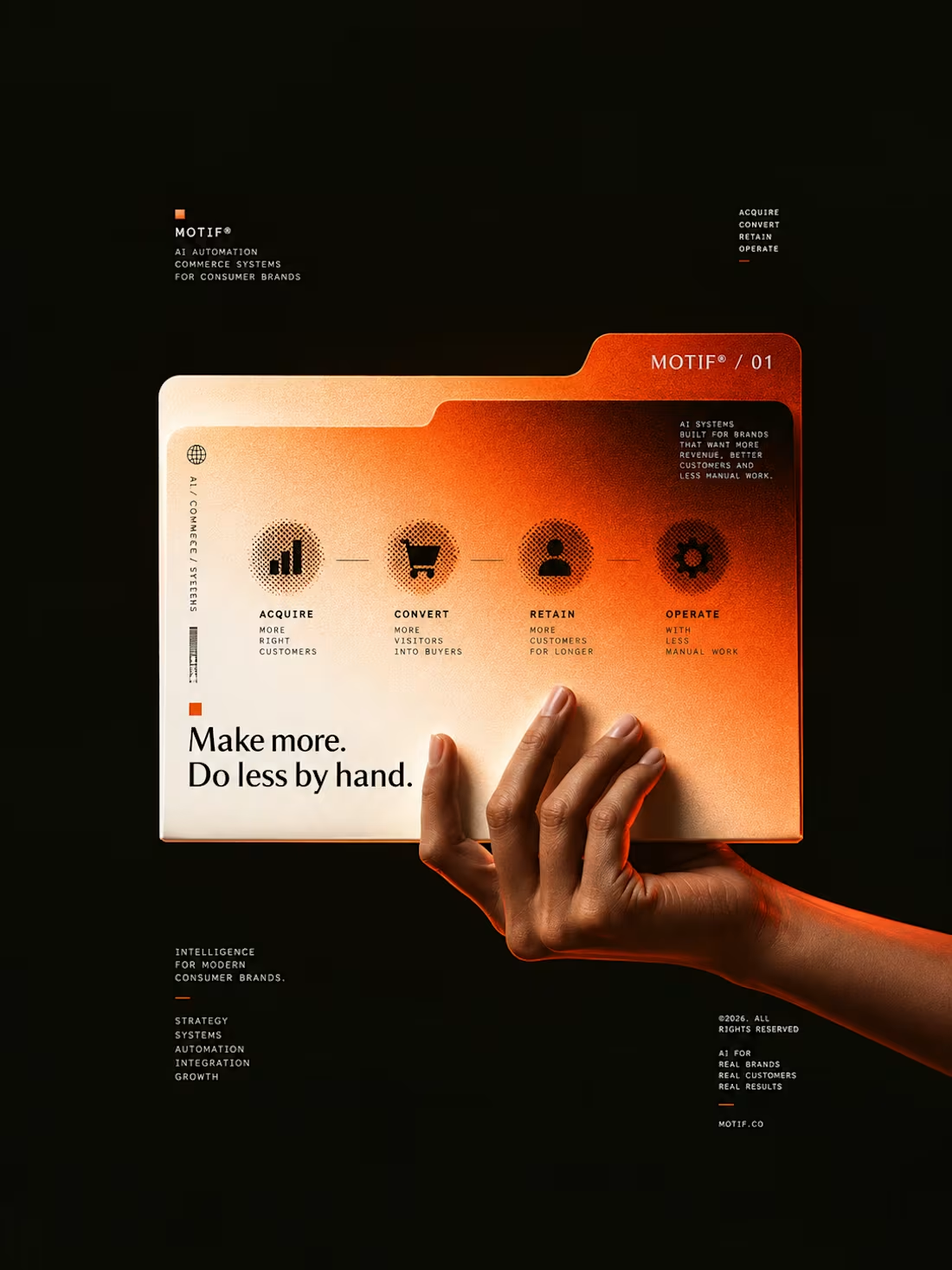
I design and implement AI systems for ecommerce and consumer brands that help increase revenue, improve customer experience and remove repetitive operational work.
From acquisition and merchandising to retention, support, reporting and internal workflows, every system has to create a believable commercial return.
Starting at $12,500
Typical projects: $12,500–$30,000+
Timeline: 4–8 weeks
Optional ongoing optimization: $2,500–$5,000/month
About this service
Most ecommerce brands are adding AI in the wrong places.
Another chatbot.
Another content generator.
Another automation nobody asked for.
I start somewhere else:
Where is the brand losing revenue, customer attention or team time?
Then we decide whether AI can actually improve it.
For consumer brands, the biggest opportunities usually sit across four parts of the business:
ACQUIRE
Bring better customers in.
CONVERT
Help more interested customers buy.
RETAIN
Give customers better reasons to come back.
OPERATE
Remove repetitive work behind the scenes.
The goal is not to make your company “AI-powered.”
The goal is to make the business more profitable, responsive and easier to operate.
The rule
Every system should do at least one of these:
MAKE MONEY
Increase qualified traffic.
Improve conversion opportunities.
Recover abandoned demand.
Improve merchandising.
Increase repeat purchase.
Help the team act faster on customer data.
SAVE TIME
Reduce manual reporting.
Remove repetitive merchandising work.
Reduce support workload.
Automate product and catalog operations.
Speed up creative and marketing workflows.
Connect systems that currently require people to move information manually.
Ideally both.
If an AI system looks impressive but has no credible commercial case, I would rather not build it.
01. ACQUIRE
Use AI to create better demand, not more noise
Possible systems include:
Audience and customer research workflows
Creative research assistants
Competitor monitoring
Ad-performance intelligence
Creative fatigue detection
Customer-review mining
Product-demand signals
Campaign reporting
Automated creative briefs
Influencer/creator prospecting
Partnership research
Wholesale prospecting
Lead enrichment
Campaign opportunity alerts
Example
Instead of your marketing team manually checking Meta, Google, Pinterest, Shopify, reviews and competitors every morning, a system can pull the relevant signals together and show:
What changed.
Why it might matter.
What deserves attention today.
The team still makes the decision.
They just stop spending hours collecting the evidence.
02. CONVERT
Help customers choose faster
This is one of the most interesting areas for consumer brands.
Possible systems include:
AI shopping assistants
Product recommendation systems
Guided product finders
Intelligent search
Product comparison assistants
Pre-purchase support
Personalized product education
Customer-objection handling
Review summarization
Product-fit recommendations
Cross-sell and upsell systems
Cart-recovery workflows
Merchandising support
Personalized landing experiences
The question is:
What does the customer still need to understand before they are comfortable buying?
Then we build around that friction.
For fashion, that might be fit, styling or sizing.
For beauty, it might be product matching, routine building or ingredients.
For wellness, it may be education and product selection.
For jewelry or luxury, it may be trust, comparison, materials and buying confidence.
AI becomes useful when it helps the customer make a better decision.
03. RETAIN
Turn customer data into better repeat purchase
Most brands have more customer information than they know how to use.
Possible systems include:
Customer segmentation
VIP detection
Win-back workflows
Churn-risk detection
Replenishment reminders
Next-product recommendations
Personalized post-purchase communication
Review requests
Referral systems
Loyalty intelligence
Customer-feedback analysis
Support-history analysis
Retention opportunity alerts
Product affinity analysis
Instead of sending the same campaign to everyone, the brand can act differently based on what customers actually bought, asked, returned, liked or ignored.
04. CUSTOMER EXPERIENCE
Faster service without turning the brand into a bad chatbot
Possible systems include:
Customer-service triage
AI support assistants
Order-status assistance
Product-question support
Returns/exchange routing
Support-ticket categorization
Conversation summaries
Escalation logic
Customer sentiment tracking
FAQ intelligence
Support knowledge bases
Agent-assist systems
The objective is not to eliminate people from customer service.
It is to stop people wasting time answering the same predictable questions while making sure complicated or sensitive issues still reach a human.
05. MERCHANDISING + PRODUCT
Use AI where product operations become repetitive
Possible systems include:
Product-data enrichment
Product-description workflows
Attribute cleanup
Product tagging
Collection logic
Merchandising assistance
Search synonym generation
Review-to-product insight
Catalog QA
Product-launch workflows
Product image/content coordination
Recommendation logic
Inventory-based merchandising alerts
For brands with large catalogs, this can remove a surprising amount of repetitive work.
06. MARKETING + CREATIVE OPERATIONS
This is where my background becomes especially useful.
Possible systems include:
Creative-performance reporting
Winning-angle detection
Customer-language mining
Review-to-creative workflows
Creative briefing
Campaign summaries
Editorial/content research
Competitor monitoring
UGC categorization
Influencer-content analysis
Campaign knowledge bases
Automated reporting
Creative asset organization
Performance-to-creative feedback loops
The goal is not AI-generated creative for the sake of volume.
The goal is helping the creative and growth teams make better decisions faster.
07. COMMERCE OPERATIONS
Remove the work nobody should still be doing manually
Potential systems include:
Shopify reporting
Daily business summaries
Order anomaly alerts
Inventory alerts
Returns analysis
Refund trend analysis
Margin reporting
Product-performance summaries
Customer-service reporting
Forecasting support
Vendor workflows
Catalog operations
Data synchronization
Operations dashboards
Internal knowledge assistants
SOP assistants
Cross-team handoffs
If a person spends hours every week copying data between Shopify, spreadsheets, ads platforms, email tools and Slack, that is usually a good place to investigate.
Platforms we can work around
Depending on your stack:
Shopify
Shopify Plus
BigCommerce
Klaviyo
Meta
Google Ads
GA4
Pinterest
TikTok
Gorgias
Zendesk
Recharge
Yotpo
Attentive
HubSpot
Salesforce
Google Workspace
Slack
Airtable
Notion
n8n
Make
Zapier
OpenAI
Claude
APIs
Custom applications
The stack follows the problem.
Not the other way around.
How the project works
Phase 1 — Find the money and time
We audit the commerce business across:
Acquisition
Storefront
Products
Customer journey
Retention
Support
Marketing operations
Merchandising
Reporting
Internal operations
Then we identify where the business is losing:
Money
Time
Customer attention
Information
Phase 2 — Build the opportunity map
Every AI opportunity is scored against:
Revenue potential
Can it realistically increase or recover revenue?
Time saved
Does it remove meaningful manual work?
Frequency
Does the problem happen every day?
Customer impact
Does it improve or damage the buying experience?
Data readiness
Do we have enough useful information?
Risk
What happens if the system gets something wrong?
Implementation effort
Is the expected return worth the build?
This stops the project becoming a pile of random AI experiments.
Phase 3 — Prioritize
We choose the systems with the strongest business case.
Not everything gets built.
Sometimes the most useful recommendation is:
Do not automate this yet.
That is still a good outcome.
Phase 4 — Architecture
For the selected systems, we define:
Workflow
Inputs
Outputs
Data
AI models
Integrations
Human approvals
Customer-facing behaviour
Failure states
Escalation
Security/access
Measurement
Phase 5 — Build + integrate
The system is implemented around your existing commerce stack wherever possible.
That may include:
AI agents
Automation workflows
APIs
Shopify integrations
Customer-data workflows
Reporting systems
Internal dashboards
Knowledge systems
Custom interfaces
Databases
Webhooks
CRM/lifecycle integrations
Phase 6 — Test
Before deployment, we test:
Accuracy
Edge cases
Bad inputs
Missing data
Customer-facing responses
Human handoffs
Duplicate events
Failure handling
Security/access
Business logic
Cost
Reliability
Phase 7 — Measure
We define the intended commercial impact before launch.
Depending on the system, that might include:
Conversion rate
Revenue recovered
AOV
Repeat purchase
Support cost
Response time
Hours saved
Creative reporting time
Merchandising workload
Retention rate
Customer-service volume
Catalog processing time
Team adoption
If we cannot explain what success looks like, we should not build it.
What you receive
Depending on scope:
Commerce AI audit
Opportunity map
Prioritized roadmap
Business-case estimates
System architecture
Workflow design
AI/automation implementation
Integrations
Custom logic
Testing
Documentation
Team training
Measurement framework
30-day post-launch review
Pricing
AI Commerce System
Starting at $12,500
Best for one meaningful revenue or operational problem.
AI Commerce Infrastructure
$20,000–$30,000+
For multiple connected systems across acquisition, conversion, retention or operations.
Ongoing Optimization
$2,500–$5,000/month
Best fit
Designed specifically for:
Fashion
Beauty
Jewelry
Wellness
Lifestyle
Luxury
DTC brands
Ecommerce brands
Retail + ecommerce brands
Consumer products
Subscription commerce
Every system should increase revenue, protect revenue, improve customer experience or save meaningful time. Otherwise, we don’t build it.
FAQs

Starting at$12,500
Duration5 weeks
Tags
N8N

OpenAI

Voiceflow

Brand Strategist
eCommerce Manager
Beauty
Fashion & Apparel
AI automations
ai consultant
Service provided by
Ash Ome proNew York, USA
- 5.00
- Rating
- 12
- Followers
AI Automation + Commerce Systems for Consumer BrandsAsh Ome
Starting at$12,500
Duration5 weeks
Tags
N8N
OpenAI
Voiceflow
Brand Strategist
eCommerce Manager
Beauty
Fashion & Apparel
AI automations
ai consultant
I design and implement AI systems for ecommerce and consumer brands that help increase revenue, improve customer experience and remove repetitive operational work.
From acquisition and merchandising to retention, support, reporting and internal workflows, every system has to create a believable commercial return.
Starting at $12,500
Typical projects: $12,500–$30,000+
Timeline: 4–8 weeks
Optional ongoing optimization: $2,500–$5,000/month
About this service
Most ecommerce brands are adding AI in the wrong places.
Another chatbot.
Another content generator.
Another automation nobody asked for.
I start somewhere else:
Where is the brand losing revenue, customer attention or team time?
Then we decide whether AI can actually improve it.
For consumer brands, the biggest opportunities usually sit across four parts of the business:
ACQUIRE
Bring better customers in.
CONVERT
Help more interested customers buy.
RETAIN
Give customers better reasons to come back.
OPERATE
Remove repetitive work behind the scenes.
The goal is not to make your company “AI-powered.”
The goal is to make the business more profitable, responsive and easier to operate.
The rule
Every system should do at least one of these:
MAKE MONEY
Increase qualified traffic.
Improve conversion opportunities.
Recover abandoned demand.
Improve merchandising.
Increase repeat purchase.
Help the team act faster on customer data.
SAVE TIME
Reduce manual reporting.
Remove repetitive merchandising work.
Reduce support workload.
Automate product and catalog operations.
Speed up creative and marketing workflows.
Connect systems that currently require people to move information manually.
Ideally both.
If an AI system looks impressive but has no credible commercial case, I would rather not build it.
01. ACQUIRE
Use AI to create better demand, not more noise
Possible systems include:
Audience and customer research workflows
Creative research assistants
Competitor monitoring
Ad-performance intelligence
Creative fatigue detection
Customer-review mining
Product-demand signals
Campaign reporting
Automated creative briefs
Influencer/creator prospecting
Partnership research
Wholesale prospecting
Lead enrichment
Campaign opportunity alerts
Example
Instead of your marketing team manually checking Meta, Google, Pinterest, Shopify, reviews and competitors every morning, a system can pull the relevant signals together and show:
What changed.
Why it might matter.
What deserves attention today.
The team still makes the decision.
They just stop spending hours collecting the evidence.
02. CONVERT
Help customers choose faster
This is one of the most interesting areas for consumer brands.
Possible systems include:
AI shopping assistants
Product recommendation systems
Guided product finders
Intelligent search
Product comparison assistants
Pre-purchase support
Personalized product education
Customer-objection handling
Review summarization
Product-fit recommendations
Cross-sell and upsell systems
Cart-recovery workflows
Merchandising support
Personalized landing experiences
The question is:
What does the customer still need to understand before they are comfortable buying?
Then we build around that friction.
For fashion, that might be fit, styling or sizing.
For beauty, it might be product matching, routine building or ingredients.
For wellness, it may be education and product selection.
For jewelry or luxury, it may be trust, comparison, materials and buying confidence.
AI becomes useful when it helps the customer make a better decision.
03. RETAIN
Turn customer data into better repeat purchase
Most brands have more customer information than they know how to use.
Possible systems include:
Customer segmentation
VIP detection
Win-back workflows
Churn-risk detection
Replenishment reminders
Next-product recommendations
Personalized post-purchase communication
Review requests
Referral systems
Loyalty intelligence
Customer-feedback analysis
Support-history analysis
Retention opportunity alerts
Product affinity analysis
Instead of sending the same campaign to everyone, the brand can act differently based on what customers actually bought, asked, returned, liked or ignored.
04. CUSTOMER EXPERIENCE
Faster service without turning the brand into a bad chatbot
Possible systems include:
Customer-service triage
AI support assistants
Order-status assistance
Product-question support
Returns/exchange routing
Support-ticket categorization
Conversation summaries
Escalation logic
Customer sentiment tracking
FAQ intelligence
Support knowledge bases
Agent-assist systems
The objective is not to eliminate people from customer service.
It is to stop people wasting time answering the same predictable questions while making sure complicated or sensitive issues still reach a human.
05. MERCHANDISING + PRODUCT
Use AI where product operations become repetitive
Possible systems include:
Product-data enrichment
Product-description workflows
Attribute cleanup
Product tagging
Collection logic
Merchandising assistance
Search synonym generation
Review-to-product insight
Catalog QA
Product-launch workflows
Product image/content coordination
Recommendation logic
Inventory-based merchandising alerts
For brands with large catalogs, this can remove a surprising amount of repetitive work.
06. MARKETING + CREATIVE OPERATIONS
This is where my background becomes especially useful.
Possible systems include:
Creative-performance reporting
Winning-angle detection
Customer-language mining
Review-to-creative workflows
Creative briefing
Campaign summaries
Editorial/content research
Competitor monitoring
UGC categorization
Influencer-content analysis
Campaign knowledge bases
Automated reporting
Creative asset organization
Performance-to-creative feedback loops
The goal is not AI-generated creative for the sake of volume.
The goal is helping the creative and growth teams make better decisions faster.
07. COMMERCE OPERATIONS
Remove the work nobody should still be doing manually
Potential systems include:
Shopify reporting
Daily business summaries
Order anomaly alerts
Inventory alerts
Returns analysis
Refund trend analysis
Margin reporting
Product-performance summaries
Customer-service reporting
Forecasting support
Vendor workflows
Catalog operations
Data synchronization
Operations dashboards
Internal knowledge assistants
SOP assistants
Cross-team handoffs
If a person spends hours every week copying data between Shopify, spreadsheets, ads platforms, email tools and Slack, that is usually a good place to investigate.
Platforms we can work around
Depending on your stack:
Shopify
Shopify Plus
BigCommerce
Klaviyo
Meta
Google Ads
GA4
Pinterest
TikTok
Gorgias
Zendesk
Recharge
Yotpo
Attentive
HubSpot
Salesforce
Google Workspace
Slack
Airtable
Notion
n8n
Make
Zapier
OpenAI
Claude
APIs
Custom applications
The stack follows the problem.
Not the other way around.
How the project works
Phase 1 — Find the money and time
We audit the commerce business across:
Acquisition
Storefront
Products
Customer journey
Retention
Support
Marketing operations
Merchandising
Reporting
Internal operations
Then we identify where the business is losing:
Money
Time
Customer attention
Information
Phase 2 — Build the opportunity map
Every AI opportunity is scored against:
Revenue potential
Can it realistically increase or recover revenue?
Time saved
Does it remove meaningful manual work?
Frequency
Does the problem happen every day?
Customer impact
Does it improve or damage the buying experience?
Data readiness
Do we have enough useful information?
Risk
What happens if the system gets something wrong?
Implementation effort
Is the expected return worth the build?
This stops the project becoming a pile of random AI experiments.
Phase 3 — Prioritize
We choose the systems with the strongest business case.
Not everything gets built.
Sometimes the most useful recommendation is:
Do not automate this yet.
That is still a good outcome.
Phase 4 — Architecture
For the selected systems, we define:
Workflow
Inputs
Outputs
Data
AI models
Integrations
Human approvals
Customer-facing behaviour
Failure states
Escalation
Security/access
Measurement
Phase 5 — Build + integrate
The system is implemented around your existing commerce stack wherever possible.
That may include:
AI agents
Automation workflows
APIs
Shopify integrations
Customer-data workflows
Reporting systems
Internal dashboards
Knowledge systems
Custom interfaces
Databases
Webhooks
CRM/lifecycle integrations
Phase 6 — Test
Before deployment, we test:
Accuracy
Edge cases
Bad inputs
Missing data
Customer-facing responses
Human handoffs
Duplicate events
Failure handling
Security/access
Business logic
Cost
Reliability
Phase 7 — Measure
We define the intended commercial impact before launch.
Depending on the system, that might include:
Conversion rate
Revenue recovered
AOV
Repeat purchase
Support cost
Response time
Hours saved
Creative reporting time
Merchandising workload
Retention rate
Customer-service volume
Catalog processing time
Team adoption
If we cannot explain what success looks like, we should not build it.
What you receive
Depending on scope:
Commerce AI audit
Opportunity map
Prioritized roadmap
Business-case estimates
System architecture
Workflow design
AI/automation implementation
Integrations
Custom logic
Testing
Documentation
Team training
Measurement framework
30-day post-launch review
Pricing
AI Commerce System
Starting at $12,500
Best for one meaningful revenue or operational problem.
AI Commerce Infrastructure
$20,000–$30,000+
For multiple connected systems across acquisition, conversion, retention or operations.
Ongoing Optimization
$2,500–$5,000/month
Best fit
Designed specifically for:
Fashion
Beauty
Jewelry
Wellness
Lifestyle
Luxury
DTC brands
Ecommerce brands
Retail + ecommerce brands
Consumer products
Subscription commerce
Every system should increase revenue, protect revenue, improve customer experience or save meaningful time. Otherwise, we don’t build it.
FAQs
$12,500