
60-Minute Product Documentation Triage CallSridhar Rayasam
What you get
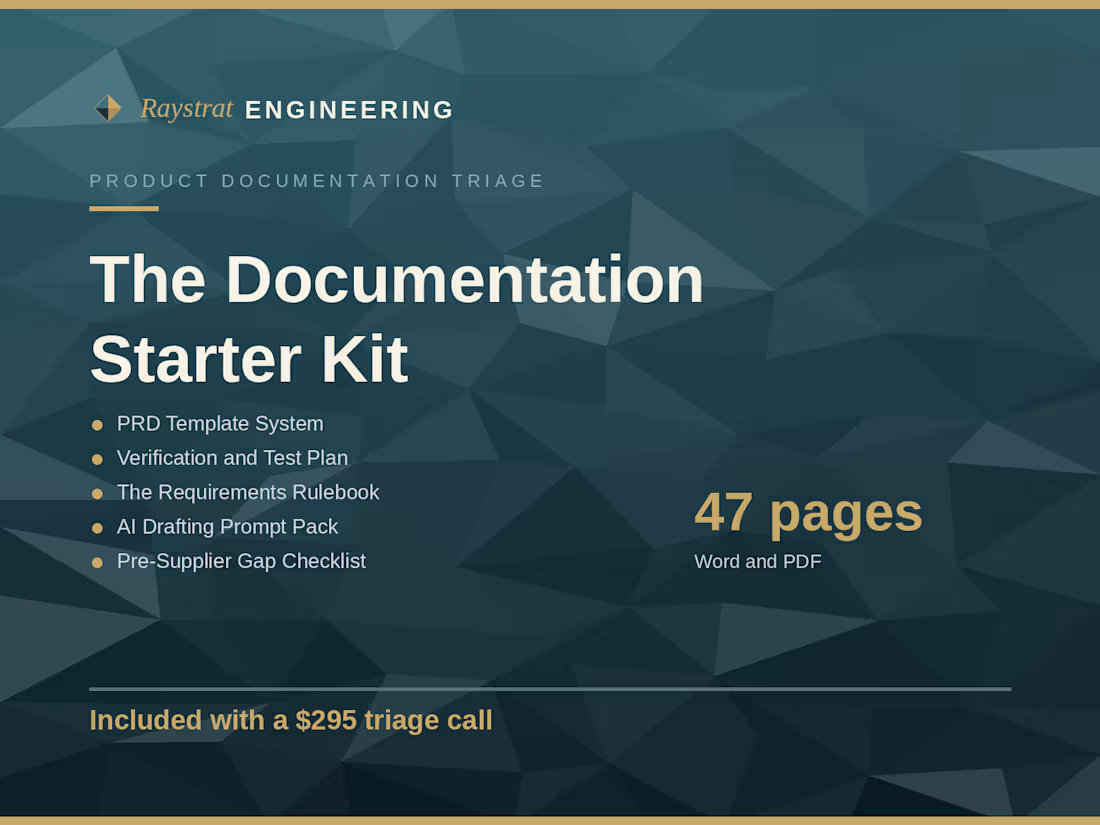
The Documentation Starter Kit, in your inbox the moment you book
Five templates I use on paid engagements, in Word and PDF:
PRD Template System. A twelve-section product requirements document with worked examples, a requirement ID convention, a separate assumptions register for anything that cannot be tested, and an open-decisions register. Ten pages.
Verification and Test Plan Template. Verification matrix, test procedure blocks written so a technician can run them unaided, results tables, a deviations register, and the coverage and residual risk section most reports leave out. Ten pages.
The Requirements Rulebook. Twenty requirements that cost somebody money, each with the rewrite that would not have, why the original failed, and what it actually cost. Hardware, firmware and software. Ten pages.
AI Drafting Prompt Pack. Ten working prompts that turn engineering conversation into structured drafts, plus the guardrails that stop a model inventing a requirement nobody stated, and five places this approach fails. Nine pages.
Pre-Supplier Gap Checklist. Thirty questions to run on your own document before it goes to a supplier, a customer or an auditor, with a scoring band and what to do at each one. Eight pages.
Contra's own guidance to buyers puts a commissioned SOP at $500 to $2,500 and a basic guide at $1,000 to $5,000. Forty-seven pages of production templates at $997 is a conservative number against that. You keep the kit either way, including if you take the refund below.
A 60-minute working session
We go through your actual documentation: the spec, the PRD, the test plan, the handover doc nobody ever wrote. I ask the questions your team has stopped asking. There is no slide deck and no discovery questionnaire.
A written gap note within 24 hours
What I heard, the three gaps I would close first, and what each one costs you if you leave it. You own the document. It reads without me in the room, so you can send it straight to your team, your supplier or your investor.
A recommended next move
What your documentation needs next, whether that is a rewrite, a template, a decision nobody has made, or nothing at all. If the answer is "you do not need me," I will say that on the call.
My guarantee
If the call and the note do not surface at least three specific gaps worth fixing, I refund the $295 and you keep the kit.
Who this is for
Founders, product leads and engineering managers whose documentation has become the bottleneck. You know something is wrong. You are not sure whether it is the spec, the process, the tool, or a decision nobody has made.
Why me
I spent my career in electronics and semiconductors, where a badly written requirement does not get fixed in the next sprint. It becomes a tooling change or a failed certification. That background makes me fast at spotting the sentence in your document that is going to cost somebody money.
I bring the same standard to software and product documentation. In software the ambiguity surfaces at the next release. In hardware it surfaces after tooling.
Process
You book. The kit arrives straight away.
Send me whatever exists: a spec, a PRD, a Notion page, a voice note. If nothing is written down, book anyway and we start from the conversation.
I review before the call, so we do not spend the hour on context.
We talk for 60 minutes.
The written gap note reaches you within 24 hours.
What I need from you
A calendar slot overlapping IST business hours, or early and late by arrangement.
Whatever material you can share, ideally 24 hours ahead.
Availability
Four of these a month. I write every note myself and I have other engagements running.
FAQs
Starting at$295
Duration1 week
Tags
Consultant
Product Manager
Product Strategist
Program Manager
Technical Writer
Documentation Specialist
Technical Project Manager,
Service provided by
Sridhar Rayasam proBengaluru, India
60-Minute Product Documentation Triage CallSridhar Rayasam
Starting at$295
Duration1 week
Tags
Consultant
Product Manager
Product Strategist
Program Manager
Technical Writer
Documentation Specialist
Technical Project Manager,
What you get
The Documentation Starter Kit, in your inbox the moment you book
Five templates I use on paid engagements, in Word and PDF:
PRD Template System. A twelve-section product requirements document with worked examples, a requirement ID convention, a separate assumptions register for anything that cannot be tested, and an open-decisions register. Ten pages.
Verification and Test Plan Template. Verification matrix, test procedure blocks written so a technician can run them unaided, results tables, a deviations register, and the coverage and residual risk section most reports leave out. Ten pages.
The Requirements Rulebook. Twenty requirements that cost somebody money, each with the rewrite that would not have, why the original failed, and what it actually cost. Hardware, firmware and software. Ten pages.
AI Drafting Prompt Pack. Ten working prompts that turn engineering conversation into structured drafts, plus the guardrails that stop a model inventing a requirement nobody stated, and five places this approach fails. Nine pages.
Pre-Supplier Gap Checklist. Thirty questions to run on your own document before it goes to a supplier, a customer or an auditor, with a scoring band and what to do at each one. Eight pages.
Contra's own guidance to buyers puts a commissioned SOP at $500 to $2,500 and a basic guide at $1,000 to $5,000. Forty-seven pages of production templates at $997 is a conservative number against that. You keep the kit either way, including if you take the refund below.
A 60-minute working session
We go through your actual documentation: the spec, the PRD, the test plan, the handover doc nobody ever wrote. I ask the questions your team has stopped asking. There is no slide deck and no discovery questionnaire.
A written gap note within 24 hours
What I heard, the three gaps I would close first, and what each one costs you if you leave it. You own the document. It reads without me in the room, so you can send it straight to your team, your supplier or your investor.
A recommended next move
What your documentation needs next, whether that is a rewrite, a template, a decision nobody has made, or nothing at all. If the answer is "you do not need me," I will say that on the call.
My guarantee
If the call and the note do not surface at least three specific gaps worth fixing, I refund the $295 and you keep the kit.
Who this is for
Founders, product leads and engineering managers whose documentation has become the bottleneck. You know something is wrong. You are not sure whether it is the spec, the process, the tool, or a decision nobody has made.
Why me
I spent my career in electronics and semiconductors, where a badly written requirement does not get fixed in the next sprint. It becomes a tooling change or a failed certification. That background makes me fast at spotting the sentence in your document that is going to cost somebody money.
I bring the same standard to software and product documentation. In software the ambiguity surfaces at the next release. In hardware it surfaces after tooling.
Process
You book. The kit arrives straight away.
Send me whatever exists: a spec, a PRD, a Notion page, a voice note. If nothing is written down, book anyway and we start from the conversation.
I review before the call, so we do not spend the hour on context.
We talk for 60 minutes.
The written gap note reaches you within 24 hours.
What I need from you
A calendar slot overlapping IST business hours, or early and late by arrangement.
Whatever material you can share, ideally 24 hours ahead.
Availability
Four of these a month. I write every note myself and I have other engagements running.
FAQs
$295