
AI workflow audit — where to automate, and where not toSebastián Balderas Espinosa
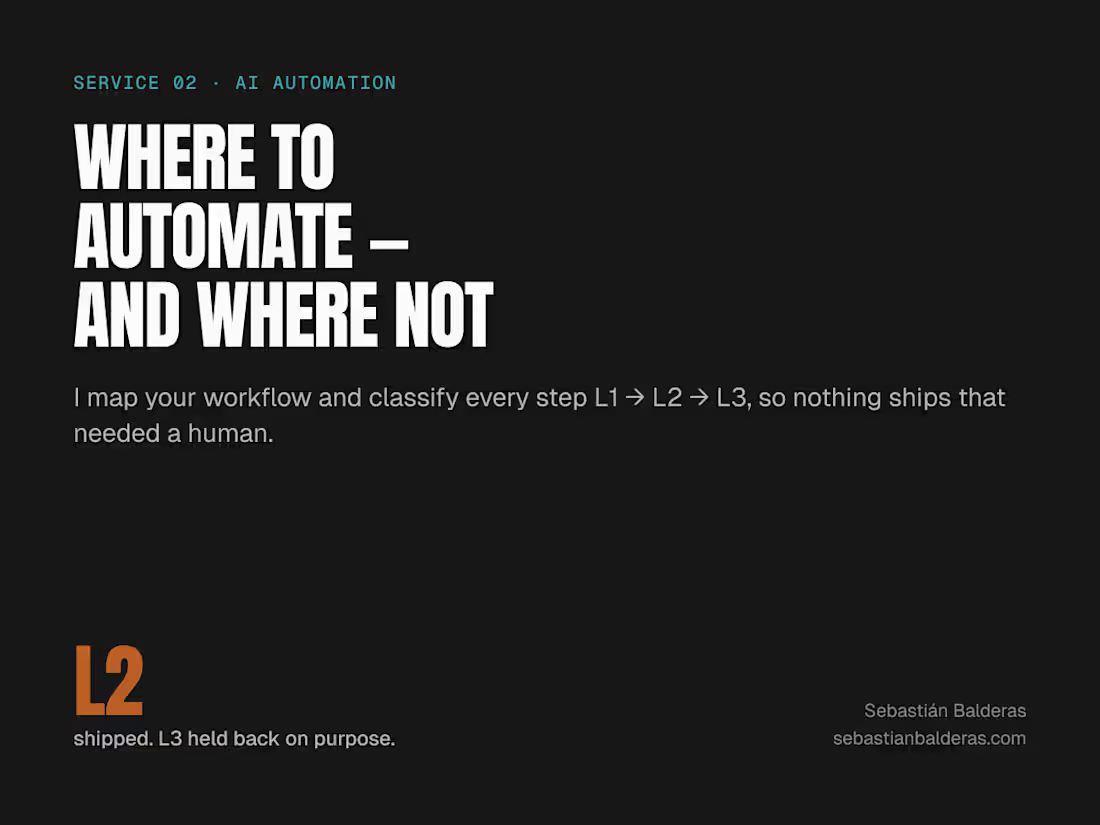
Most AI projects fail at the same place: someone automated a decision that needed a human, or left a human doing work a fixed rule could have handled.
I map your workflow — states, roles, permissions, business rules — and sequence AI adoption with a three-tier maturity framework. Tier 1 is fixed-rule automation, no reasoning. Tier 2 is an agent making bounded decisions inside a step. Tier 3 is adaptive loops, and it usually shouldn't ship yet.
On Strata I shipped Tier 2 into production where the decision surface was narrow enough to trust, and designed Tier 3 deliberately held back until audit trails and permission scopes could remove human review safely. Knowing where not to put AI is half the job.
What you get:
· Full workflow map with states, roles and permissions
· Every step classified L1 / L2 / L3, with the reasoning written down
· What ships now, what waits, and what has to exist before it can
· The audit-trail and permission requirements to move a step up a tier
· A model-selection note: which steps need a frontier model and which don't, so inference cost stays predictable
FAQs
Example work

Starting at$2,400
Duration2 weeks
Tags
Claude

Figma

N8N

AI Automation
Product Strategist
UX Engineer
Service provided by
Sebastián Balderas Espinosa Puebla, Mexico
AI workflow audit — where to automate, and where not toSebastián Balderas Espinosa
Starting at$2,400
Duration2 weeks
Tags
Claude
Figma
N8N
AI Automation
Product Strategist
UX Engineer
Most AI projects fail at the same place: someone automated a decision that needed a human, or left a human doing work a fixed rule could have handled.
I map your workflow — states, roles, permissions, business rules — and sequence AI adoption with a three-tier maturity framework. Tier 1 is fixed-rule automation, no reasoning. Tier 2 is an agent making bounded decisions inside a step. Tier 3 is adaptive loops, and it usually shouldn't ship yet.
On Strata I shipped Tier 2 into production where the decision surface was narrow enough to trust, and designed Tier 3 deliberately held back until audit trails and permission scopes could remove human review safely. Knowing where not to put AI is half the job.
What you get:
· Full workflow map with states, roles and permissions
· Every step classified L1 / L2 / L3, with the reasoning written down
· What ships now, what waits, and what has to exist before it can
· The audit-trail and permission requirements to move a step up a tier
· A model-selection note: which steps need a frontier model and which don't, so inference cost stays predictable
FAQs
Example work
$2,400