AI That Knows Your Business- RAG Knowledge SystemPATHAKHRK INC
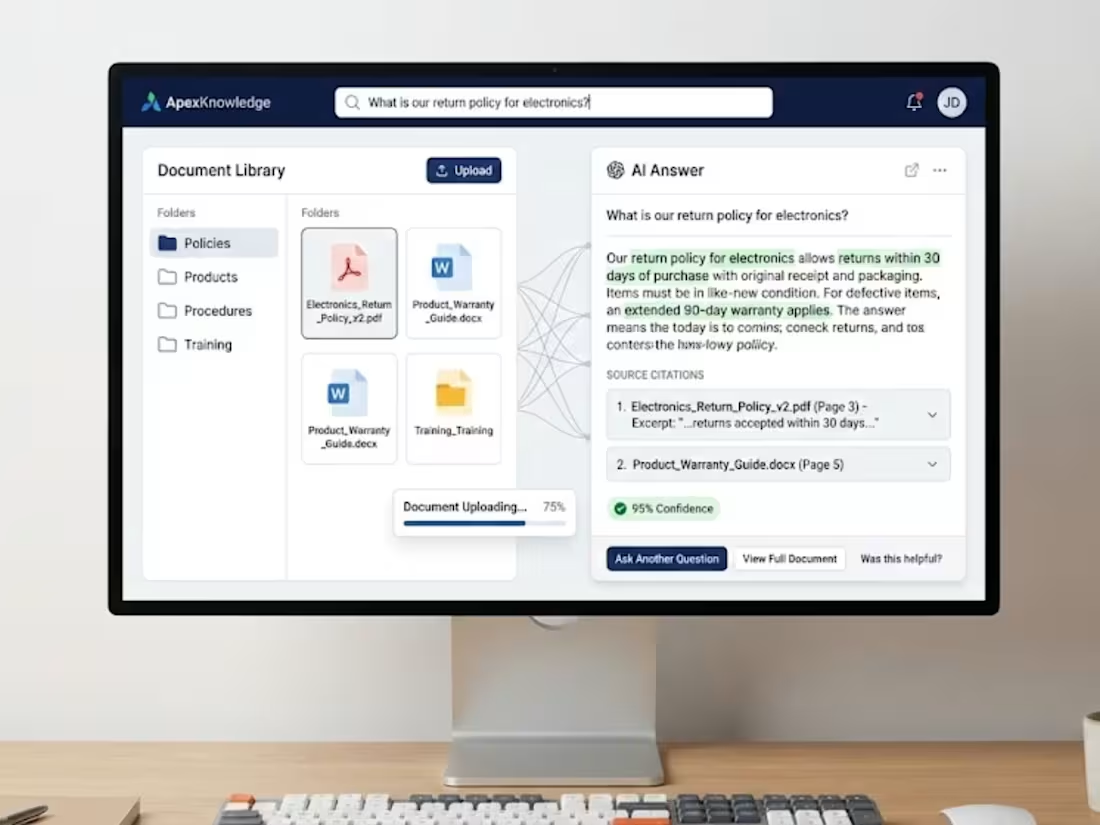
I'll build you a RAG-powered AI knowledge system that actually understands your business by learning from your documentation, policies, product specs, and internal resources—then answers questions with accurate, cited information instead of making things up or giving generic responses. Your team, customers, or whoever needs access gets instant, reliable answers to complex questions by querying your entire knowledge base conversationally, with every response traceable back to source documents for verification. This is for businesses tired of AI hallucinations who need an intelligent system grounded in their actual company knowledge that they can trust and verify.
What's included
Custom RAG Knowledge System Architecture
Complete Retrieval-Augmented Generation system designed specifically for your business documentation. This is the foundation that makes your AI actually know your business instead of making educated guesses. I'll engineer the architecture for ingesting your documents, breaking them into optimal chunks, generating embeddings, storing them efficiently, and retrieving the most relevant information when questions are asked. You get an AI that references your actual policies, products, and procedures—not generic internet knowledge.
Document Processing & Ingestion Pipeline
Automated pipeline that takes your business documents and makes them AI-searchable. Upload PDFs, Word docs, text files, HTML pages, or spreadsheets, and the system automatically processes them—extracting text, chunking intelligently (not just every 500 words, but based on semantic meaning), generating vector embeddings, and indexing for lightning-fast retrieval. The pipeline handles various document formats, preserves important structure, and updates the knowledge base as you add new content.
Intelligent Vector Database Setup
High-performance vector database configured specifically for your knowledge retrieval needs. This isn't just storage—it's the smart search engine that finds relevant information from thousands of document chunks in milliseconds. The database uses semantic similarity (understanding meaning, not just keywords) to retrieve the most relevant context for any question. Whether someone asks about "refund policies" or "getting my money back," the system understands they're related and finds the right information.
Context-Aware Answer Generation
AI response system that combines retrieved knowledge with natural language generation to produce accurate, helpful answers. When someone asks a question, the system retrieves the 3-5 most relevant document chunks, synthesizes them intelligently, and generates a clear answer grounded in your actual documentation. It's not just copying text—it's understanding your documents and explaining them conversationally while staying factually accurate to the source material.
Source Citation & Verification System
Every answer includes citations showing where the information came from in your documents. Users see "According to your Returns Policy (page 3)..." or "Based on the Product Manual section 2.4..." This transparency builds trust, allows verification, and helps identify when documentation might be outdated or incomplete. You can trace every AI response back to its source material, ensuring accountability and accuracy.
Web-Based Query Interface
Clean, intuitive web interface where users ask questions and get answers from your knowledge base. The interface is simple—type your question, get a clear response with sources, refine your question if needed. Works beautifully on desktop and mobile. Users don't need training—if they can use a search engine, they can use this. Behind the scenes, the complex RAG system does its magic, but users just see helpful answers instantly.
Multi-Document Knowledge Integration
The system doesn't treat each document in isolation—it understands relationships across your knowledge base. If product specifications are in one document, pricing in another, and policies in a third, the AI can synthesize information across all three to answer comprehensive questions. "What's the warranty on Product X and how do returns work?" gets answered using multiple document sources seamlessly.
Admin Dashboard for Knowledge Management
User-friendly admin panel where you manage your knowledge base without touching code. Upload new documents, delete outdated ones, view what's currently in the system, see which documents are being referenced most, and monitor query patterns. You can update your AI's knowledge by simply uploading files—no developer needed. The system processes updates automatically and makes new information available immediately.
Confidence Scoring & "I Don't Know" Intelligence
The system knows when it doesn't have enough information to answer confidently. Instead of making something up or giving a vague response, it explicitly says "I don't have information about that in the knowledge base" and can suggest alternative resources or human contact. Confidence scores show how certain the AI is about each answer, helping users understand when they should verify information or ask follow-up questions.
Query Analytics & Insights
Dashboard showing what people are asking, which documents are most useful, what topics have no good answers, and where your knowledge base has gaps. This intelligence helps you identify frequently asked questions, spot outdated documentation, understand what's confusing users, and prioritize content creation. Your knowledge base evolves based on real usage patterns, getting more valuable over time.
Search Optimization & Relevance Tuning
Fine-tuned retrieval that returns the most helpful information for your specific domain. Generic RAG systems treat all content equally; this system is calibrated for your business—understanding which document types are more authoritative, which sections contain key policies, and which information is most likely relevant to common queries. Retrieval accuracy is optimized through testing and feedback until it's finding the right content consistently.
Version Control & Document History
When you update documents, the system maintains version history so you can see what changed and when. If you discover the AI is referencing outdated information, you can check what version is in the system and update it. This is crucial for businesses where policies, products, or procedures evolve regularly. You have full visibility and control over what knowledge the AI is using.
Security & Access Control
Proper security for your business information. All documents are encrypted at rest, access is controlled through authentication, and you can set permissions for who can query the system, upload documents, or manage the knowledge base. If you have sensitive internal documentation, it's protected appropriately. The system complies with data privacy requirements and can be deployed behind your firewall if needed.
API Access for Integration
RESTful API that lets you integrate the RAG system with other applications. Want to embed it in your website? Add it to your internal tools? Build a Slack bot that queries company knowledge? The API makes that possible. Comprehensive documentation shows developers exactly how to query the system, retrieve sources, and handle responses. Your RAG system becomes intelligent infrastructure powering multiple touchpoints.
45-Day Training & Optimization Period
6 weeks after launch where we actively improve the system based on real usage. I'll monitor which queries are working well, identify questions that aren't getting good answers, tune the retrieval to improve relevance, help you fill knowledge gaps we discover, and train your team on best practices for maintaining the knowledge base. We'll refine it together until it's consistently delivering excellent answers to your users' actual questions.
FAQs
Example work
Starting at$6,000
Duration3 weeks
Tags
FastAPI

LangChain
MongoDB

OpenAI

Python

AI Chatbot Developer
ML Engineer
Prompt Writer
Service provided by
PATHAKHRK INC Kangra, India
- 2
- Followers
AI That Knows Your Business- RAG Knowledge SystemPATHAKHRK INC
Starting at$6,000
Duration3 weeks
Tags
FastAPI
LangChain
MongoDB
OpenAI
Python
AI Chatbot Developer
ML Engineer
Prompt Writer
I'll build you a RAG-powered AI knowledge system that actually understands your business by learning from your documentation, policies, product specs, and internal resources—then answers questions with accurate, cited information instead of making things up or giving generic responses. Your team, customers, or whoever needs access gets instant, reliable answers to complex questions by querying your entire knowledge base conversationally, with every response traceable back to source documents for verification. This is for businesses tired of AI hallucinations who need an intelligent system grounded in their actual company knowledge that they can trust and verify.
What's included
Custom RAG Knowledge System Architecture
Complete Retrieval-Augmented Generation system designed specifically for your business documentation. This is the foundation that makes your AI actually know your business instead of making educated guesses. I'll engineer the architecture for ingesting your documents, breaking them into optimal chunks, generating embeddings, storing them efficiently, and retrieving the most relevant information when questions are asked. You get an AI that references your actual policies, products, and procedures—not generic internet knowledge.
Document Processing & Ingestion Pipeline
Automated pipeline that takes your business documents and makes them AI-searchable. Upload PDFs, Word docs, text files, HTML pages, or spreadsheets, and the system automatically processes them—extracting text, chunking intelligently (not just every 500 words, but based on semantic meaning), generating vector embeddings, and indexing for lightning-fast retrieval. The pipeline handles various document formats, preserves important structure, and updates the knowledge base as you add new content.
Intelligent Vector Database Setup
High-performance vector database configured specifically for your knowledge retrieval needs. This isn't just storage—it's the smart search engine that finds relevant information from thousands of document chunks in milliseconds. The database uses semantic similarity (understanding meaning, not just keywords) to retrieve the most relevant context for any question. Whether someone asks about "refund policies" or "getting my money back," the system understands they're related and finds the right information.
Context-Aware Answer Generation
AI response system that combines retrieved knowledge with natural language generation to produce accurate, helpful answers. When someone asks a question, the system retrieves the 3-5 most relevant document chunks, synthesizes them intelligently, and generates a clear answer grounded in your actual documentation. It's not just copying text—it's understanding your documents and explaining them conversationally while staying factually accurate to the source material.
Source Citation & Verification System
Every answer includes citations showing where the information came from in your documents. Users see "According to your Returns Policy (page 3)..." or "Based on the Product Manual section 2.4..." This transparency builds trust, allows verification, and helps identify when documentation might be outdated or incomplete. You can trace every AI response back to its source material, ensuring accountability and accuracy.
Web-Based Query Interface
Clean, intuitive web interface where users ask questions and get answers from your knowledge base. The interface is simple—type your question, get a clear response with sources, refine your question if needed. Works beautifully on desktop and mobile. Users don't need training—if they can use a search engine, they can use this. Behind the scenes, the complex RAG system does its magic, but users just see helpful answers instantly.
Multi-Document Knowledge Integration
The system doesn't treat each document in isolation—it understands relationships across your knowledge base. If product specifications are in one document, pricing in another, and policies in a third, the AI can synthesize information across all three to answer comprehensive questions. "What's the warranty on Product X and how do returns work?" gets answered using multiple document sources seamlessly.
Admin Dashboard for Knowledge Management
User-friendly admin panel where you manage your knowledge base without touching code. Upload new documents, delete outdated ones, view what's currently in the system, see which documents are being referenced most, and monitor query patterns. You can update your AI's knowledge by simply uploading files—no developer needed. The system processes updates automatically and makes new information available immediately.
Confidence Scoring & "I Don't Know" Intelligence
The system knows when it doesn't have enough information to answer confidently. Instead of making something up or giving a vague response, it explicitly says "I don't have information about that in the knowledge base" and can suggest alternative resources or human contact. Confidence scores show how certain the AI is about each answer, helping users understand when they should verify information or ask follow-up questions.
Query Analytics & Insights
Dashboard showing what people are asking, which documents are most useful, what topics have no good answers, and where your knowledge base has gaps. This intelligence helps you identify frequently asked questions, spot outdated documentation, understand what's confusing users, and prioritize content creation. Your knowledge base evolves based on real usage patterns, getting more valuable over time.
Search Optimization & Relevance Tuning
Fine-tuned retrieval that returns the most helpful information for your specific domain. Generic RAG systems treat all content equally; this system is calibrated for your business—understanding which document types are more authoritative, which sections contain key policies, and which information is most likely relevant to common queries. Retrieval accuracy is optimized through testing and feedback until it's finding the right content consistently.
Version Control & Document History
When you update documents, the system maintains version history so you can see what changed and when. If you discover the AI is referencing outdated information, you can check what version is in the system and update it. This is crucial for businesses where policies, products, or procedures evolve regularly. You have full visibility and control over what knowledge the AI is using.
Security & Access Control
Proper security for your business information. All documents are encrypted at rest, access is controlled through authentication, and you can set permissions for who can query the system, upload documents, or manage the knowledge base. If you have sensitive internal documentation, it's protected appropriately. The system complies with data privacy requirements and can be deployed behind your firewall if needed.
API Access for Integration
RESTful API that lets you integrate the RAG system with other applications. Want to embed it in your website? Add it to your internal tools? Build a Slack bot that queries company knowledge? The API makes that possible. Comprehensive documentation shows developers exactly how to query the system, retrieve sources, and handle responses. Your RAG system becomes intelligent infrastructure powering multiple touchpoints.
45-Day Training & Optimization Period
6 weeks after launch where we actively improve the system based on real usage. I'll monitor which queries are working well, identify questions that aren't getting good answers, tune the retrieval to improve relevance, help you fill knowledge gaps we discover, and train your team on best practices for maintaining the knowledge base. We'll refine it together until it's consistently delivering excellent answers to your users' actual questions.
FAQs
Example work
$6,000