
Reza Fadillah
Industrial Technical & Commercial Consultant in lubrication.
- 1
- Followers


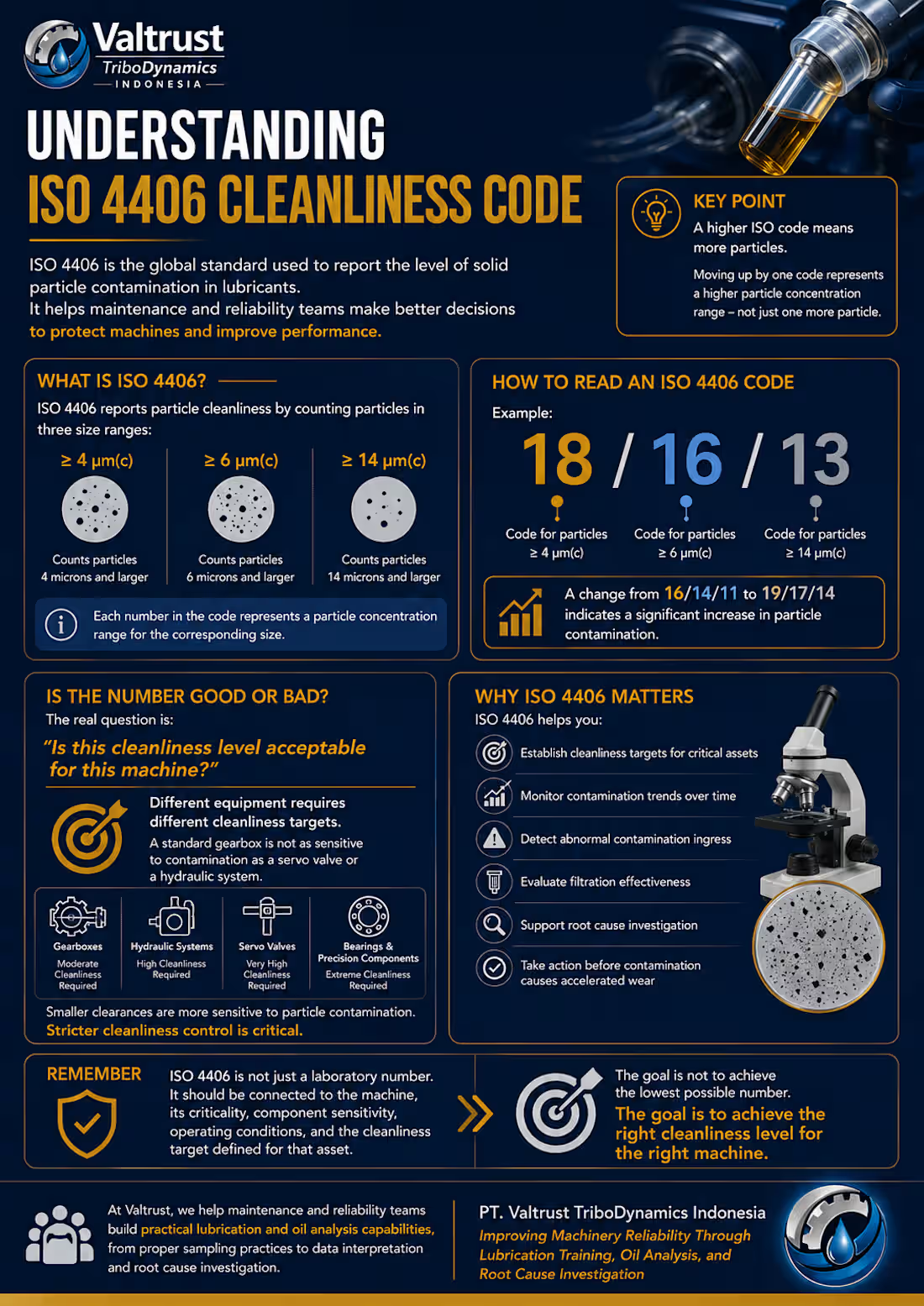
Understanding ISO 4406 Cleanliness Code
Your oil analysis report says:
ISO 4406: 18/16/13
But what does it actually mean?
For many maintenance professionals, ISO 4406 can look like just three numbers.
In reality, these numbers provide important information about the level of
solid particle contamination in your oil.
ISO 4406 is commonly used to report particle cleanliness by counting particles
in three size ranges:
≥ 4 µm(c)
≥ 6 µm(c)
≥ 14 µm(c)
Each number represents a particle concentration range.
For example:
ISO 4406: 18/16/13
18 represents the particle concentration code for particles ≥ 4 µm(c).
16 represents the particle concentration code for particles ≥ 6 µm(c).
13 represents the particle concentration code for particles ≥ 14 µm(c).
One important point:
A higher ISO code means more particles.
And because the ISO 4406 code uses concentration ranges, moving up by one code
does not mean “one more particle.”
It represents a higher particle concentration range.
This is why a change in ISO 4406 results should not be ignored.
For example, if your oil changes from:
16/14/11 to 19/17/14
The oil has experienced a significant increase in particle contamination.
The next question is not simply:
“Is this number good or bad?”
The real question is:
“Is this cleanliness level acceptable for this machine?”
Different equipment requires different cleanliness targets.
A standard industrial gearbox does not have the same contamination sensitivity
as a servo valve.
Hydraulic systems, precision components, and other critical equipment may
require stricter cleanliness control because smaller clearances can be more
sensitive to particle contamination.
This is where ISO 4406 becomes useful.
It helps maintenance and reliability teams:
• Establish cleanliness targets for critical assets
• Monitor contamination trends over time
• Detect abnormal contamination ingress
• Evaluate filtration effectiveness
• Support root cause investigation
• Take action before contamination causes accelerated wear
But remember:
ISO 4406 is not just a laboratory number.
It should be connected to the machine, its criticality, component sensitivity,
operating conditions, and the cleanliness target defined for that asset.
The goal is not to achieve the lowest possible number.
The goal is to achieve the right cleanliness level for the right machine.
At Valtrust, we help maintenance and reliability teams understand oil analysis
data and turn it into practical maintenance decisions through lubrication
training, oil analysis, and root cause investigation.
PT. Valtrust TriboDynamics Indonesia
Improving Machinery Reliability Through Lubrication Training, Oil Analysis, and
Root Cause Investigation
#ISO4406
(https://www.linkedin.com/search/results/all/?keywords=%23iso4406&origin=HASH_TAG_FROM_FEED)#OilAnalysis
(https://www.linkedin.com/search/results/all/?keywords=%23oilanalysis&origin=HASH_TAG_FROM_FEED)#Lubrication
(https://www.linkedin.com/search/results/all/?keywords=%23lubrication&origin=HASH_TAG_FROM_FEED)#ConditionMonitoring
(https://www.linkedin.com/search/results/all/?keywords=%23conditionmonitoring&origin=HASH_TAG_FROM_FEED)#MachineryReliability (https://www.linkedin.com/search/results/all/?keywords=%23machineryreliability&origin=HASH_TAG_FROM_FEED)
0
87
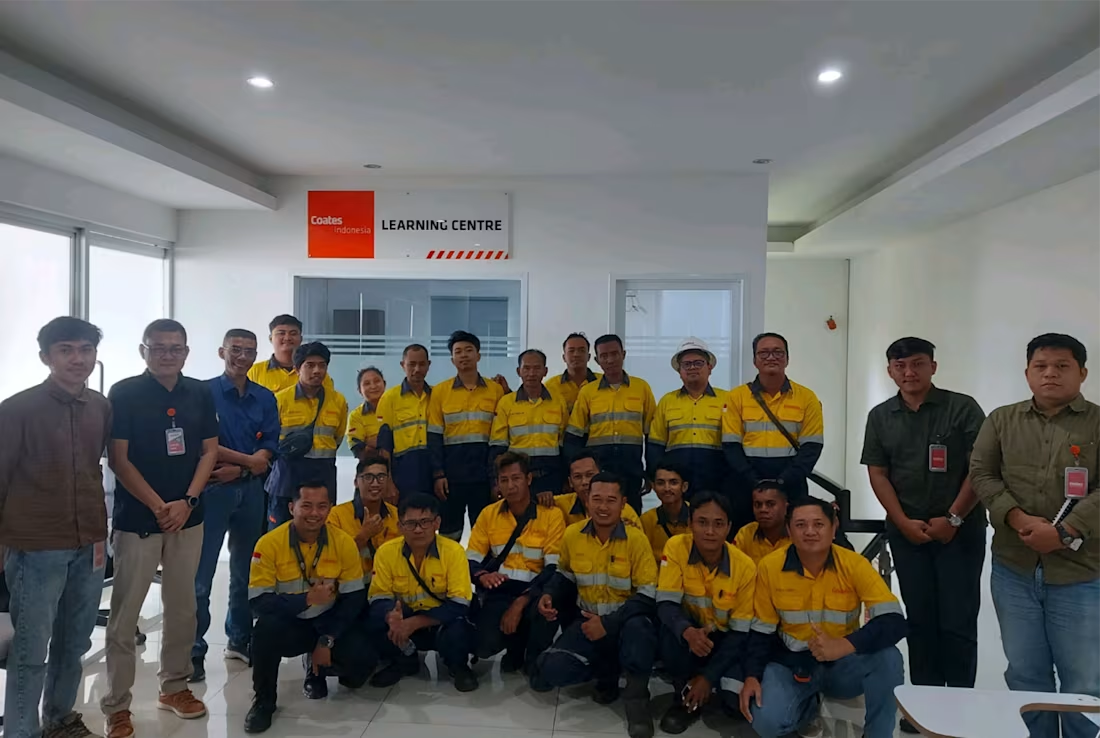
Reliability Training for Mining Customer.
0
79

Reliability maintenance training "Condition Monitoring for Fault Detection & Root Cause Analysis".
0
70
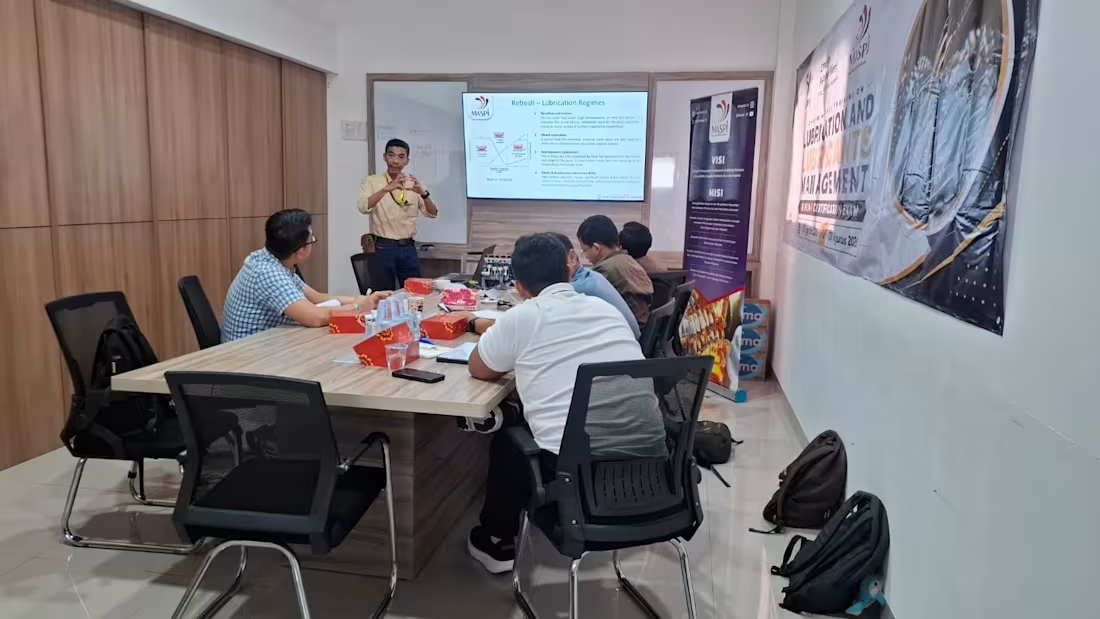
ICML MLA I Exam preparation training.
0
69