
RAVI RAJPUT
Lead Engineer → Technical Consultant
New to Contra
RAVI is building their profile!
Building Proactive Operational Monitoring for Reputation-Sensitive Infrastructure
A backend workflow I worked on focused on improving operational visibility for infrastructure systems where external reputation and trust signals could directly impact platform reliability and performance.
One recurring operational challenge was that reputation-related issues were often discovered reactively — usually after downstream impact had already started affecting delivery performance or operational health. The existing process relied heavily on manual checks and fragmented visibility, making it difficult to identify emerging risks early or establish reliable historical tracking.
The goal was not simply to add alerts, but to build a maintainable operational monitoring workflow that could proactively surface infrastructure health signals and provide meaningful visibility into evolving risk patterns over time.
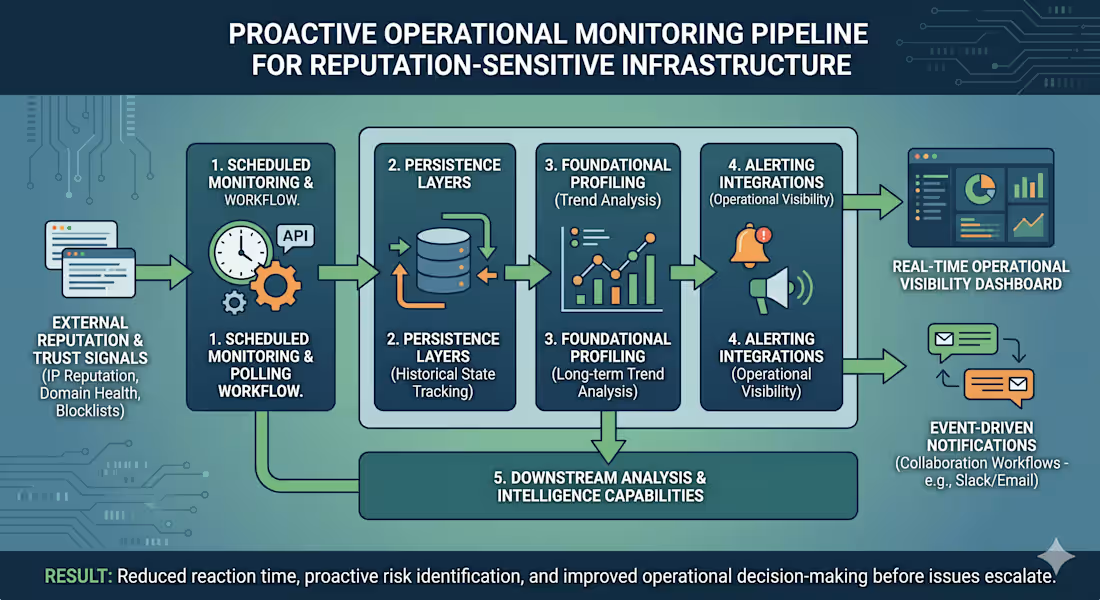
To solve this, I designed and implemented a monitoring pipeline that continuously tracked external reputation signals, persisted historical observations, and automated operational notifications through collaboration workflows.
The system involved:
scheduled monitoring and polling workflows
persistence layers for historical state tracking
alerting integrations for operational visibility
event-driven notification handling
foundational profiling mechanisms for long-term trend analysis
One important architectural consideration was ensuring the monitoring workflow remained lightweight, reliable, and operationally maintainable while still being extensible enough to support future analysis and intelligence capabilities.
Instead of designing it as a tightly coupled utility, the workflow was intentionally structured as a modular operational pipeline where:
monitoring
persistence
alerting
profiling
downstream analysis
could evolve independently over time.
The result was a proactive monitoring system that significantly improved operational visibility, reduced manual effort, and established the foundation for more advanced infrastructure health and reputation intelligence workflows.
What I enjoyed most about this project was that it highlighted how backend engineering is often less about individual services and more about designing systems that improve operational awareness, reduce reaction time, and help teams make better decisions before small issues evolve into larger operational problems.
0
9
Turning Delivery Failures into Actionable Operational Intelligence
One backend system I enjoyed designing involved improving visibility into high-volume delivery failure events generated by a communication infrastructure platform.
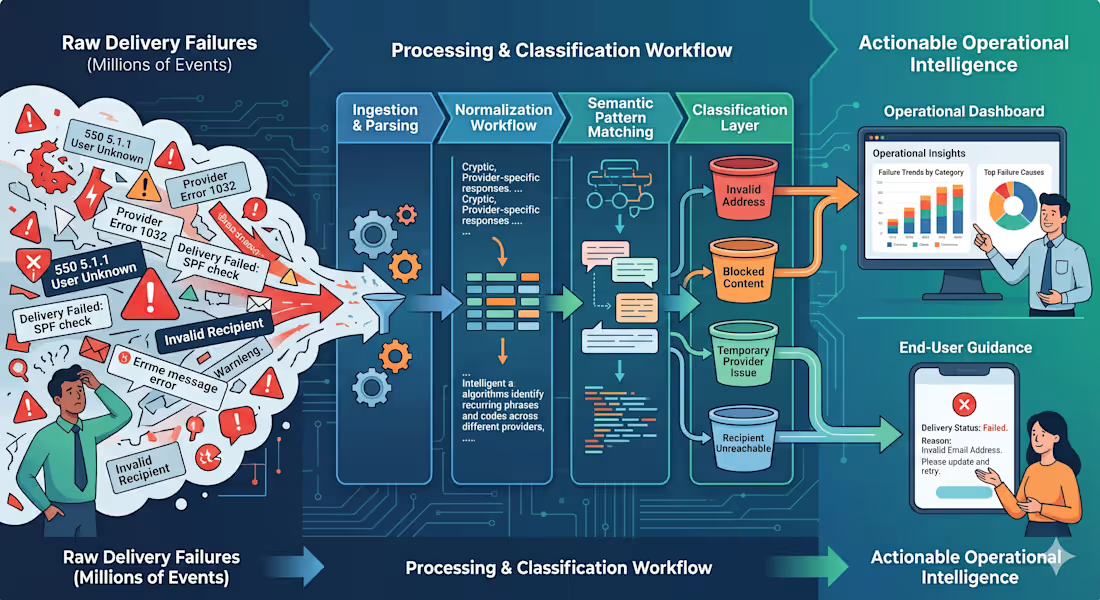
As the platform scaled, millions of delivery events were being processed regularly, including a large volume of failed deliveries originating from different providers and infrastructure layers. The challenge was that these failures were often inconsistent, noisy, and difficult to interpret operationally. Similar failures could appear with entirely different messages depending on the provider, while multiple underlying causes could surface through nearly identical responses.
This created two major problems:
operational teams lacked meaningful visibility into failure patterns
end users had limited guidance on why failures were occurring or how to improve delivery performance
The raw failure events themselves were technically available, but they were not actionable.
To improve this, I worked on designing a classification and processing workflow that transformed unstructured delivery failures into structured operational insights.
The system focused on:
parsing large volumes of failure events
identifying recurring semantic patterns across providers
grouping failures into meaningful operational categories
normalizing inconsistent responses into standardized classifications
exposing trends and diagnostics through analytics workflows
A major design consideration was balancing flexibility with maintainability. Provider responses evolved continuously, and the system needed to accommodate new patterns without repeatedly requiring deep changes to the processing pipeline.
The architecture evolved into a layered workflow where:
ingestion pipelines handled raw event processing
normalization workflows standardized provider-specific responses
classification layers mapped events into operationally meaningful categories
analytics systems exposed trends and remediation visibility
The result was a system that transformed previously noisy infrastructure events into actionable operational intelligence, helping improve visibility into delivery behavior patterns and enabling more informed remediation decisions.
What I found particularly interesting about this project was that the challenge was not purely about processing large volumes of events — it was about designing workflows that could convert operational noise into understandable, maintainable, and scalable product intelligence. It reinforced how impactful backend systems become when they help users reason about complex operational behavior rather than simply exposing raw infrastructure data.
0
9
Decoupling Product Logic from Payment Workflows for Faster Product Onboarding
A product onboarding workflow I worked on a few years ago taught me an important lesson about how operational complexity quietly accumulates in growing systems.
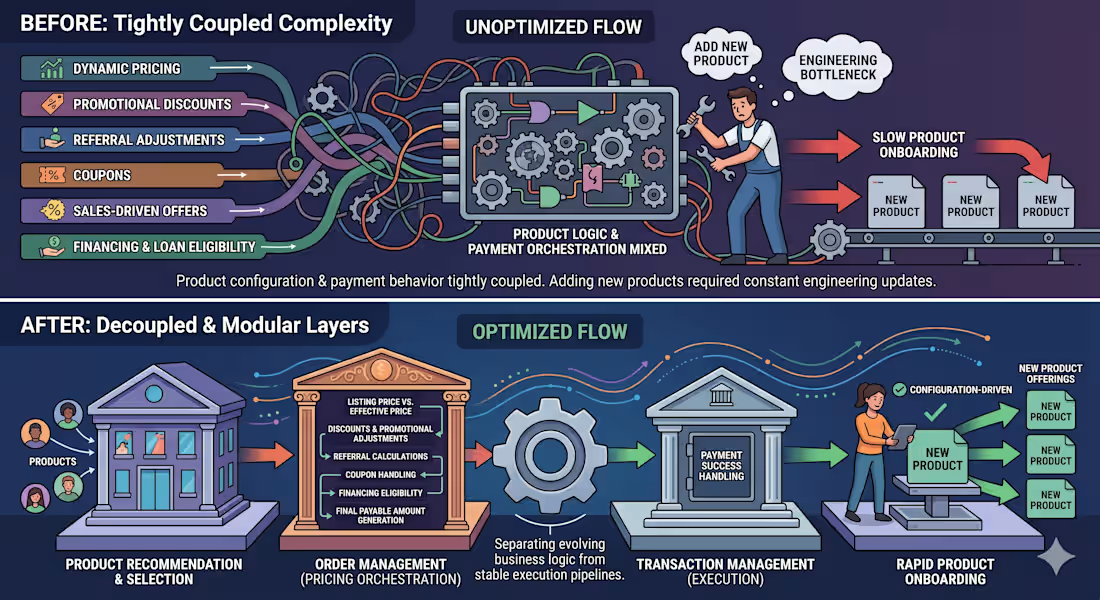
The platform had a recommendation-driven purchase journey where users were guided toward products based on assessments, learning requirements, and personalized growth paths rather than simple catalog browsing. Over time, the payment and onboarding flows evolved to support multiple business scenarios including:
dynamic pricing
promotional discounts
referral adjustments
coupons
sales-driven offers
financing and loan eligibility
As the product lineup expanded, onboarding new products started becoming increasingly engineering-dependent because product configuration and payment behavior were tightly coupled. Adding a new offering often required updates across pricing logic, payment workflows, order handling, and user preference management.
The main issue was that the system treated product configuration and payment orchestration as part of the same workflow.
To improve scalability and reduce operational dependency, I redesigned the flow into modular layers with clearly separated responsibilities.
The purchase journey was broken into:
product recommendation and selection
order management
transaction management
The order management layer became responsible for all pricing orchestration and commercial logic:
listing price vs effective price
discounts and promotional adjustments
referral calculations
coupon handling
financing eligibility
final payable amount generation
The transaction management layer was intentionally kept isolated from business-specific pricing logic and focused purely on transaction execution and payment success handling.
This separation significantly simplified the architecture and allowed product onboarding to become largely configuration-driven rather than engineering-driven. New products could now be introduced rapidly without repeatedly modifying core payment flows.
The project reinforced a principle I still apply frequently while designing backend and workflow systems: operational scalability often comes from separating evolving business logic from stable execution pipelines. Once responsibilities are isolated properly, systems become easier to extend, reason about, and scale without creating engineering bottlenecks every time product complexity increases.
1
10

Highlevel, Lead Software Engineer
Led Elasticsearch optimization initiatives for high-scale event ingestion pipelines processing ~80M+ events/day (~120GB+ indexed data daily), implementing bulk/batch indexing, index partitioning, and shard optimization that reduced peak-hour CPU utilization by ~50% and enabled annual infrastructure savings of ~$31K.
Architected and scaled deliverability enforcement systems, including ESP spam/AUP controls, reducing blocked email volume by 60%+ during peak periods (~2.2M → ~0.4M blocked emails) while improving shared infrastructure reputation and compliance.
Led development of a high-scale bounce classification system processing ~2M email bounces across ~180 categorized failure scenarios, enabling actionable deliverability diagnostics and customer-facing remediation insights.
Designed and developed blacklist/RBL monitoring infrastructure with alerting and persistent tracking workflows, establishing the foundation for sender reputation profiling and deliverability intelligence capabilities.
Contributed to scaling high-volume email infrastructure processing ~40M emails daily, including event ingestion pipelines, downstream reporting systems, and deliverability analytics workflows.
Implemented dedicated IP infrastructure and inbox placement optimization initiatives supporting a deliverability offering generating ~$708K in annual recurring revenue.
Led latency optimization initiatives for critical backend workflow systems, improving p99 latency, reducing upstream disruptions, and enhancing platform reliability.
Provided technical leadership through architecture discussions, PR reviews, mentorship, and cross-team collaboration to improve engineering quality and execution consistency
0
7