
Premaansh Vyas
Engineer with a designer's eye. Melbourne.
New to Contra
Premaansh is building their profile!
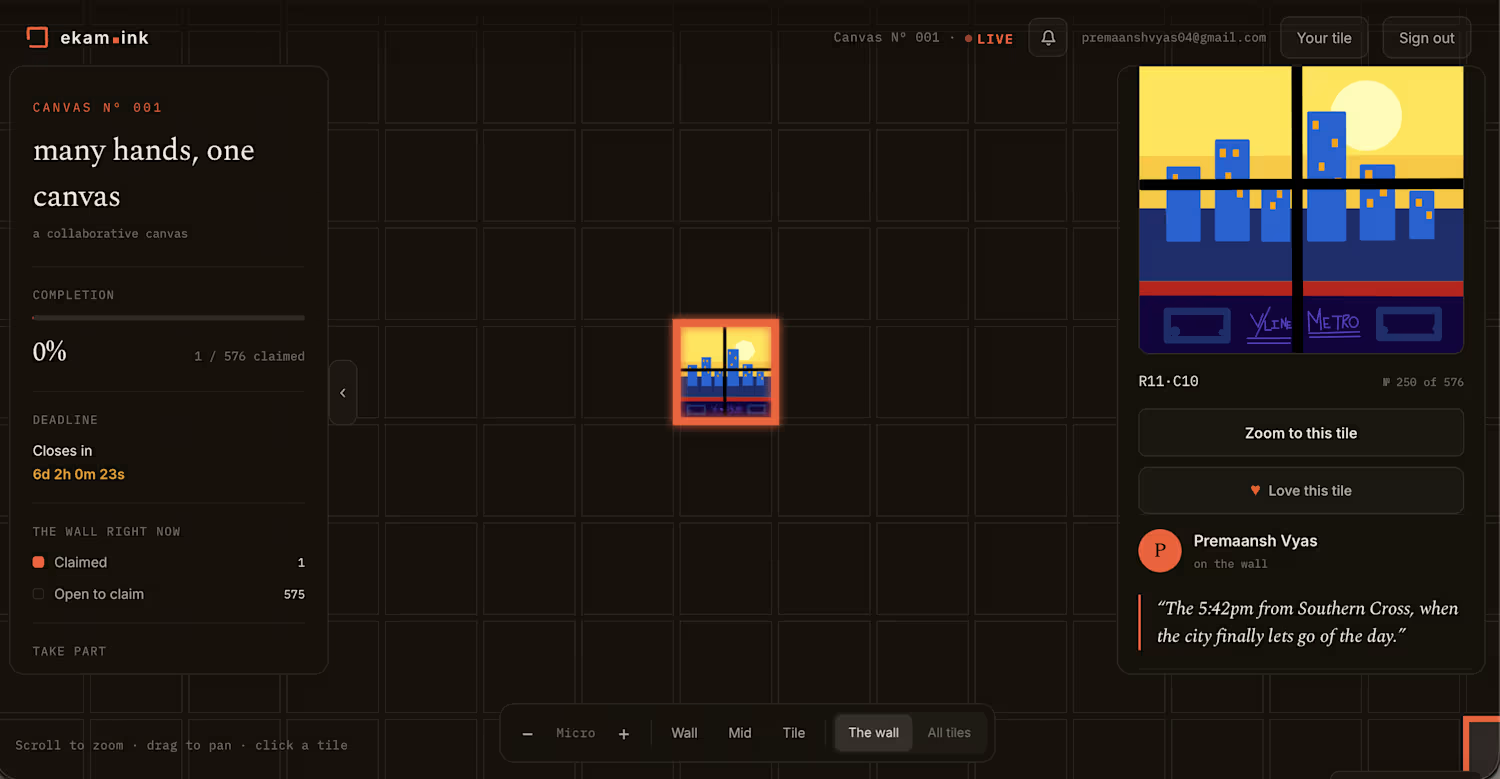
ekam.ink (http://ekam.ink) - many hands, one canvas
We scroll past more people in a day than our grandparents met in a lifetime, and somehow feel further apart for it. ekam is a small, stubborn argument against that distance. ekam is Sanskrit for one, and it asks a quiet question: give 576 strangers one small square each, trust them to be honest, and ask them to paint. Can they make a single, whole thing together?
One shared 24×24 wall. You don't get the whole canvas, you get one tile, and it is entirely yours. You verify with your email, hand-paint your square in the browser, leave one line of story, and step back. Alone it's a tile. Beside 575 others it becomes an artwork no one person could have made, or even imagined. That's the whole point: we don't come together by erasing what makes us different, we come together by each bringing one true mark.
How it comes together
Claim - tap any open tile, verify with an 8-digit email code. No password, no account, no app. One square per person, because scarcity is what makes it yours.
Paint - a real studio on a 1024px canvas: brushes, shapes, fills, your own colours, zoom, undo, and drafts that follow you across devices. The prompt is soft, paint what's in your mind, so the wall's character comes from honesty, not curation.
Belong - approved squares appear for everyone in about a second. People upvote the tiles that move them; the most-loved one wears a golden frame on the wall itself.
Reveal - when the canvas closes, the grid dissolves and the wall becomes one seamless piece (unfinished squares settle into paper), with a scrolling reel that names every artist and a one-click 9216×9216 download for everyone who helped make it. The moment the metaphor stops being a metaphor.
Why strangers can trust it
Coming together only works if it's safe to. So every submission is screened in seconds by an AI moderator (Claude Opus 4.8, vision) in two independent passes, one reads and transcribes every mark in any language before judging, a second hunts for anything hidden or disguised. They have to agree; any doubt, any error, anything uncertain goes to a human, never straight to the wall. The artist watches the verdict resolve live and can always ask for a person. It protects the wall without ever feeling like a wall.
How it was built - design and code as one
A project about many things becoming one deserved to be built that way. The entire design system, variable collections, the full type ramp, every component and every screen, lives in one Figma file that was built programmatically through the Figma MCP. The Figma variables and the live CSS variables mirror each other 1:1, so design and code never drifted apart. They came from one source. The chrome stays deliberately near-monochrome (Spectral · Inter · IBM Plex Mono, a single ember accent) so the only colour on screen is what the artists themselves brought.
Built with Figma + the Figma MCP · the Claude API (claude-opus-4-8) · Next.js 16 · Supabase (Postgres, Storage, Auth, Realtime ~1s live updates) · Vercel. Artist emails never leave the server; privacy is structural, not just promised.
This first canvas - Nº 001 - is open now and closes during judging week, revealing itself before winners are announced, and then it begins again next month. The wall you're looking at is filling in real time: square by square, hand by hand.
Come add yours.
🔗 Live: ekam.ink (http://ekam.ink)
· 🎨 Figma: https://www.figma.com/community/file/1648580688223265467 · 💻 Code: github.com/PremaanshVyas/ekam (https://github.com/PremaanshVyas/ekam)
3
4
279