Gradewise - AI-powered interview mastery platform

Sachin Rajan


GradeWise
AI-Powered Interview Mastery Platform
GradeWise is an AI-powered interview preparation platform built around a simple idea:
Preparing more is not the same as becoming interview-ready.
Most interview-preparation products measure activity. They track questions completed, hours studied, mock interviews taken, or content consumed.
GradeWise instead focuses on readiness.
The platform combines diagnostic assessment, evidence-driven mastery, adaptive planning, targeted practice, and continuous feedback to help candidates understand where they actually stand and what they should work on next.
The goal is not to give every learner another giant preparation library. It is to help someone prepare for the interview they actually have, based on their target role, company, level, timeline, current strengths, and demonstrated gaps.
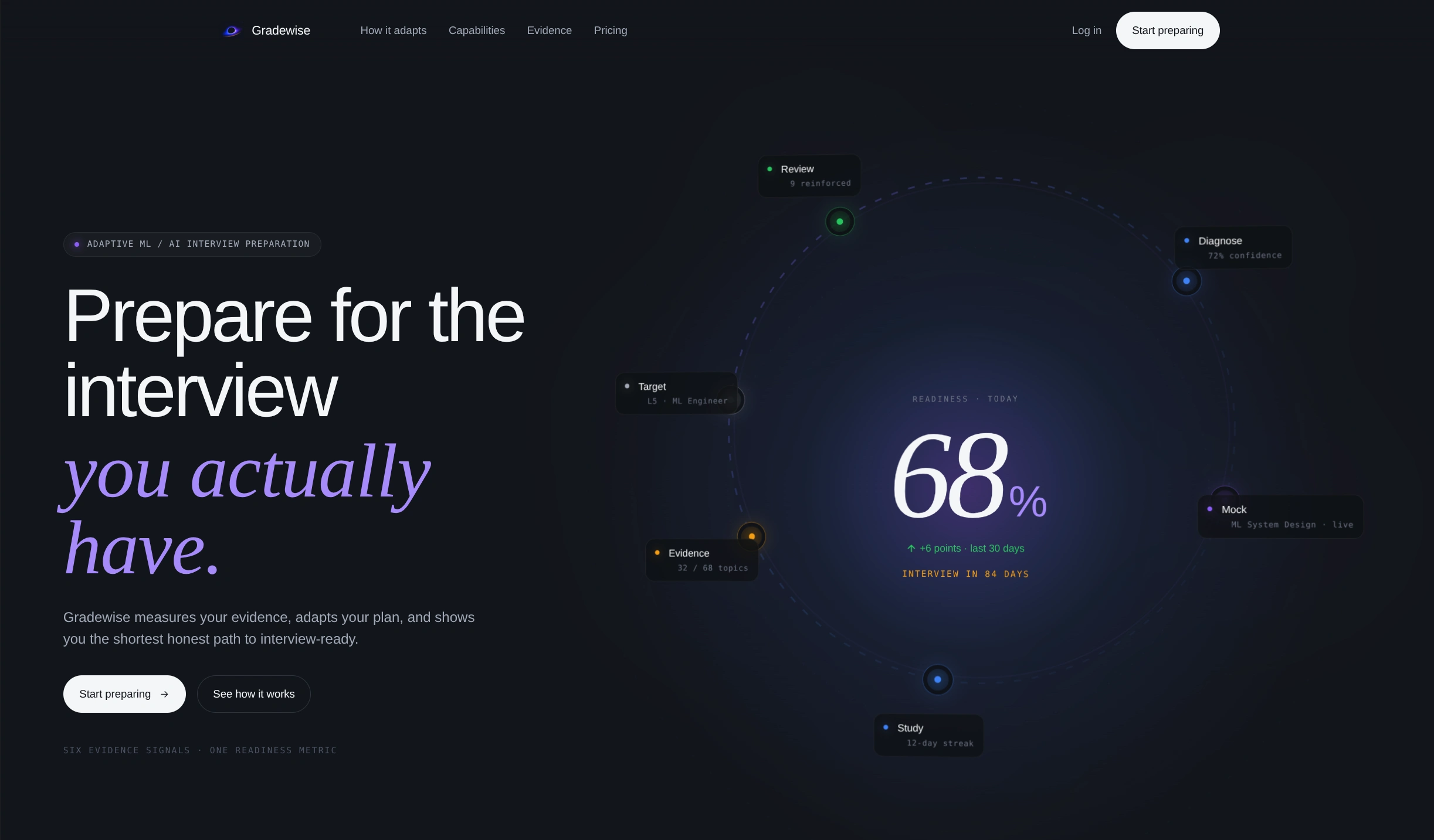
**Readiness is the central product concept in GradeWise. Multiple preparation signals contribute to an evolving picture of how interview-ready a candidate actually is.**
The Problem
Technical interview preparation is usually fragmented.
Candidates move between question banks, videos, notes, coding platforms, mock interviews, spreadsheets, and generic study plans. Each tool may be useful individually, but very few answer the most important question:
“Given the interview I am preparing for, what should I do next?”
A candidate preparing for a startup junior engineering role should not receive the same preparation path as someone targeting a senior machine-learning role at a large technology company.
Even within the same role, two candidates can have completely different gaps.
One may understand the theory but struggle to implement it.
Another may write correct code but fail to communicate tradeoffs.
Someone else may perform well in practice but repeatedly struggle under interview conditions.
A static curriculum cannot respond intelligently to those differences.
GradeWise was designed around the idea that preparation should change as new evidence becomes available.
Product Thesis
The core product principle behind GradeWise is:
Prepare for the interview you actually have.
A user begins with a concrete target rather than an abstract desire to “get better at interviews.”
That target can include the role, company, expected level, preparation timeline, and curriculum.
GradeWise then tries to understand four things:
what the candidate is preparing for
what they currently know
what evidence supports that assessment
what action would produce the highest-value improvement next
This creates a feedback loop rather than a fixed checklist.
The preparation plan becomes something that can evolve.
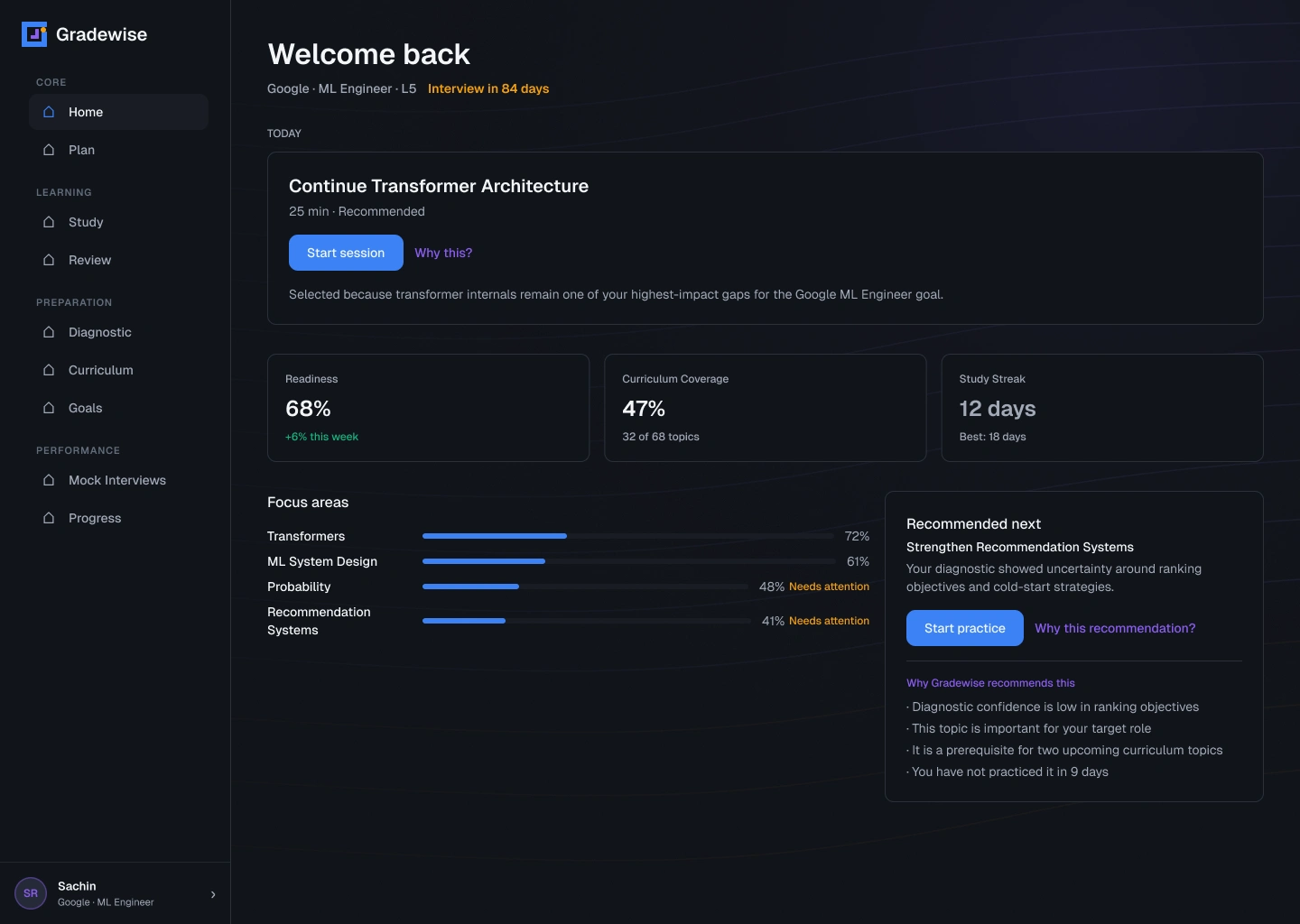
**Preparation begins with a specific interview target. GradeWise uses the role, company, level, curriculum, and timeline as context for the rest of the experience.**
Establishing a Baseline
Before GradeWise can recommend what someone should study, it needs evidence of where they currently stand.
That is the purpose of the diagnostic assessment.
Rather than immediately dumping the candidate into a long curriculum, the system establishes a baseline across the relevant preparation areas.
The diagnostic is designed to reveal strengths, weaknesses, uncertainty, and areas where additional evidence is needed.
This baseline becomes the starting point for personalization.
A candidate who already demonstrates strong knowledge in one area should not spend the same amount of time there as someone with a major gap.
Likewise, a weak result is not treated simply as a failure. It becomes information the system can use to decide what should happen next.
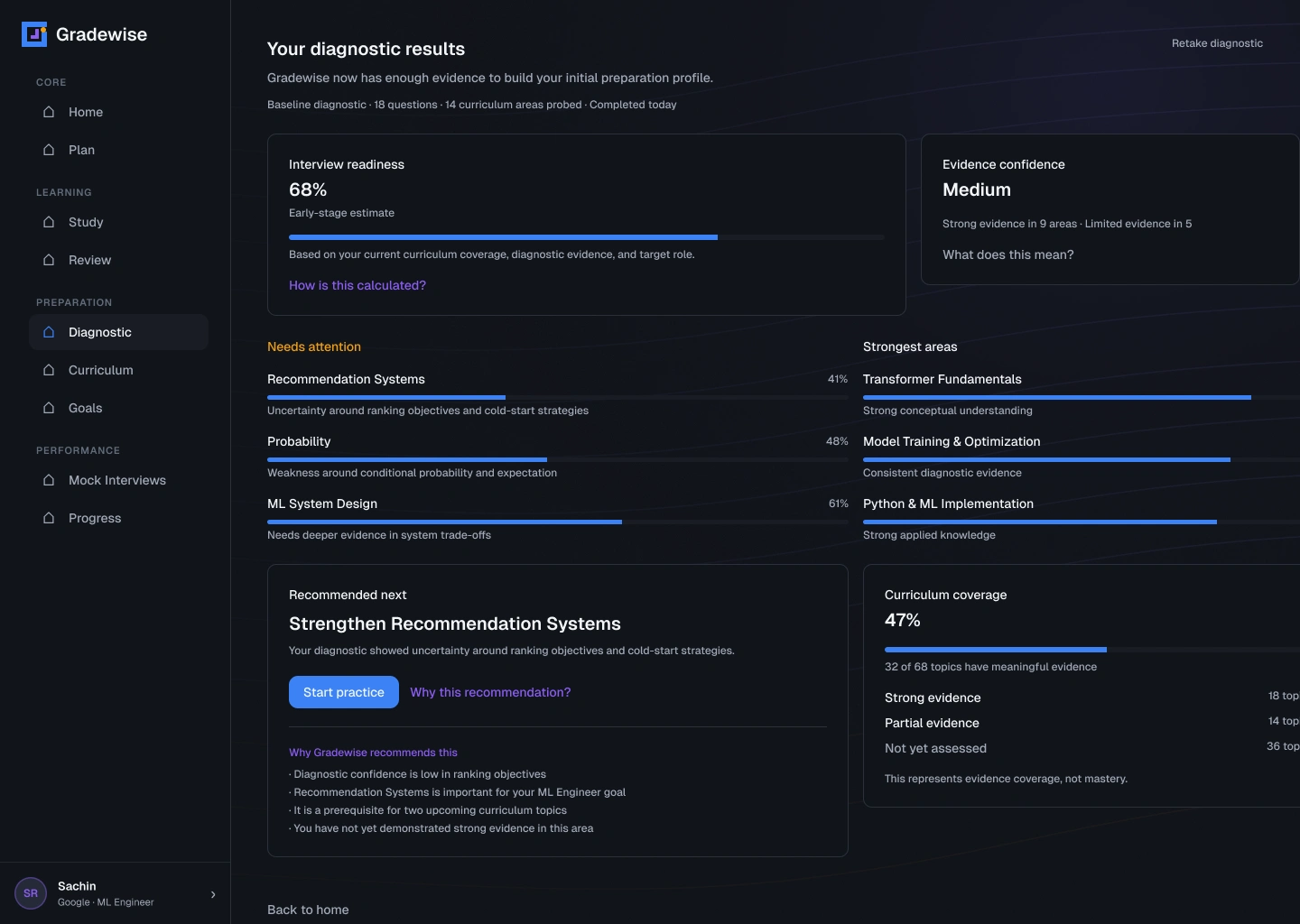
**The diagnostic establishes the candidate’s starting point and gives the system the initial evidence required to personalize preparation.**
Evidence-Driven Mastery
One of the most important design decisions in GradeWise was separating activity from mastery.
Completing a lesson does not necessarily mean the learner understands it.
Answering one question correctly does not necessarily prove interview readiness.
GradeWise therefore treats learning interactions as evidence.
Assessments, diagnostic performance, practice outcomes, review activity, and other relevant signals can contribute to the system’s understanding of a candidate’s current mastery.
The mastery layer is designed to evolve as new evidence arrives.
This also means that the product can represent uncertainty.
Instead of pretending that every topic is either “complete” or “incomplete,” GradeWise can build a more nuanced view of preparation progress.
That view becomes the basis for recommendations and prioritization.
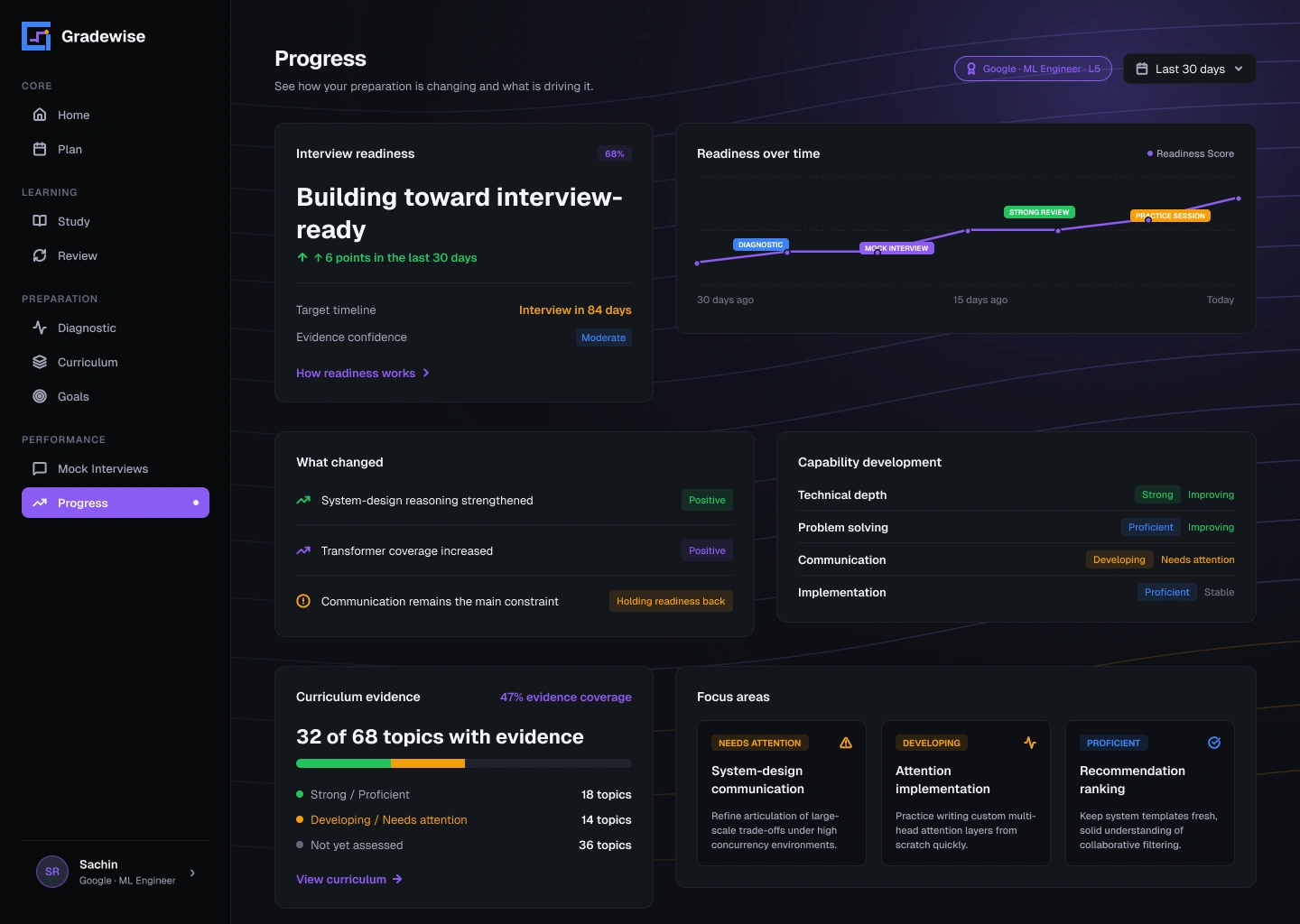
**GradeWise tracks demonstrated mastery rather than treating content completion as proof of readiness.**
Adaptive Preparation
Once the system understands the target and has evidence about the candidate, it can start answering the useful question:
What should this person work on next?
The preparation experience is designed to continuously prioritize areas that provide the greatest improvement toward the active goal.
That may mean:
studying a weak concept, reviewing previously learned material, attempting another diagnostic-style assessment, practicing implementation, completing a mock interview, or revisiting a topic where confidence has weakened.
The important part is that recommendations come from the candidate’s current state rather than from a universal sequence.
This makes GradeWise less like a course and more like a preparation system.
Readiness as a Product Language
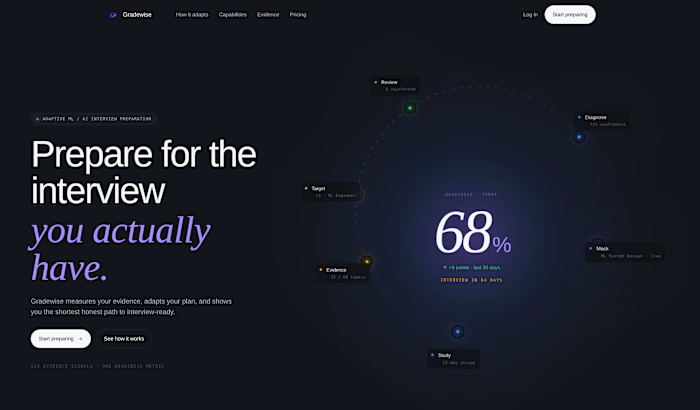
The visual language of GradeWise is also built around readiness.
The orbit system used throughout the product represents the idea that interview readiness is not determined by one score or one activity.
Different signals contribute to the candidate’s overall state.
Study, review, diagnostics, evidence, mock interviews, responses, and other preparation activities can all influence that picture.
The orbit provides a visual metaphor for those signals continuously interacting around the candidate’s readiness.
The goal was to make the product feel analytical without turning it into a cold enterprise dashboard.
It needed to communicate progress, uncertainty, and direction while still feeling motivating to use.
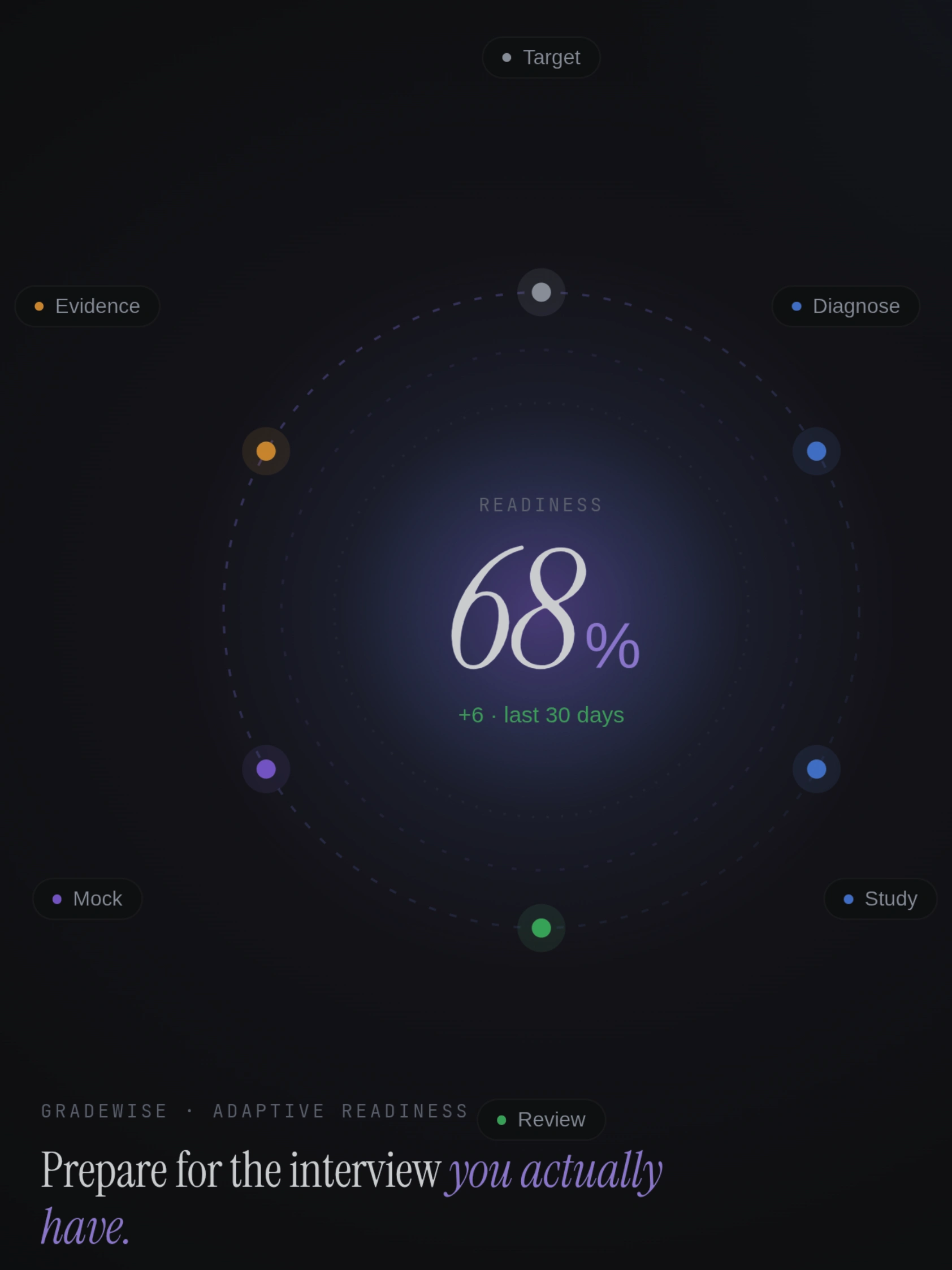
**The GradeWise orbit visualizes readiness as an evolving system of signals rather than a single isolated metric.**
Building the Platform
I worked across the full product rather than treating GradeWise as only an AI feature layered onto an existing application.
That included the product model, backend architecture, preparation workflows, diagnostic system, mastery logic, data model, user experience, and the reliability required to keep those systems consistent.
The backend was designed around clearly separated concerns for assessments, evidence, diagnostics, mastery computation, and user-facing preparation state.
A particularly important engineering challenge was making mastery updates reliable when multiple pieces of evidence or assessments could affect the same logical state.
The system was hardened around transaction boundaries, historical state, concurrency, validation, and convergence so that the user-facing mastery state remains consistent even as underlying evidence changes.
That engineering work matters because adaptive systems become difficult to trust if the same evidence can produce inconsistent outcomes depending on timing or execution order.
GradeWise therefore treats correctness and traceability as part of the product, not merely backend implementation details.
AI With Guardrails
GradeWise was not designed around the idea that an LLM should simply decide everything.
Where AI is useful, it operates within a broader system of structured data, deterministic rules, policies, evidence, and application state.
This lets the product use AI for interpretation and personalization while keeping important state transitions explicit and auditable.
That distinction is important for any production AI system.
A prototype can often rely on a model response.
A product needs to understand what happens when the response is wrong, incomplete, duplicated, delayed, or inconsistent with existing state.
GradeWise was built with that production mindset from the beginning.
Product Experience
The interface was designed to keep a complex preparation model understandable.
Instead of exposing every internal calculation, GradeWise surfaces the things the learner actually needs:
their active goal, current readiness, important gaps, diagnostic state, mastery progress, and the next recommended action.
The design deliberately avoids turning preparation into a wall of analytics.
The system may be complex underneath, but the user experience should still answer simple questions:
Where am I?
What am I weak at?
What should I do next?
Am I getting closer to being ready?
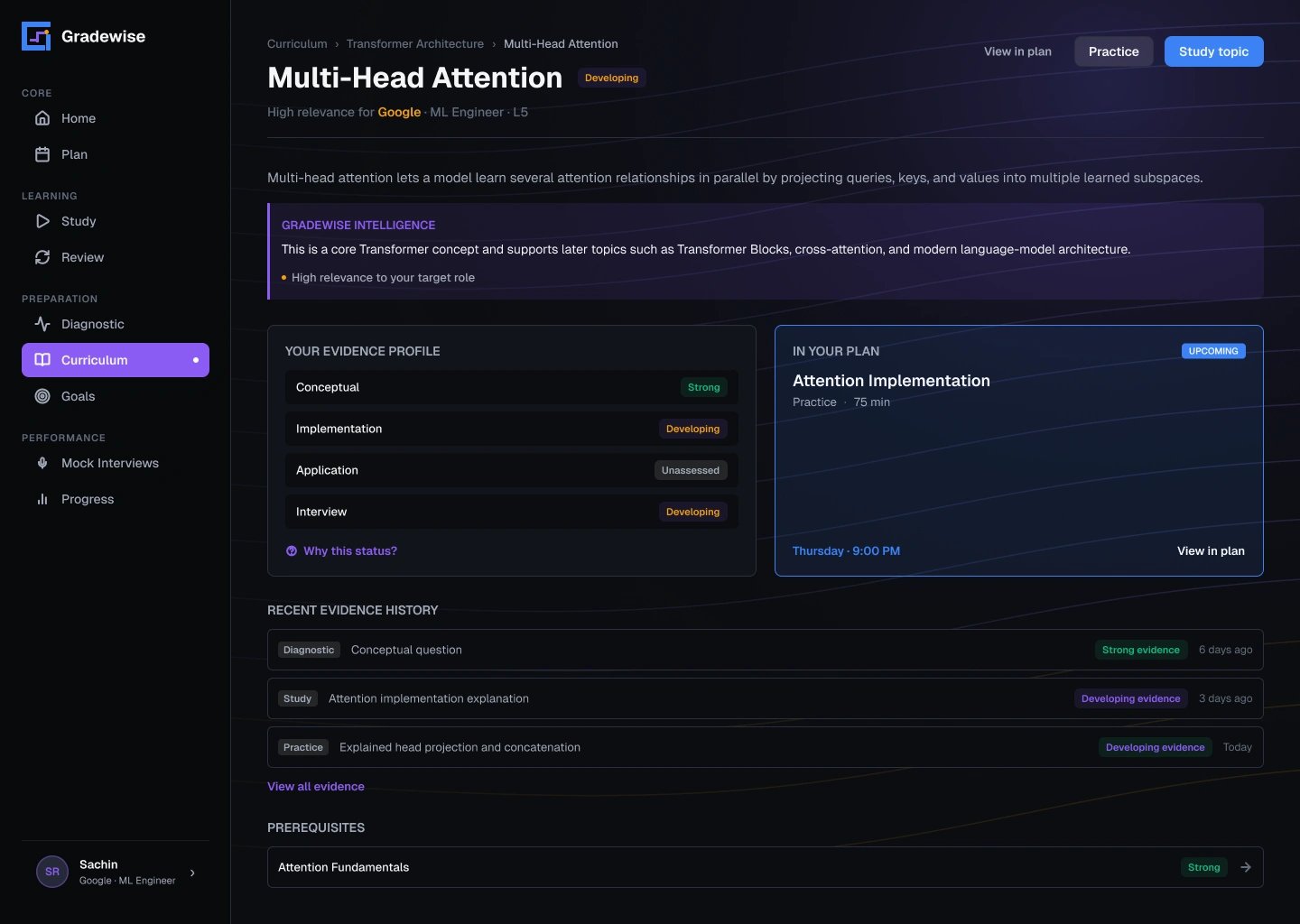
**The system converts readiness and mastery signals into concrete next actions instead of leaving the learner to interpret dashboards themselves.**
My Role
I built GradeWise as an end-to-end AI product.
My work spans product architecture, backend engineering, AI/ML-driven product logic, diagnostics, evidence and mastery modeling, data workflows, API design, reliability hardening, and the user experience required to make those systems understandable.
I also developed the product direction and interaction model around readiness, evidence, and adaptive preparation.
This allowed the technical architecture and product experience to evolve together rather than treating the AI layer, backend, and interface as separate projects.
Result
GradeWise has evolved into a platform built around a much stronger question than:
“How much preparation have you completed?”
It asks:
“What evidence do we have that you are ready?”
That shift changes how the entire product works.
Diagnostics establish the baseline.
Evidence updates mastery.
Mastery influences priorities.
Priorities drive recommendations.
New preparation produces new evidence.
And the cycle continues as the candidate moves toward the interview.
The result is an interview-preparation system designed to become more personalized and useful as the learner uses it, rather than simply delivering the same content to everyone.
Like this project
Posted Sep 2, 2026
GradeWise is an AI-powered interview mastery platform built to help candidates prepare for the specific interview they actually have.
Likes
0
Views
2
Timeline
Aug 1, 2025 - Jul 2, 2026