Brute Force Attack Detection & Investigation - Wazuh SIEM

Aaliya Khalil

Brute Force Attack Detection & Investigation -Wazuh SIEM
Overview
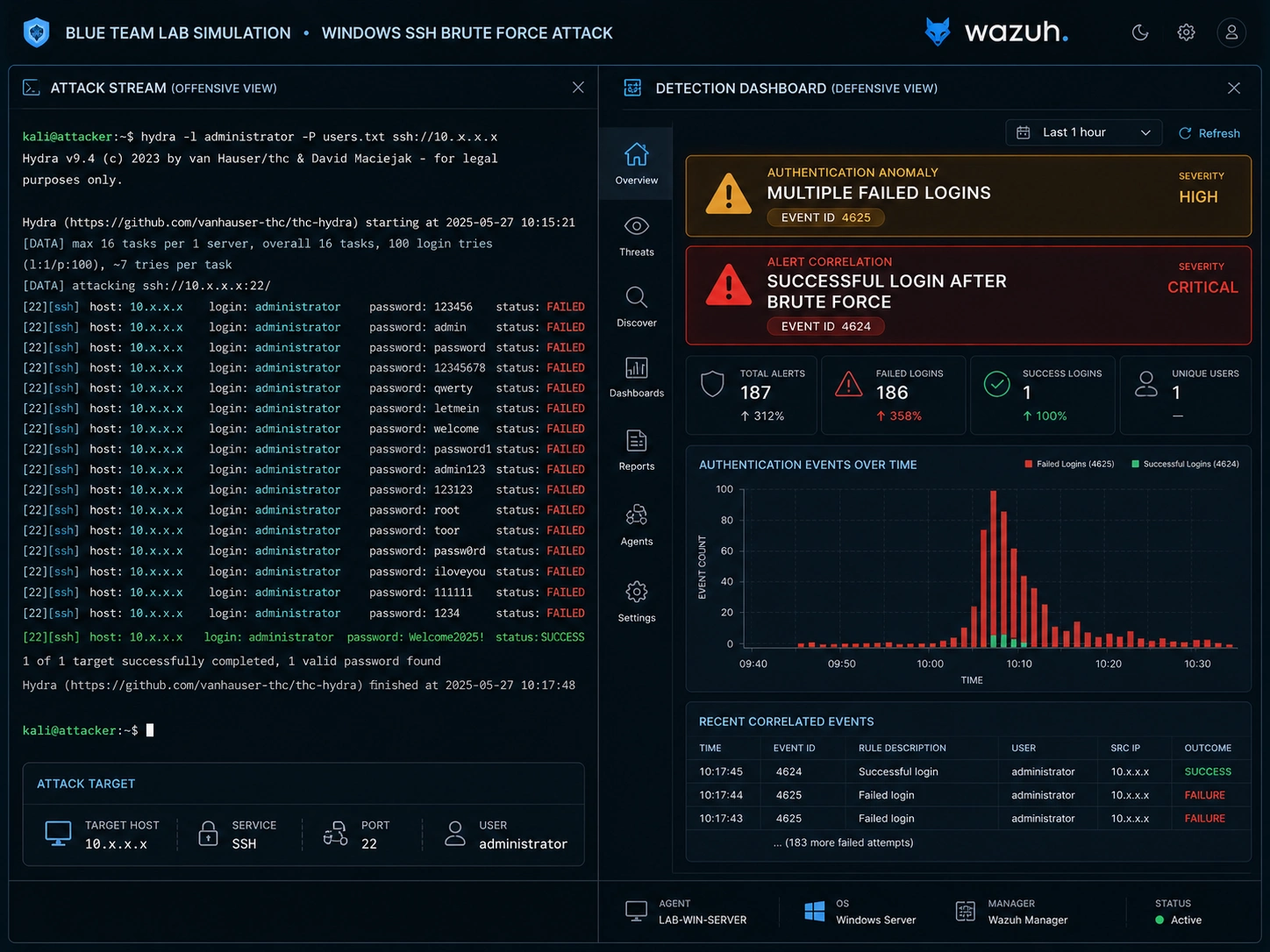
This investigation involved simulating and analyzing a brute force authentication attack targeting a Windows system via OpenSSH. The objective was to detect abnormal login behavior, correlate failed and successful authentication attempts, and reconstruct the attack sequence using SIEM log analysis.
Environment & Tools
Wazuh SIEM (log collection and alerting)
Windows Event Logs (Security logs)
SSH authentication logs (Windows OpenSSH service)
Event ID analysis (4625, 4624)
Log correlation and timeline reconstruction techniques
Investigation Steps
1. Initial Log Review
Authentication logs were reviewed from Windows Security Event Logs to identify abnormal login activity patterns.
2. Detection of Failed Login Activity
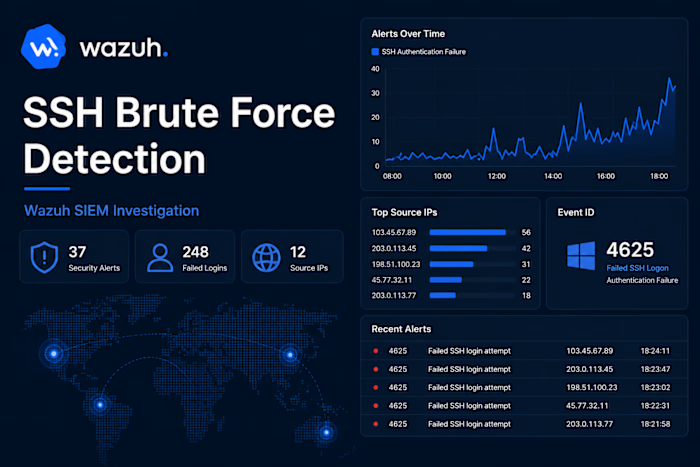
A series of Event ID 4625 (failed logon attempts) was observed from a single source pattern, indicating repeated authentication failures consistent with brute force behavior.
3. Correlation with Successful Login
Following multiple failed attempts, a successful authentication event (Event ID 4624) was detected from the same context, indicating potential credential compromise.
4. Attack Pattern Validation
The event sequence showed:
Repeated authentication failures
Short interval between failures and success
No prior successful baseline activity from the same pattern
This pattern aligned with a brute force authentication attempt.
5. SIEM Contextual Analysis (Wazuh)
Wazuh correlation rules helped surface and reinforce the abnormal authentication behavior, supporting detection confidence.
Key Findings
Multiple failed login attempts (Event ID 4625) within a short timeframe
Successful login (Event ID 4624) following repeated failures
Behavior consistent with password guessing / brute force technique
No evidence of legitimate user authentication patterns during the timeframe
Attack scenario successfully demonstrated weakness in account lockout enforcement
Attack Timeline (Simplified)
Repeated unauthorized login attempts initiated
Continuous authentication failures recorded
Persistent credential-guessing behavior observed
Successful authentication achieved after multiple attempts
Session established following login success
MITRE ATT&CK Mapping
T1110 – Brute Force
T1078 – Valid Accounts (post-authentication access scenario)
Outcome
This controlled investigation demonstrated how brute force authentication attempts can be identified through SIEM log analysis and event correlation. The absence of account lockout mechanisms allowed repeated login attempts, eventually resulting in successful authentication.
Key Takeaway
This case study demonstrates my ability to simulate attack scenarios, analyze authentication logs, correlate security events, and reconstruct attacker behavior using SIEM tools like Wazuh.
Like this project
Posted Jun 1, 2026
Simulated and analyzed a brute force attack using Wazuh SIEM on a Windows system.
Likes
0
Views
17