Global Protests and Coalition Formation for Iranian Change

Sahar Ghorishi


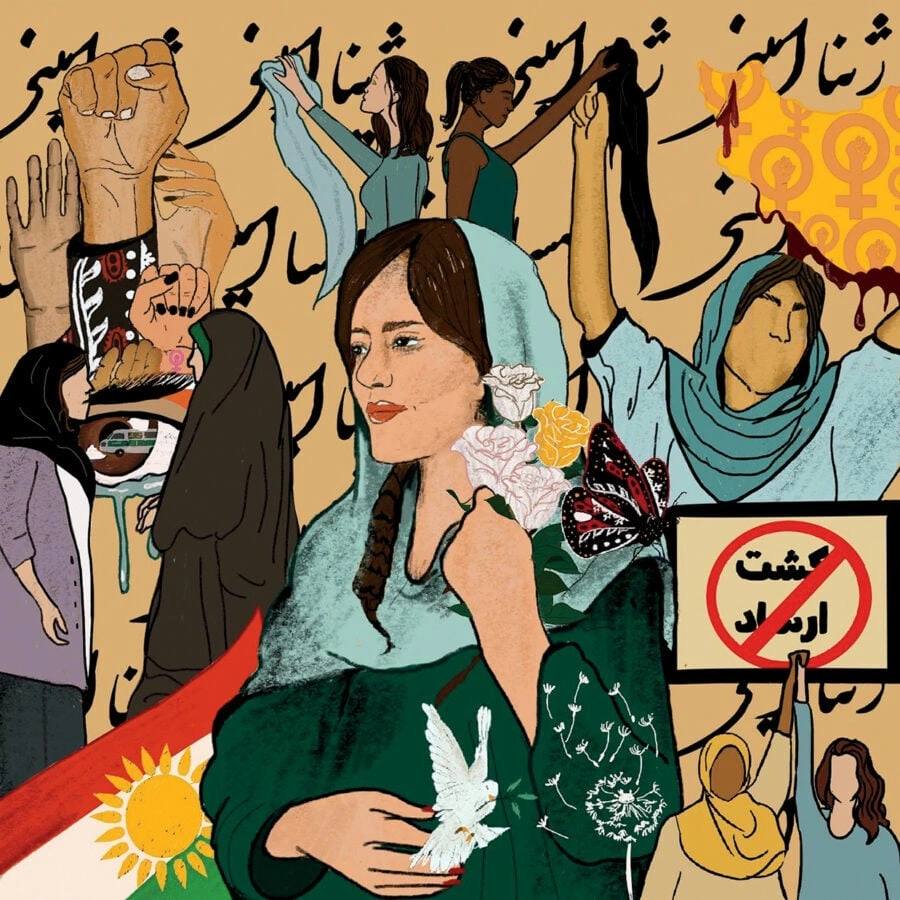
On September 13, 2022, the so-called morality police near Tehran’s Shahid Haqqani metro station stopped Mahsa Amini, a twenty-two-year-old visitor, for allegedly wearing an “improper hijab.” Officers put her in a van and, while driving to the police station, reportedly beat her as she begged to be released. She died three days later.
As the story of her murder, along with a picture of Amini on her deathbed, spread on social media, what felt like decades of pent-up rage began to surface. The first protests happened in front of Kasra Hospital, where Amini had died. Thousands of mourners attended her funeral. The symbols and gestures that would come to represent the uprising emerged on that day: women removed their headscarves and chanted “women, life, freedom”—a slogan once used by female Kurdish-Syrian fighters who resisted ISIS in their territory. The funeral gave way to a national uprising.
Days later, Iranian president Ebrahim Raisi traveled to New York to address the United Nations General Assembly. Iranians in the country issued a call to gather at Dag Hammarskjöld Plaza to protest his visit, and I arrived around noon with my family. As we turned onto 47th Street, I encountered a surreal scene: Iranians of all stripes had filled the block; at the corner, someone had set up an elaborate stand with pictures of hundreds of people, including those in the MEK—an opposition group once deemed a terrorist organization by the State Department—who had been killed in a mass execution in 1988. Farther down the street, nationalists hoisted their lion-and-sun flags. Leftists sold books in a reenactment of the early months of the Iranian Revolution. Virtually every Iranian I had met in the city was there. I ran into famous reformists, people who had held high office in the current regime before joining the opposition abroad, artists, journalists, students, professors, engineers, programmers. Many of us had participated in protests before leaving Iran, but I had never seen anything like this. Just a week before, it would have been unimaginable to see all these faces and flags congregated in one place. Like other traumatized diasporas, the communities of Iranians abroad have been riven by infighting. Yet now, at least for the moment, long-held grudges had been sidelined.
After hours of chanting, Hamed Esmaeilion stepped onto the platform to deliver a speech. It was the first time I had seen him up close in nearly fifteen years; now he was forty-six with a graying beard, a gentle, reserved demeanor, and a soft voice. I thought of the turns our lives had taken since we’d first met. I had known Esmaeilion as a writer of literary fiction, the author of a celebrated short story collection. I was also a writer, and when we lived in Tehran our paths had crossed frequently. Now I was raising a family in Beacon, New York, and still writing, but in English. Meanwhile, a strange and tragic chain of events had turned Esmaeilion from an emigrant author into a major political figure among Iranians living abroad, a man occasionally named as a viable choice to lead the country past the Islamic Republic. I began to see how our parallel lives and respective fates reflected the uncertainties and impossible choices that burden our generation of Iranian artists.
Esmaeilion was born in 1977 in Kermanshah, an ancient town dotted with historical sites, some dating back three thousand years, in the mountains of western Iran. When he was three years old, the Iran–Iraq War broke out, and his hometown became a frequent target for Saddam Hussein’s army. Esmaeilion’s most vivid memory of this time is of empty houses. “We had to move all the time,” he recently told me. “From our house to other towns where we had family, then back home and out again. To this day, I feel oddly comfortable in unfurnished houses.”
His father had a large library that contained the works of major Iranian writers as well as Western classics, and Esmaeilion grew up reading Sadegh Hedayat, Gholam-Hossein Sa’edi, Mahmoud Dowlatabadi, as well as Romain Rolland and Dostoevsky. “It is good to write down your thoughts,” a cousin told Esmaeilion when he was fifteen, “so in the future you will know how you used to think.” The insight struck him as genius. He started keeping a journal.
I was born three years after Esmaeilion, and I read more or less the same books. I grew up a few hundred miles south of Kermanshah, in Ahvaz, a town that Saddam’s army hit even harder. My college years coincided with the rise of the reformist era, and I recall the first few years of the millennium as critical in our generation’s political evolution. But in 2009, after a midnight militia attack on a student dorm at the University of Tehran, and a reportedly rigged parliamentary election, it became clear to us that the reformists were not who we thought they were. If change were to come to Iran, it wouldn’t be at the hands of the reformers we had at the time.
As we discussed our lives some years later, I learned that Esmaeilion had experienced the same disenchantment. He studied dentistry at the University of Tabriz, where he fell in love with a classmate, Parisa Eghbalian, a serious and calm woman at the top of her class. They married in the summer of 2003. Even in the wake of political disappointment, Esmaeilion wanted to stay in Iran, but Parisa had had enough, and they applied to immigrate to Canada, a process that would take years. They settled in Tehran in the meantime. One day, coming out of a theater, Parisa saw a flyer for a fiction workshop taught by Amir Hassan Cheheltan. Parisa knew that he was one of Esmaeilion’s favorite authors, and at her insistence, he enrolled in the workshop. He submitted a series of linked stories—seven monologues by seven characters living on the same street in Kermanshah, a structure similar to that of V. S. Naipaul’s Miguel Street—written during time stolen from work at his dentistry practice. After polishing the stories in Cheheltan’s workshop, Esmaeilion sent the manuscript out for publication. The censorship office cut one of the monologues, but the remaining six were published in 2009 as Thyme Is Not Pretty.
The book was a success, winning a prestigious literary prize. As I recall, it was at a literary event that I met Esmaeilion for the first time. After that, we would run into each other at this party or that ceremony, this bookstore or that reading in Tehran’s small literary scene. Alcohol is still illegal in Iran, and back then cafés were few and far between. Meeting fellow writers often meant gathering at one another’s homes or taking walks downtown. Like writers around the world, we gossiped and complained about how little we were paid for our work, but unlike some of those writers, much of our talk was about censorship. We all had stories about what the censorship office, officially known as the Ministry of Culture and Islamic Guidance, had done to our work. We swapped tips for how to fly under the radar. But their stranglehold was tight, eventually driving out some of Iran’s writers, including the two of us.
Shortly after his first taste of literary success and seven years after applying for Canadian visas, Esmaeilion and Parisa were approved. They arrived in Toronto when their daughter Reera was six months old. Meanwhile, my decade-long struggle with the censors had come to a head. By 2010, three of my books had been banned, and the publishing house where I worked as an editor had been shut down, as well as the newspaper where I wrote a column. With my books gathering dust and my sources of income severed, I left, landing in Brisbane, Australia, to begin a PhD.
Esmaeilion diligently chronicled his family’s first years in Canada on a popular blog called The Lost Highway. Through his posts, I learned of Reera’s sleeplessness on the transcontinental flight, the terror of stepping into the merciless Canadian cold, the indecipherable transit system, the challenge of finding the right places to shop, and the daunting paperwork. He wrote about the unfamiliar texture of the bread, the oddness of hearing old ladies speak to his daughter in English, the surprising number of Iranians they met, the way the wind would rise from the lake and pierce the skin to the bone. During their first year in Canada, he and Parisa studied for their dental license exams, while Reera spent a good deal of her time babbling at her grandmothers through a screen.
I was similarly disoriented by my new environment. Brisbane’s January was the hottest and most humid month I had ever experienced. I was completely unprepared for the gap between the English I knew—learned mostly from books—and the one needed for daily life and its endless bureaucracies. I read Esmaeilion’s blog with a sense of relief—the kind that comes from encountering familiar hardships in someone else’s life.
As they built their lives in Canada, Esmaeilion continued to write. His first novel, Dr. Datis, was published in Iran in 2012. The semi-autobiographical book tells the story of a middle-class dentist who sets up an office in one of the city’s poorest and most religious corners. He connects with the community and ends up running for city council. This book established him as a major voice of our generation. Two years later, he published Gamasiab Has No Fish, which had been delayed for years by censors. Its plot concerns a large cast of characters undergoing radical metamorphoses: prerevolutionary drunkards become postrevolutionary zealots, simple peasants become shrewd military commanders, and MEK fighters become the regime’s number one enemy. The book was banned shortly after its release.
While Esmaeilion and his family were settling into life in suburban Toronto, I finished my studies in Australia and returned to Iran, intending to start over. I was hearing that censorship was more relaxed under Hassan Rouhani, the new president. My plan was to find a steady university job and pick up where I had left off. I tried and failed for nine months and ultimately migrated again, this time to New York City, on a scholarship to study fiction at NYU.
As I relocated from one rented room in Brooklyn to another in Harlem, I continued reading Esmaeilion’s posts, this time on his Facebook page. I’d been working on my first novel in English while straining against the Trump Administration’s travel ban; the calm, stable life he described contrasted starkly with the turbulence I was living through. Following his story was a form of escapism for me, a brief departure from my own precarity. But even as Esmaeilion was safely ensconced in Canada, the Iranian regime’s response to his increasingly political work complicated things. When Parisa’s father fell ill, and the family traveled to Iran to be with him, authorities confiscated Esmaeilion’s passport at the airport. He had to divide his time between the ICU and a government office, where he was asked about his childhood in Kermanshah, his military service in Gorgan, his dental practice in Tehran, and the Iranians he knew in Toronto. He missed the final moments of his father-in-law’s life. Eventually, he got the passport back and was allowed to leave the country.
In September 2019, Parisa came home with exciting news: her sister, Parnian, was getting married in January. Worried that a second detention would spoil the wedding, Esmaeilion decided to stay home, but he insisted that Parisa and Reera go without him. Parisa bought the plane tickets from a Ukrainian airline. Esmaeilion protested mildly, recalling the Malaysian flight that Russia had shot down over Ukraine five years before, but this was the only airline that had seats for their preferred date. She and Reera left on Christmas Day. In the early hours of January 8, 2020, they returned to Tehran’s Imam Khomeini International Airport to fly to Kyiv, where they would stop for their first layover. Mere minutes after takeoff, two missiles hit the aircraft. The plane erupted into a ball of flames, then it descended in the sky over Tehran, and debris rained across a soccer field.
Just days before the catastrophe, members and supporters of an Iran-backed Iraqi Shiite militia group, known as Kata’ib Hezbollah, had stormed the American embassy compound in the Green Zone in Baghdad, responding to American air strikes on the militia’s weapons depots that had killed a number of its members. Thanks to the laxity of the Iraqi security forces, the mob made it over the walls with surprising ease. They shattered windows, set a room on fire, and covered surfaces with graffiti, the last of which English-speaking media largely ignored. But one photo in particular circulated in Iranian media. In it, two men wearing black masks stand on either side of a red phrase on the wall behind them: never, never america—my leader, soleimani, referencing Qasem Soleimani, the head of the Islamic Revolutionary Guard Corps Quds Force. Thousands of miles away, at Mar-a-Lago, Donald Trump followed the attack on TV. Just days prior, according to the New York Times, he had met with Pentagon officials to decide on a show of force against Iran, choosing the air strikes. Trump rejected a more extreme option: the assassination of Soleimani. After the embassy attack, however, he changed his mind. On January 3, 2020, after Soleimani and his associates stepped out of a plane and climbed into two vehicles on the tarmac in Baghdad, an MQ-9 Reaper drone fired two missiles. The whole group was killed. Massive rallies broke out in Iran, where walls and billboards were covered with promises of bitter revenge. Trump took to Twitter, announcing that American forces had locked onto fifty-two targets in Iran. Should Iran take any retaliatory action, he wrote, those targets would “BE HIT VERY FAST AND VERY HARD.”
On January 8, a few hours before Ukraine International Airlines Flight 752 was scheduled for departure, Iran launched several missiles at Iraqi military bases where American forces were stationed. Halfway around the world in Toronto, Esmaeilion was closely following the situation. Iranian airspace was obviously unsafe, and his wife and daughter were about to board a plane. He made calls to Iran. He couldn’t reach Parisa, who had already checked in, so he called her sister and mother and asked them to find her and tell her not to board. They reassured him that Parisa and Reera would be fine. In Toronto, Esmaeilion kept refreshing the flight radar. When he saw the plane leaving the airport, he finally calmed down and started cleaning the house. When he checked his phone an hour later, he had eight missed calls from Iran.
A few hours after the explosion, I woke from a listless sleep in Queens and checked the news. The first headline I saw was about the Ukrainian airliner. All 176 passengers and crew members were dead. On Persian Twitter, the disaster was all anyone was talking about. Early reports out of Iran blamed the crash on a technical failure, but some alleged that the plane had been hit by a missile. I ignored this as a conspiracy theory. Meanwhile, the list of victims trickled out. When I saw the names Parisa Eghbalian and Reera Esmaeilion, I froze, then opened Esmaeilion’s Facebook page. He had published a short post, announcing that he was headed to Tehran to bury his family, and his wish was to die shortly after. I composed several messages of condolence and deleted them. Words were inadequate, even absurd.
Iranian state media briefly covered the crash the morning after, attributing it to a technical issue, and quickly pivoted to the Soleimani assassination. While news anchors glorified the commander, whispers about missiles hitting the airplane spread wide enough to compel a spokesperson for the armed forces to speak publicly. He vehemently denied the rumors, describing them as American psychological warfare. The government’s cyber army suggested that Boeing was behind the reports.
Of the 176 people on the flight, eighty-five were Canadian citizens or permanent residents. The day after the crash, Prime Minister Justin Trudeau held a press conference, announcing that Canada had received credible evidence that the plane was hit by a missile. The day after that, the Iranian authorities came clean.
Amir Ali Hajizadeh, the Aerospace Force commander, appeared on TV, claiming devastation. “The moment I heard that we shot down the plane,” he said, “I wished I had died.” He offered a brief explanation: the operator of the missile system mistook the plane for a cruise missile. He tried to consult with his superior officer but there were problems with the communication system. The man had ten seconds to decide whether to press the button, and unfortunately, he decided to fire the missile.
This has been the official line ever since, though Iran has largely refused to provide evidence to international investigators. The aircraft was shot down by a Russian-made Tor-M1 missile, which, if it is working properly, should be able to distinguish between a commercial flight and a cruise missile. Even if the operator somehow misread the reading, Canadian officials still questioned how he was able to shoot without authorization and how, exactly, the communications were jammed, as Iran’s investigation claims. Further information that might clarify what happened, like data from the black box, has still not been released by Iranian authorities, despite frequent requests from the families.
Esmaeilion was in Sari, Parisa’s hometown, when he heard that Iranian authorities had admitted to shooting down the plane. He had been planning to bury his wife and daughter next to Parisa’s father in the local cemetery. When the truth came out, he decided instead to take his family to Canada, bury them there, and devote the rest of his life to hunting down their murderers.
In April, Esmaeilion and others founded the Association of Families of Flight PS752 Victims. Within a few months, the association developed a global presence, and it organized rallies around the world and launched letter-writing campaigns to politicians and international organizations. Meanwhile, Esmaeilion published post after post on Facebook—videos and pictures, letters to Parisa and Reera, stories about Reera’s schoolmates and Parisa’s friends, essays about what he felt and what he was planning to do. He shared the shrapnel of an annihilated life. More than once he quoted Milan Kundera: “The struggle of man against power is the struggle of memory against forgetting.”
On the first anniversary of the crash, Esmaeilion gave an interview in which he spoke about broadening the association’s aims. In their pursuit of justice, he said, the organization would “[keep] all the victims of the Islamic Republic in mind and [fight] for them as well.” That spring, Ukraine was beginning to refer to the downing of the plane as a “terrorist” incident. One investigator said that Iran’s resistance to outside investigations suggested some nefarious involvement. The first talks about bringing the Islamic Republic to the International Court of Justice in the Hague got underway.
Having evolved through personal and political phases, Esmaeilion’s Facebook posts then shifted toward legal matters. He detailed the avenues one could use to prosecute the regime, discussing the matter in highly technical language. Around this time, the renowned international lawyer Payam Akhavan joined the advisory team for Canada’s investigation. Akhavan has a stellar record of bringing state criminals to justice, and this was the association’s primary focus—at least until Mahsa Amini was killed.
Last September, on a makeshift platform across the street from the UN, Esmaeilion talked about the history of the institution founded in the wake of massacres and gas chambers, and wondered how it could now brazenly host a serial murderer (Raisi was closely involved with the 1988 executions of thousands of political prisoners in Tehran). He warned against negotiation for the sake of negotiation, arguing that the regime was beyond reform. Then he addressed Amjad Amini, Mahsa Amini’s father. He understood the pressure their family was enduring, he said, the agony, the sense of paralysis. He implored the family not to sink into despair. “This is not the time for mourning,” he said. “This is the time for rage.”
On October 1, the association led protests in more than 150 cities around the world—from Sydney to San Francisco, New York to Warsaw, seemingly any place outside Iran that was home to enough Iranians to make a community—by far the most significant political action taken by the Iranian diaspora since the 1979 revolution. Through years of relentless efforts, Esmaeilion and his colleagues had developed a structure and a discipline; when the moment came, they were ready to devote their resources to the larger cause.
The largest protest took place later that month in Berlin. After weeks of planning, Esmaeilion arrived in Frankfurt and took the train to the capital. His astonishment grew on the way from the train station to Berlin’s Great Star square. Protesters had traveled from all over Europe. More than eighty thousand Iranians from every imaginable background had come together. People dressed in traditional clothing, from Kurdish pants and dishdashas to floral Bakhtiari dresses and Balochi kameez, held a dizzying variety of flags, chanting in Persian and Kurdish and English and German. All the diversity organic to Iran and yet suppressed by its rulers had exploded to the surface. In drone images, the streets leading to the Victory Column are packed with protesters, as if the Berlin Wall had fallen all over again.
“I don’t think any Iranian who was in Berlin that day would ever forget it,” Esmaeilion later told me. He addressed the massive audience in the style of Martin Luther King Jr.: “We have a dream . . . In our dream, poets are not in chains . . . In our dream, no one will have the heart to fire a missile at a civilian airliner.” He demanded that Western powers put nuclear negotiations on hold and drive away Iranian oligarchs who looted the nation to start affluent lives in the West. The regime, he shouted, is impervious to reform.
Already, the Berlin protest feels like it belongs to a different era. Fissures emerged shortly after the event. Many complained about the speakers, several of whom were alleged separatists, and others lamented those who had been excluded, most notably the nationalists and monarchists who make up a substantial portion of the diasporic community. While the bickering abroad flared, the protests in Iran began to wind down. By December, the country had sunk back into depressed silence as people struggled to put food on the table in the face of unbridled inflation. The Iranian diaspora, predisposed to depression and resentment, smelled defeat and retreated to the internet, where they engaged in a spirited postmortem. Old animosities surfaced. Tribalism and name-calling superseded attempts at continued organizing. In September, in front of the UN, people from across the political spectrum stood together, calling for an end to the current regime. Five months later, at a rally in Brussels, a man raised an anti-Shah placard and some attendees beat him to within an inch of his life.
Esmaeilion has made changes too. Earlier this year, he left his position as the association’s president. He had by then joined other opposition figures, including Masih Alinejad, Reza Pahlavi, and Shirin Ebadi, to form a new coalition. The members attended meetings with Western officials and recruited experts and activists to compose a charter for the future of Iran. While giving him more room to maneuver as a politician, this shift seemed to sap his moral authority. In October you would have been hard-pressed to find anyone outside of government apologists who didn’t like Esmaeilion. Nowadays, every move he makes elicits public opprobrium. A bitterness has seeped into his writing: he constantly finds himself in a position in which “every word has to be weighed by goldmakers’ scales.” In a letter to Parisa posted on his Instagram page, he wrote,
They spread rumors that, if you were alive, you would laugh your head off. They used every person willing to work with them to undermine me. I don’t care. That was our deal, wasn’t it? I have carried on with two bullets in my heart. I will not give up.
In navigating the jungle of global politics, he sometimes finds himself in the company of strange bedfellows. He has always been unequivocally against any form of military intervention in Iran, yet at the Brussels protest, where he advocated putting the IRGC on the E.U.’s terrorist watch list, someone took the stage to read a message of support from George W. Bush and John Bolton, two of the most extreme Iran hawks in American politics. He has always written passionately against all forms of fascism, yet at another event that he spoke at, he found himself in the company of people from the Brothers of Italy party, many members of which express open nostalgia for Italy’s interwar past.
Still, Esmaeilion remains hopeful. In February, during a panel at Georgetown with other members of the coalition, he said, “Every revolution comes in waves.”
Each wave has its crest and trough. It is extremely important for us not to turn against each other when we find ourselves at the trough. We have to double our efforts and strengthen our solidarity when things are not going well. I have no doubts that the second wave will come soon, and it will be more crushing than the first one.
So far, his optimism has proved unfounded. On April 21, 2023, Esmaeilion published a letter announcing his exit from the coalition, saying he wanted to pursue concrete goals, like providing free internet for Iranians and organizing strikes, rather than lead a broader movement. He tried to stay away from controversies, but it proved nearly impossible. He lamented the undemocratic atmosphere of the meetings and the pointless fights while people were dying in the streets of Iran. The coalition, already in tatters, collapsed shortly thereafter.
To me and many other Iranians, Esmaeilion’s rise, the exuberant discourse around him, and the eventual fracturing of the movement all testified to both the attractions and the tragic limitations of attempting to create change from abroad. If the current regime in Iran is to be dismantled, the work will have to be led by the people who live there. All the tweets and Instagram posts; the statements of solidarity from Judith Butler, Kim Kardashian, Ted Cruz, and Bernie Sanders; the words of support from world leaders and the spectacles of celebrities cutting their hair—these are not as effective as one protest in the streets of Tehran. Yet for those of us who remain deeply connected to our country, no matter how far we have traveled from it, doing nothing is impossible. Esmaeilion, a writer and dentist, did not volunteer to become a central figure in Iran’s political drama. He had been condemned to it by a tragedy borne of the very political corruption and incompetence that we had both left the country hoping to escape.
Esmaeilion’s fate could well be mine. After one of our conversations, as I sat down at my desk to work on my novel, I was reminded of Paul Auster’s 1993 essay about his friend Salman Rushdie, who was in hiding at the time. Auster always thought of Rushdie when he sat down to write, a routine that had lasted for more than four years after the fatwa was issued. “I pray for this man,” Auster wrote,
but deep down I know I am also praying for myself. His life is in danger because he wrote a book, and I know that if not for the quirks of history and pure blind luck I could be in his shoes.
Esmaeilion’s life has mostly returned to what it was before the September uprising. He goes to work. He attends many meetings, in person and online, and watches court dramas in preparation for the trial he hopes for at the Hague. (In July, Britain, Canada, Sweden, and Ukraine filed suit, demanding that Iran be held accountable.) He rarely visits the graves of Parisa and Reera. “Every time I go there,” he said, “I am paralyzed for a whole day.” I asked him if he still writes fiction. “I don’t,” he told me. “Writing a novel needs a couple of years of focused work, research, and all that. I can never do that again.” All he wants from life is peace for Iran after the Islamic Republic is gone. “It is not easy,” he told me, “but I am convinced that it will happen.”
Of the hundreds of pages of Esmaeilion’s writing I have read, one image has stuck with me. In his memoir, It Snows In This House, he describes taking the school bus as a six-year-old in Kermanshah. Every winter morning, he waited in the dark by a slim mulberry tree on a little patch of land used neither by pedestrians nor by cars, staring ahead, looking for a pair of headlights. The metaphor offered by this image encapsulates his position: Esmaeilion standing in the strange landscape of Iranian politics, at a corner traversed by no one else. He stands looking into the dark, not just with his two eyes, but through two bullet holes in his heart, waiting for the lights that will put an end to his wait.
Like this project
Posted Oct 7, 2025
Esmaeilion led global protests and formed a coalition for Iranian political change.
Likes
0
Views
14
Timeline
Sep 12, 2022 - Apr 20, 2023