Analyzing Generative AI in Spiritual Guidance

Justin Trantham


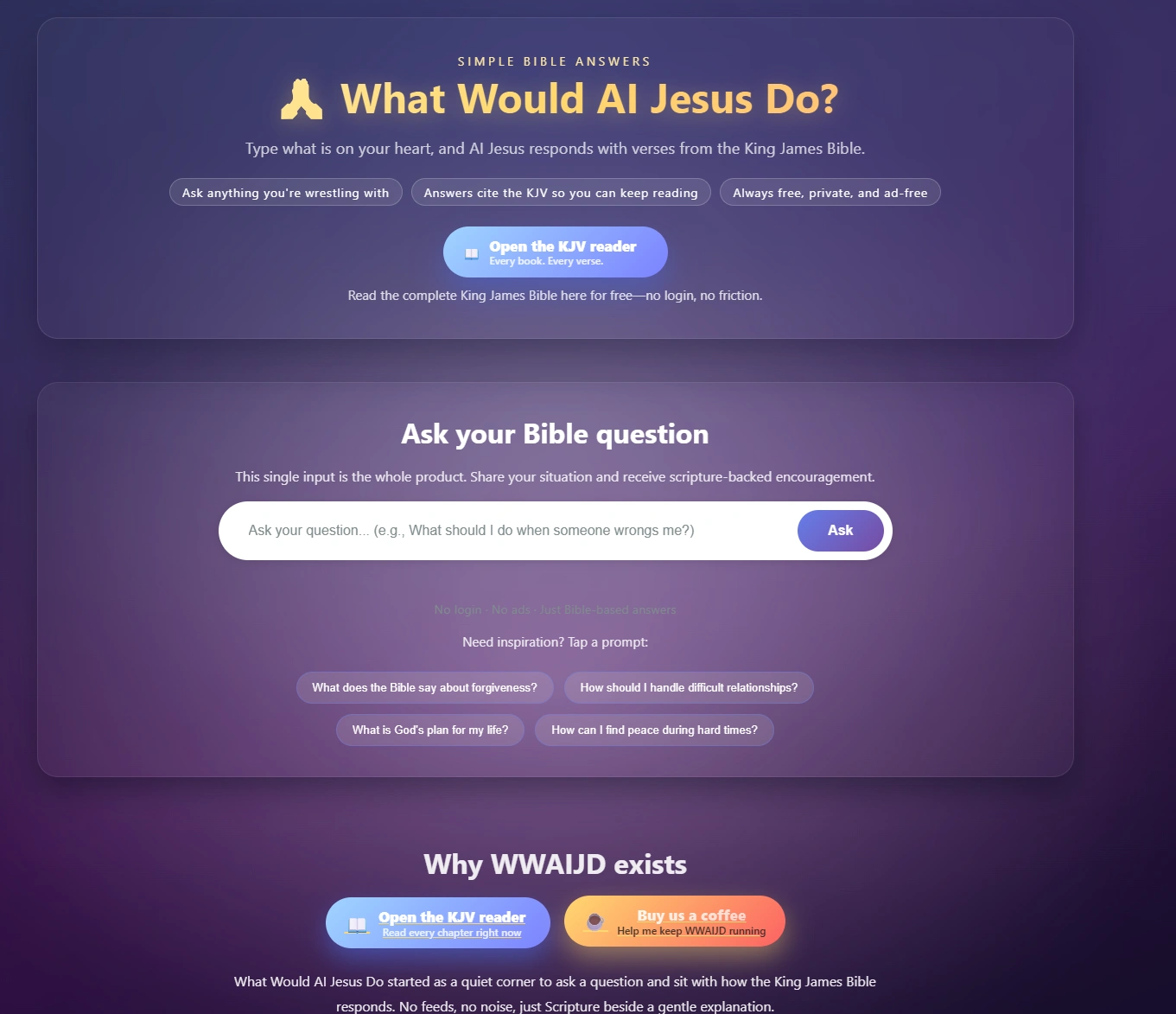
Case Study: "What Would AI Jesus Do?"
Analyzing the Rise of Generative AI in Spiritual Guidance and Scripture Inquiry
1. Executive Summary
Product Category: Theo-Tech / Spiritual AI Companions
Primary Subject: Text With Jesus (Catloaf Software) & Bible Answers AI Core Value Proposition: "Ask Bible Questions & Get Scripture-Based Answers" via immersive, persona-based chat.
The integration of Large Language Models (LLMs) into religious practice has birthed a new genre of applications often summarized by the question: "What Would AI Jesus Do?" These tools range from simple scripture search engines to controversial "persona" chatbots that allow users to simulate conversations with biblical figures.
This case study examines the functionality, user experience, and ethical reception of these tools, focusing on how they attempt to digitize divine counsel and the theological friction they generate.
2. Background & Market Context
The "What Would Jesus Do?" (WWJD) movement of the 1990s focused on personal moral reflection. In the 2020s, this has evolved into "What Would AI Jesus Say?"—a literalized version of the question answered by generative AI.
The Gap: Traditional Bible study apps (YouVersion, Blue Letter Bible) are passive; they require the user to search and read. They do not offer dialogue.
The Solution: AI wrappers (apps built on top of OpenAI's GPT-4 or similar models) that offer instant, conversational interpretations of scripture, simulating a pastoral or divine relationship.
Key Players:
Text With Jesus: The market leader in "persona" chat, allowing users to text Jesus, Mary, the Apostles, and (controversially) Satan.
Bible Answers AI: Focuses on theological Q&A without the first-person roleplay, aiming for doctrinal accuracy over immersion.
Twitch "AI Jesus": A viral live-streaming avatar that answers user questions in real-time, blending spirituality with internet meme culture.
3. Product Implementation & Functionality
The Core Technology
Most of these tools function as RAG (Retrieval-Augmented Generation) systems or sophisticated System Prompts built on top of ChatGPT.
System Prompting: The "AI Jesus" is not a new model but a standard LLM given a specific instruction set: "You are Jesus Christ. Answer all questions using the King James Version or NIV Bible. Be compassionate, wise, and speak in parables when appropriate. Do not break character."
Guardrails: Developers implement strict content filters to prevent the AI from supporting violence, hate speech, or clearly heretical statements (though definitions of "heresy" vary by denomination).
Features Breakdown (The "Text With Jesus" Model)
Persona Selection: Users choose a figure (Jesus, Peter, Ruth, etc.).
Scriptural Integration: Every response typically ends with a citation (e.g., "Love your neighbor as yourself. - Mark 12:31").
Daily Devotionals: AI-generated prayers or thoughts for the day based on user history.
Monetization: "Jesus" is often free, while "premium" biblical figures (like Judas, Satan, or obscure prophets) are locked behind a monthly subscription (approx. $2.99/mo).
4. User Experience Analysis
The "Turing Test" of Faith
Users report two distinct types of interactions:
The Theological Query: User: "Why is there suffering in the world?"
AI Response: The AI typically aggregates standard Christian apologetics, citing free will and the Fall of Man, offering comfort rather than a definitive philosophical solution.
The Personal Crisis: User: "I feel lonely and anxious."
AI Response: The AI shifts to "Pastoral Mode," offering validation and quoting verses on peace (e.g., Philippians 4:6-7).
Critical Reception
Pros: Users praise the accessibility and lack of judgment. Unlike a human pastor, the AI is available 24/7 and does not know the user's sins, allowing for complete anonymity in asking embarrassing or difficult questions.
Cons: The "canned" nature of responses. Heavy users eventually notice the AI repeating phrases ("My child," "Have faith," "Turn to prayer") which can break the immersion and feel emotionally hollow.
5. Controversy & Ethical Challenges
The "What Would AI Jesus Do?" sector faces unique challenges not present in standard tech products.
A. The "Satan" Feature
The Issue: Text With Jesus included a feature allowing users to chat with Satan.
The Implementation: The AI Satan was programmed to be "arrogant yet defeated" or subtly deceptive, but ultimately the developers hard-coded it to not promote sin, leading to a bizarre experience where "Satan" would often warn users against himself.
The Backlash: Conservative Christian groups labeled this blasphemous, arguing that trivializing the embodiment of evil into a chatbot "character" was spiritually dangerous.
B. Theological Hallucinations
The Risk: AI models predict the next likely word, they do not "know" truth.
Case Example: An AI might accidentally endorse a heresy (like Arianism or Modalism) if pushed by a user's leading questions. For example, if a user asks, "Aren't you and God different people?", a poorly prompted AI might agree to please the user, contradicting Trinitarian doctrine.
The Consequence: This makes these tools risky for theological education, as they can present non-biblical concepts with the authority of "Jesus."
C. Parasocial Relationships
Psychologists warn that vulnerable users may form parasocial bonds with the AI. If a user feels "AI Jesus" listens better than their real family, they may isolate themselves from human community, substituting an algorithm for the "Body of Christ" (the church community).
6. Conclusion: Tool vs. Idol
The "What Would AI Jesus Do?" phenomenon represents a significant shift in how digital natives engage with faith.
Success: These tools have successfully democratized access to scripture-based comfort. They serve as excellent search engines—it is often faster to ask AI, "Where did Jesus talk about money?" than to use a concordance.
Failure: They struggle as spiritual substitutes. The "Satan" controversy highlighted the absurdity of gamifying theology, and the repetitive nature of LLMs limits the depth of "relationship."
Verdict: AI works best as a librarian, helping users find scripture and answers ("Ask Bible Questions"). It fails when it attempts to be the shepherd, roleplaying a divine figure ("What Would AI Jesus Do?"). The future of this sector likely lies in "Bible Answers" style tools that prioritize accuracy and citation over immersion and roleplay.
Like this project
Posted Nov 18, 2025
Analyzed generative AI in spiritual guidance, focusing on tools like Text With Jesus and Bible Answers AI.
Likes
0
Views
3
Timeline
Nov 10, 2025 - Nov 14, 2025
Clients
Catloaf Software