Technical writing for B2B SaaS — two original articles

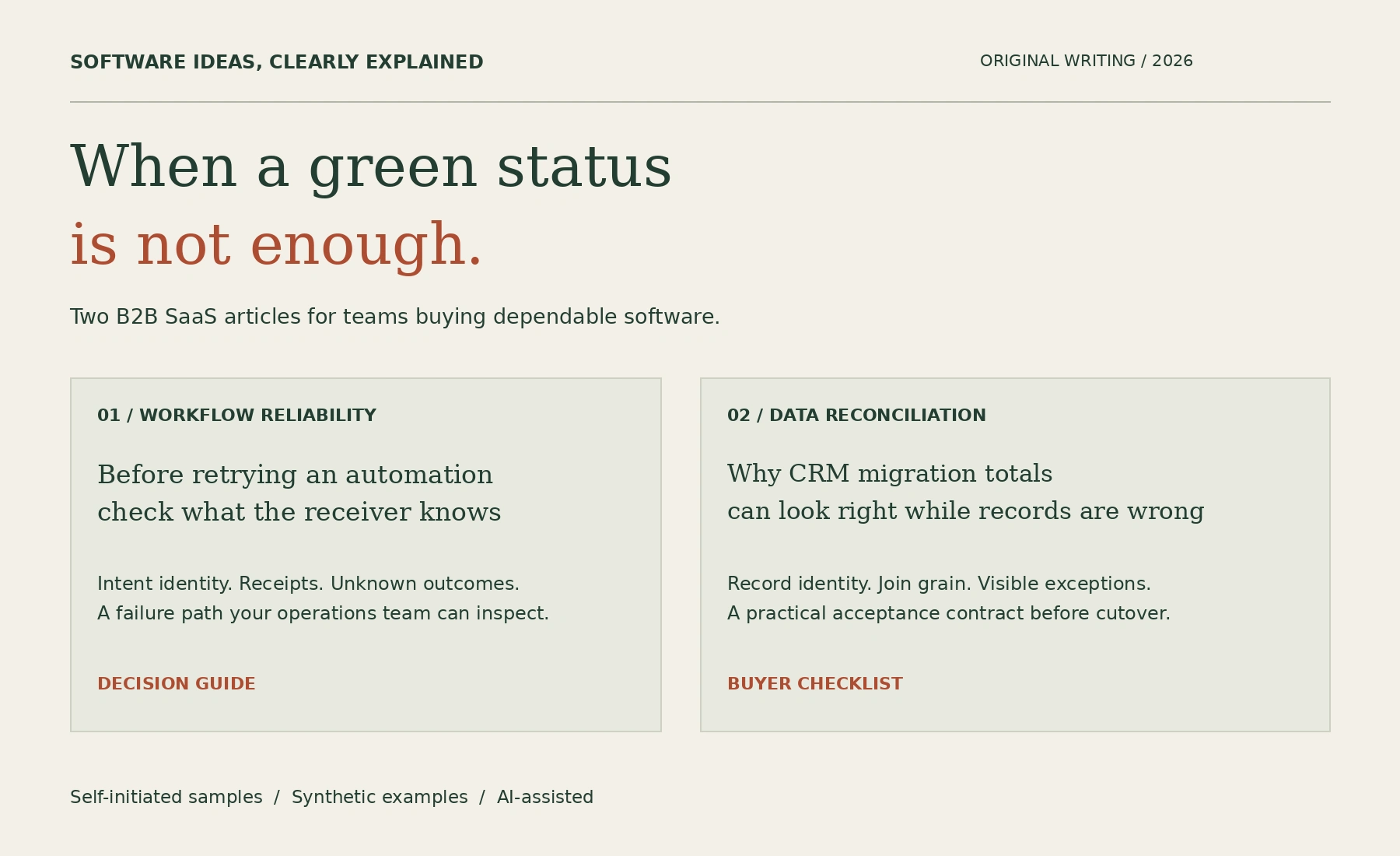
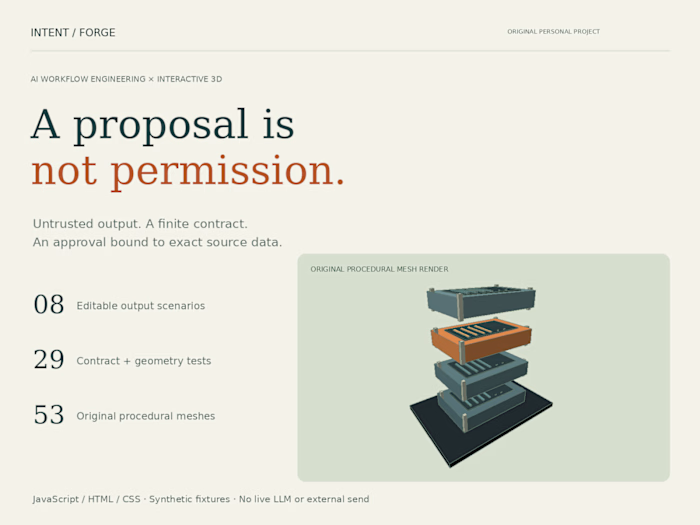
Two original B2B SaaS writing samples for operations leaders buying dependable software. Each explains a concrete failure, the business decision it creates and an inspectable acceptance step. The scenarios are synthetic. These are self-initiated samples developed with AI assistance, not commissioned client work or measured marketing results.
Before retrying an automation check what the receiver knows
Original self-initiated B2B SaaS writing sample. AI-assisted development; fictional scenario, no commissioned client results.
A customer support workflow sends a reply, waits for confirmation and times out. The dashboard offers a retry button. Someone clicks it because the customer is waiting. A second reply arrives, and the team now has to explain why its automation contacted the same person twice.
The problem started before that click. A timeout described what the sender knew: it had not received a response. It did not establish what the receiving service had done. For an operations team buying or maintaining automation software, that distinction should shape the recovery workflow.
Ask the supplier to show what happens after the receiver accepts an action but before the sender records success. A healthy retry policy needs a way to recognize the original action, recover its outcome and make unresolved cases visible. Adding more attempts cannot supply missing evidence.
Separate a failed request from an unknown outcome
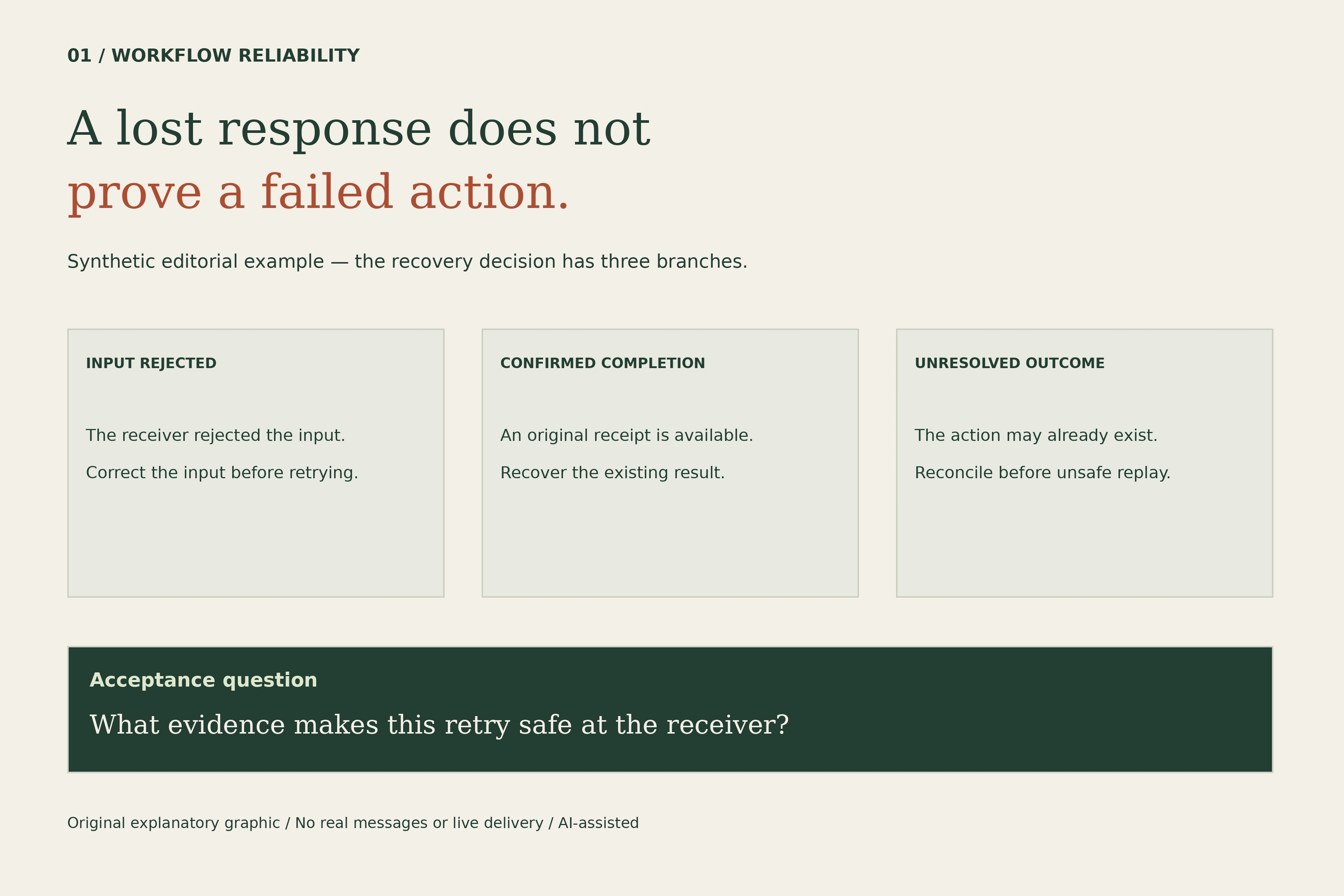
An invalid address can produce a clear rejection. A request that never left the sender may also be safe to attempt again. A lost response is different: the action might already exist at the receiver. Treating every red status as the same failure creates an avoidable decision problem for the person handling it.
A useful operations screen separates confirmed rejection, confirmed completion and unresolved outcome. It shows the request identity, the last attempt and the evidence available. An unresolved case should explain why recovery is waiting and which observation would allow it to continue. That is more useful than a generic error followed by an unrestricted retry control.
This does not require exposing database internals to every support agent. It requires translating those internals into an honest next action: retry safely, correct an input or reconcile the result.
Give the business action a stable identity
The same intended reply should retain the same request identity across repeated clicks and recovery attempts. That identity lets a compatible receiver distinguish another attempt at the original action from a genuinely new action.
Identical content is not enough to establish identical intent. A customer could legitimately request two identical reports. Conversely, two attempts at one report could have slightly different timestamps. The identity should represent the intended action rather than an accidental similarity between payloads.
The Amazon Builders' Library discussion of idempotent APIs explains the value of caller-supplied request identifiers. For a buyer, the practical follow-up is to inspect the receiver's actual contract: how it scopes those identifiers, binds them to inputs and retains the record of an outcome.
Check the receiver contract before relying on it
A sender can store an action in an outbox before attempting delivery. That helps preserve work across a restart, but it does not control what happens inside another service. If the receiver forgets the original request or does not recognize its identifier, the sender's durable record cannot prevent a second external action.
Ask what a repeated identifier returns. Does it recover the original receipt? What happens if the same identifier arrives with changed content? How long does the receiver retain its deduplication record, and can a late recovery attempt outlive that period?
These answers determine whether a retry is supported. If they are unknown, the product should hold the ambiguous case for reconciliation. A local label saying “idempotent” cannot substitute for a verified external behavior.
Preserve the relationship between review and dispatch
Safe recovery also needs to respect changes to the underlying work. Imagine that a support agent approves a response and then a new customer message arrives. The old approval remains useful as history, but it may no longer authorize sending that response.
Bind the approval to the version that was reviewed. Recheck it when accepting the send request and when claiming the queued work. Keep the edited draft visible if it becomes stale, so the reviewer can update it without rebuilding it from nothing.
There is still a boundary: a new message arriving after the local check can race an external delivery. Version checks protect the steps they govern; they do not freeze the customer or the remote service. A credible implementation makes that remaining window clear.
Make the failure demonstration part of acceptance
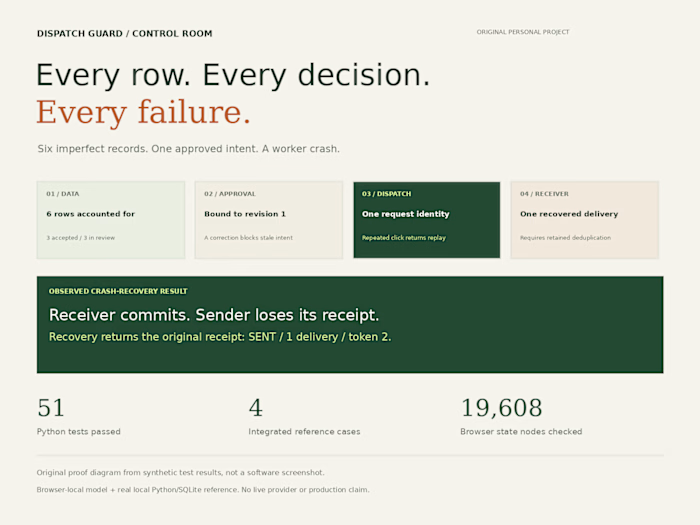
Before approving an integration, request a controlled demonstration with synthetic data. Have the receiver record an action, then deliberately interrupt the sender before it saves the acknowledgment. Restart the sender and inspect both systems. The expected result should include the external action count and the receipt used for recovery.
Repeat the demonstration with a double-click, changed inputs under the same identifier and an unavailable receiver contract. Test an expired worker attempting a late acknowledgment, too. Screenshots of a successful initial send do not answer those recovery questions.
For the operations interface, check whether a colleague can identify the unresolved case and its next step without asking an engineer to interpret a log. The failure path is part of the product your team will use.
Start with one consequential workflow
Choose an action whose duplication would matter, then define its intent, approval version, receiver behavior and reconciliation path. Agree what the failure test must show before expanding to additional workflows.
This creates a practical buying question: can the supplier demonstrate recovery at the boundary where an action may already have happened? If the answer is clear, the retry button becomes an informed operational choice. If the answer is unclear, resolve that contract before increasing retry volume.
Why CRM migration totals can look right while records are wrong
Original self-initiated B2B SaaS writing sample. AI-assisted development; synthetic example, no commissioned client results.
A migration dashboard shows the expected revenue total. The team signs off, switches systems and later discovers that several deals point to the wrong contacts. The total was accurate, but the migration was not. Money reconciled at one level while record identity and relationships failed at another.
For a SaaS operations lead planning a CRM migration, a matching grand total is useful evidence. It is not complete acceptance. The safer question is whether each source record has a traceable destination, each exception remains visible and each relationship follows an agreed rule.
You can establish that contract before moving live data. Begin with a small synthetic fixture that contains the mistakes your import must handle. Use its result to define what the migration report will account for and what remains a decision for the business.
Define what one row represents
Choose the unit of reconciliation explicitly: a deal, a contact or an association between the two. Each has a different identity. A table with one row per deal may become several rows per deal after joining contact associations. Summing the joined table can count a legitimate deal more than once.
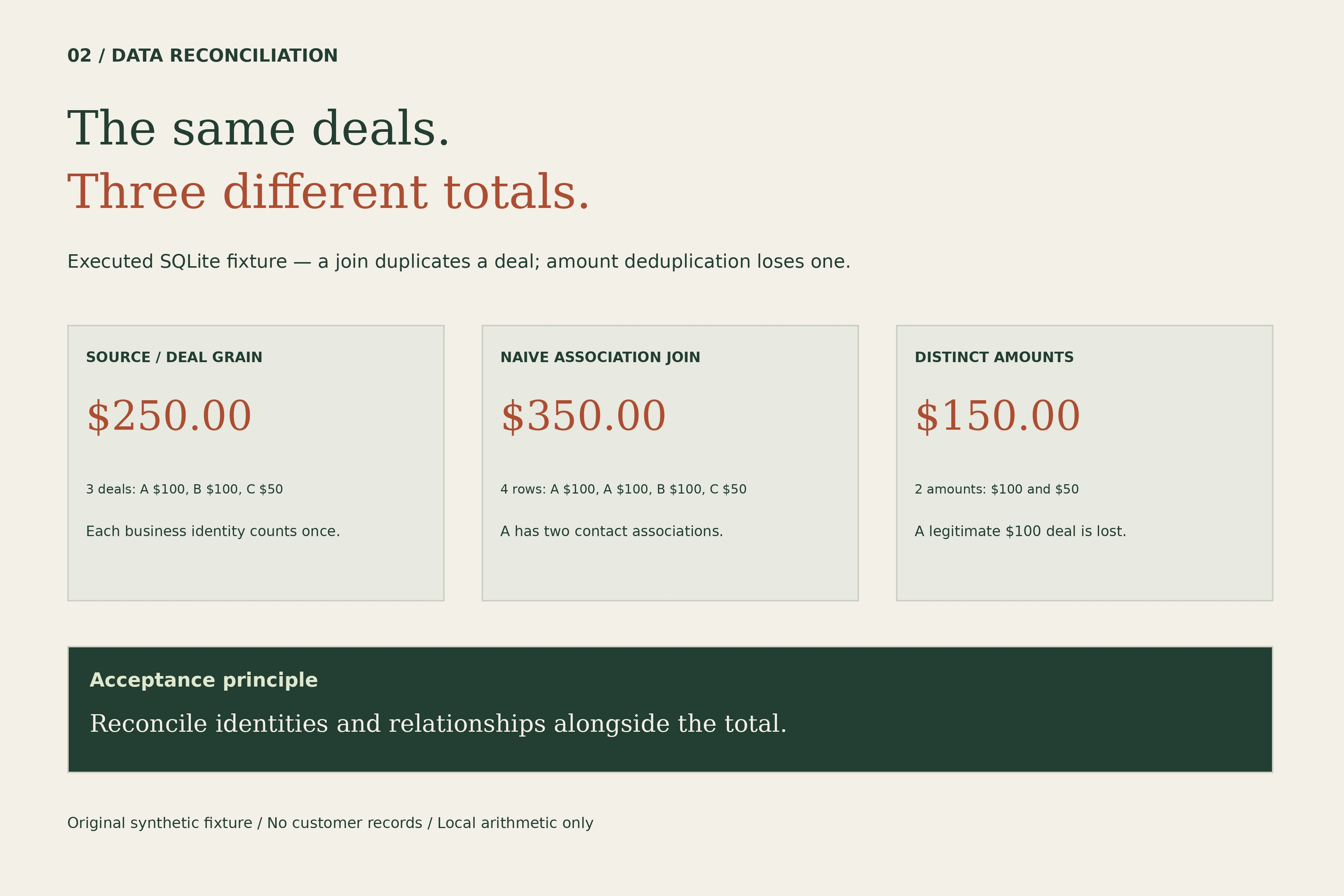
Consider three synthetic deals worth 100, 100 and 50 dollars. Two equal amounts belong to different deals. If the first deal has two contact associations, a straightforward association join produces four rows and a 350-dollar sum. The original deal total was 250 dollars.
Removing duplicate amounts would introduce a different error: the two genuine 100-dollar deals should remain distinct. Reconcile by deal identity, and treat contact relationships as a separate question. The arithmetic is simple; the difficult part is agreeing which entity the report describes.
Account for every source row
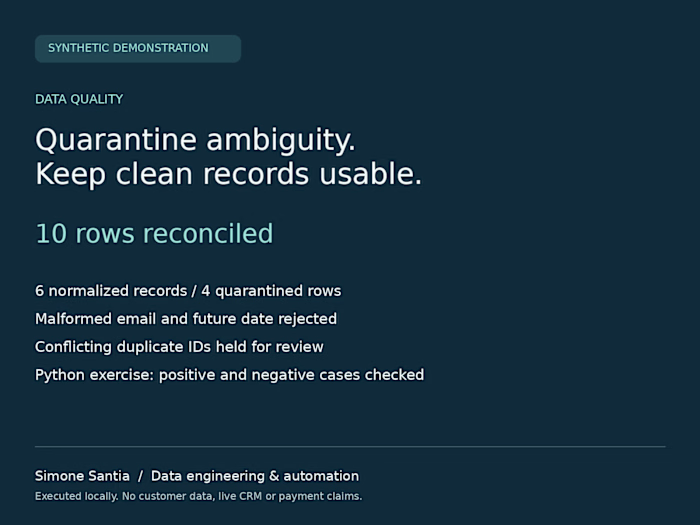
A migration report should explain the disposition of each input row. Accepted records, quarantined records and deliberately excluded records need clear meanings and reasons. A duplicate business identifier should remain visible with enough context to resolve the conflict.
For a declared import policy, input rows should reconcile to their recorded dispositions. If multiple source rows intentionally become one destination record, retain that mapping. Otherwise a lower destination count can hide either a valid consolidation or a missing record.
Ask to see the exception output before cutover. A useful exception names the source identity, the failing rule and the permitted next action. A generic “three records failed” message leaves the business to rediscover the underlying problem.
Keep missing amounts and currencies explicit
An unknown amount and a zero amount mean different things. Replacing every missing value with zero may make a dashboard easier to draw, but it can erase the distinction the business needs to resolve.
The PostgreSQL aggregate documentation distinguishes aggregation of non-null values from a result with no input rows. The migration report should preserve those meanings. State the known total alongside the count of records with unknown amounts, rather than presenting the known total as complete revenue.
Keep currencies separate unless an explicit conversion rule applies. A report containing USD and EUR needs currency-specific totals or a documented rate and conversion date. The same numeric amount in two currencies is not interchangeable. For monetary comparisons, choose an exact representation consistent with the source precision rather than relying on rounded display text.
Treat relationships as acceptance criteria
A correct deal count and total can coexist with wrong contact links. Define how the import chooses a primary contact, what it does when several candidates exist and how it handles a missing reference.
Prefer a visible exception to a guess that creates a plausible but incorrect relationship. The business may choose a deterministic rule, but that rule should be agreed and traceable. “Take the first row” is especially weak when source order can change between exports.
Inspect a small set of representative relationships in the target after the import. Include ambiguous and missing-reference fixtures, not only clean examples. If the target modifies identifiers or normalizes fields, retain enough mapping information to reconcile back to the source.
Test reruns and corrections separately
An import often needs to run again after an interruption. Replaying an unchanged source should follow the agreed identity rule without creating another copy of every record. A corrected source is a different test: it should update or quarantine the affected record according to policy, while keeping its earlier disposition inspectable.
Do not infer either behavior from a single successful import. Include an interruption, an unchanged rerun and a corrected-input run in the acceptance exercise. Where the database uses transactions, verify which changes belong to the same transaction and which external effects fall outside it. SQLite's transaction documentation describes local transaction behavior; a separate destination service still needs its own verified import contract.
Approve a reconciliation packet before cutover
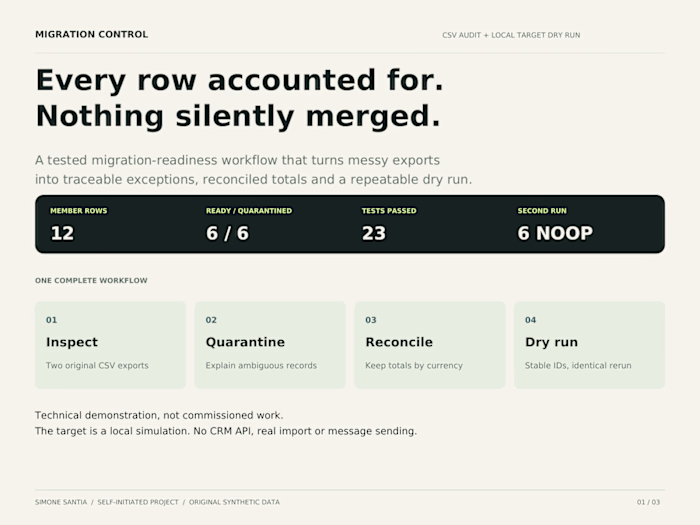
Ask the supplier for the source snapshot identity, entity counts, currency totals, unknown-value counts, exception file, relationship rules and rerun results. Review these together with the business owner who can resolve ambiguous records.
The first deliverable can be a bounded migration-readiness audit of a representative export. It should identify decisions needed before a live move, without quietly expanding into authentication changes or a production cutover.
A convincing migration report lets you follow a record from input to outcome. The grand total then supports acceptance alongside identity, relationships and recovery evidence. It no longer carries a promise it was never designed to prove.
Verification and scope
The sample arithmetic was executed in a local SQLite fixture: three deals total $250; a one-to-many association join inflates the total to $350. SUM(DISTINCT amount) incorrectly reduces it to $150. Source identifiers preserve the distinction. No client outcome or SEO ranking is claimed.
0 likes · 3 views · Oct 13, 2026
Two original B2B SaaS articles on automation recovery and CRM migration, with synthetic examples, checked arithmetic and primary-source links.