
🏥 HIPAA-Ready Health Data Platform on AWS
A production-grade, compliance-first healthcare data platform designed with security, observability, and operational maturity as non-negotiable requirements.
📌 Project Overview
This project demonstrates how to design, build, and operate a HIPAA-ready health data platform on AWS using modern DevOps and cloud-native best practices.
The platform securely handles Protected Health Information (PHI) while enforcing:
Strong identity and access controls
Encryption at rest and in transit
Immutable audit logging
Continuous observability
Disaster recovery and backup validation
This repository is intentionally structured to reflect real enterprise environments in regulated industries such as healthcare and fintech.
🎯 What This Project Proves
✅ Senior-level DevOps & Platform Engineering mindset ✅ Healthcare compliance awareness (HIPAA safeguards) ✅ Security-by-design architecture ✅ Production-ready CI/CD pipelines ✅ Operational maturity (monitoring, DR, auditability)
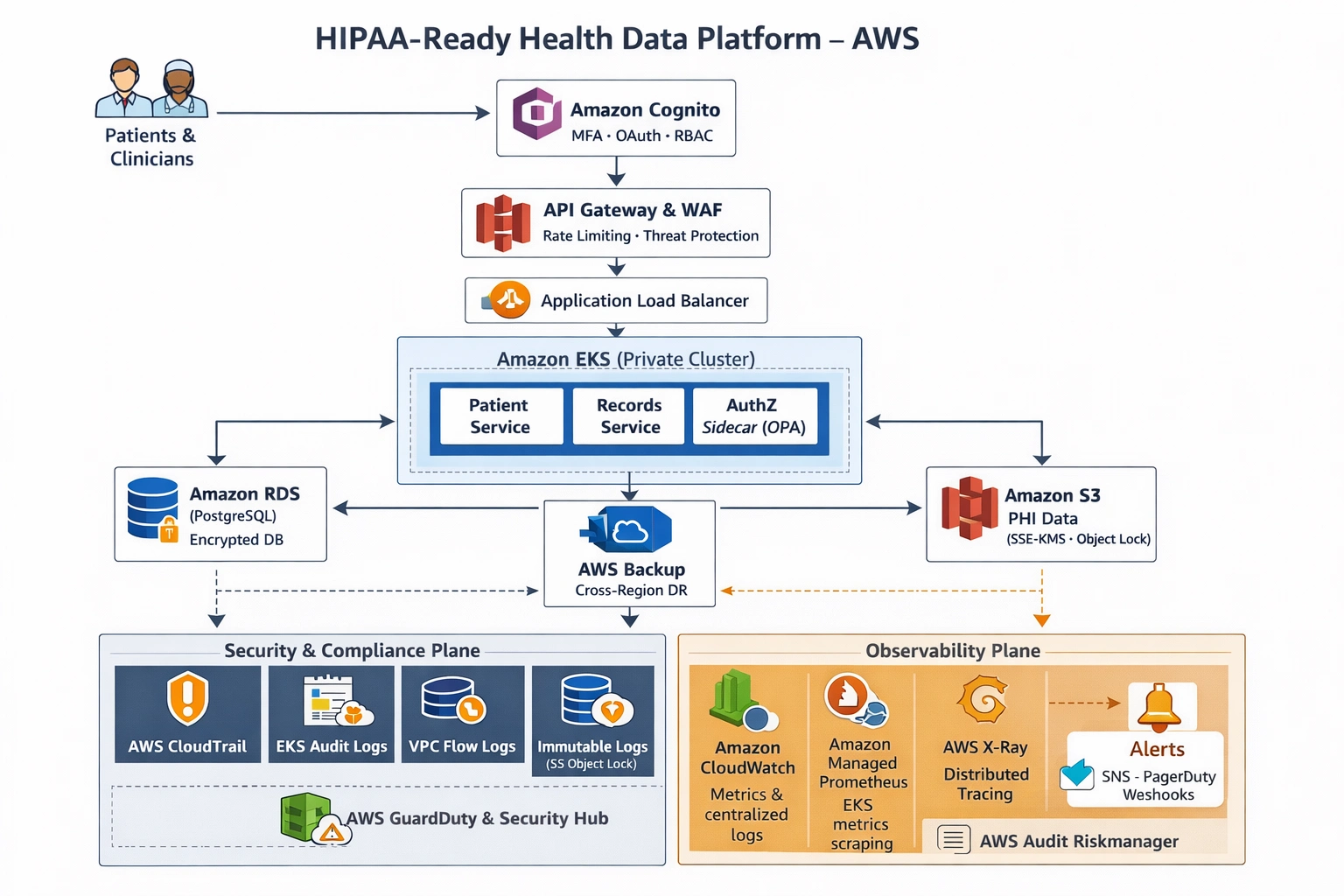
🧱 High-Level Architecture
Request Flow
Users → Cognito → API Gateway + WAF → ALB → EKS → RDS / S3
Control Planes
🔐 Security & Compliance Plane
📊 Observability Plane
💾 Backup & Disaster Recovery Plane
Full architecture diagrams are available in the /architecture directory.
🛠 Technology Stack
Cloud & Infrastructure
Amazon EKS (private cluster)
Amazon RDS (PostgreSQL) – Multi-AZ, KMS-encrypted
Amazon S3 – PHI storage, SSE-KMS, Object Lock
Amazon Cognito – MFA, OAuth2, RBAC
AWS KMS – Customer-managed keys
AWS Backup – Cross-region DR
Security & Compliance
AWS CloudTrail (org-wide)
EKS Audit Logs
VPC Flow Logs
AWS GuardDuty & Security Hub
IAM Roles for Service Accounts (IRSA)
OPA (policy-as-code)
Observability
Amazon CloudWatch (metrics & logs)
Amazon Managed Prometheus
Amazon Managed Grafana
AWS X-Ray (distributed tracing)
Alerts via SNS / PagerDuty
DevOps & IaC
Terraform (modular, multi-environment)
GitHub Actions (secure CI/CD)
Trivy (IaC + container scanning)
GitOps deployment model
🔐 Security & HIPAA Considerations
This platform is designed to align with HIPAA Administrative, Physical, and Technical Safeguards.
Key Controls Implemented
Least-Privilege Access
IAM + IRSA per service
No shared credentials
Encryption Everywhere
KMS-encrypted RDS, S3, EBS, secrets
TLS 1.2+ enforced
Auditability
Immutable logs (S3 Object Lock)
Centralized logging
Data Access Governance
Cognito RBAC
OPA authorization for PHI access
Compliance is treated as a system property, not a documentation exercise.
📊 Observability Strategy
The platform provides full visibility across metrics, logs, and traces.
Metrics
API latency & error rates
EKS pod and node health
RDS performance
Authentication failures
Logs
Application logs
EKS audit logs
API Gateway access logs
CloudTrail events
Traces
End-to-end request tracing via AWS X-Ray
Alerting
Security anomalies
Unauthorized access attempts
Infrastructure degradation
Backup failures
💾 Backup & Disaster Recovery
Automated backups using AWS Backup
Cross-region replication
Regular restore testing
Defined recovery objectives:
RTO: < 1 hour
RPO: < 15 minutes
Disaster recovery is tested, not assumed.
Backup Strategy
RDS automated backups with 35-day retention
S3 versioning for data protection
EBS volume backups with lifecycle policies
Automated restore testing (monthly)
Disaster Recovery Components
RDS read replicas in secondary region
S3 cross-region replication
Automated failover procedures
DR testing playbook with monthly drills
🚀 CI/CD Pipeline Overview
Security-First Pipeline Stages
Terraform format & validation
Trivy IaC scanning (fail on HIGH)
Container image scanning
Policy-as-code validation
Manual approval for production
GitOps-based deployment to EKS
A deployment that fails security checks is considered a successful pipeline outcome.
Pipeline Security Gates
The CI/CD pipeline implements multiple security gates to prevent misconfigurations:
terraform-validate: Validates Terraform configuration syntax and structure
trivy-iac: Scans infrastructure code for security vulnerabilities
opa-policy: Enforces policy-as-code compliance using Open Policy Agent
signed-artifacts: Verifies cryptographic signatures on deployment artifacts
📂 Repository Structure
🛡️ Security Best Practices & Secret Management
This project follows security best practices for handling sensitive information:
No Hardcoded Secrets
All sensitive values (passwords, API keys, etc.) are handled as variables
Variables are marked as
sensitive = true where appropriateSecrets are stored in AWS Secrets Manager or Parameter Store when deployed
Recommended Secret Configuration
Create a separate
terraform.tfvars file (not committed to version control) with sensitive values:.gitignore Configuration
The project includes a comprehensive
.gitignore file that prevents:Terraform state files
Variable files containing secrets
Local configuration files
Certificate and key files
Log files
Secure Deployment Process
Configure AWS credentials using AWS CLI or IAM roles
Create
terraform.tfvars file with your sensitive valuesRun
terraform plan and terraform apply from a secure environmentStore Terraform state in a secure, encrypted remote backend (S3 with KMS encryption)
🚀 Getting Started
Prerequisites
AWS account with appropriate permissions
Terraform v1.0+
AWS CLI configured
Initial Setup
Clone the repository
Navigate to the
terraform/ directoryCreate a
terraform.tfvars file with your sensitive values (see above)Run
terraform init to initialize providersRun
terraform plan to review the planned infrastructureRun
terraform apply to deploy the infrastructure0 likes · 7 views · Apr 7, 2026
Developed a HIPAA-compliant health data platform on AWS using DevOps best practices.


