MetalFlow: Multi-Tenant SaaS for Metal Fabrication

Andrew Balogun


Overview
Many fabrication shops still manage quote requests through email, manual CAD review, spreadsheets, and repeated customer follow-up. I built MetalFlow to turn that fragmented process into a branded, multi-tenant workflow from CAD intake to quote, order, and production visibility.
The customer product brings together projects, secure CAD uploads, sanitized 2D and 3D previews, manufacturability feedback, part configuration, carts, quotes, orders, and production tracking. A separate tenant-admin product covers customers, catalog, pricing, quotes, orders, operations, work centers, users, domains, and settings.
I built and owned the product definition, architecture, and implementation across the React interfaces, portal-specific Backend-for-Frontend layers, Java/Spring Boot backend, versioned API and event contracts, Scalar documentation, private C++ geometry engine, and GCP/Cloudflare delivery environment.
The Challenge
MetalFlow had to support real fabrication behavior rather than a simplified one-file checkout:
Customers may upload one part or an assembly, save configurations, order selected items, request a formal quote, submit a purchase order, or reorder later.
Every fabrication company needs isolated branding, users, catalog, commercial rules, data, storage, permissions, entitlements, and processing limits without a separate codebase.
CAD files are untrusted and frequently ambiguous. Missing units, open contours, unsupported entities, incomplete assemblies, or unsafe repairs can create expensive quote errors.
Customer interfaces, admin tools, integrations, and geometry workers cannot become competing sources of commercial truth.
The central problem was connecting customer self-service, fabrication operations, secure multi-tenancy, and specialized CAD processing while keeping manufacturing, commercial, and tenant authority on the server.
The Approach
Model the real manufacturing lifecycle
I modeled projects, file versions, parts, configurations, carts, quotes, orders, payment state, and production state separately.
That separation supports partial orders, revisions, purchase orders, repeat ordering, and locked commercial snapshots. A later project or pricing change cannot silently rewrite an accepted quote or manufacturing commitment.
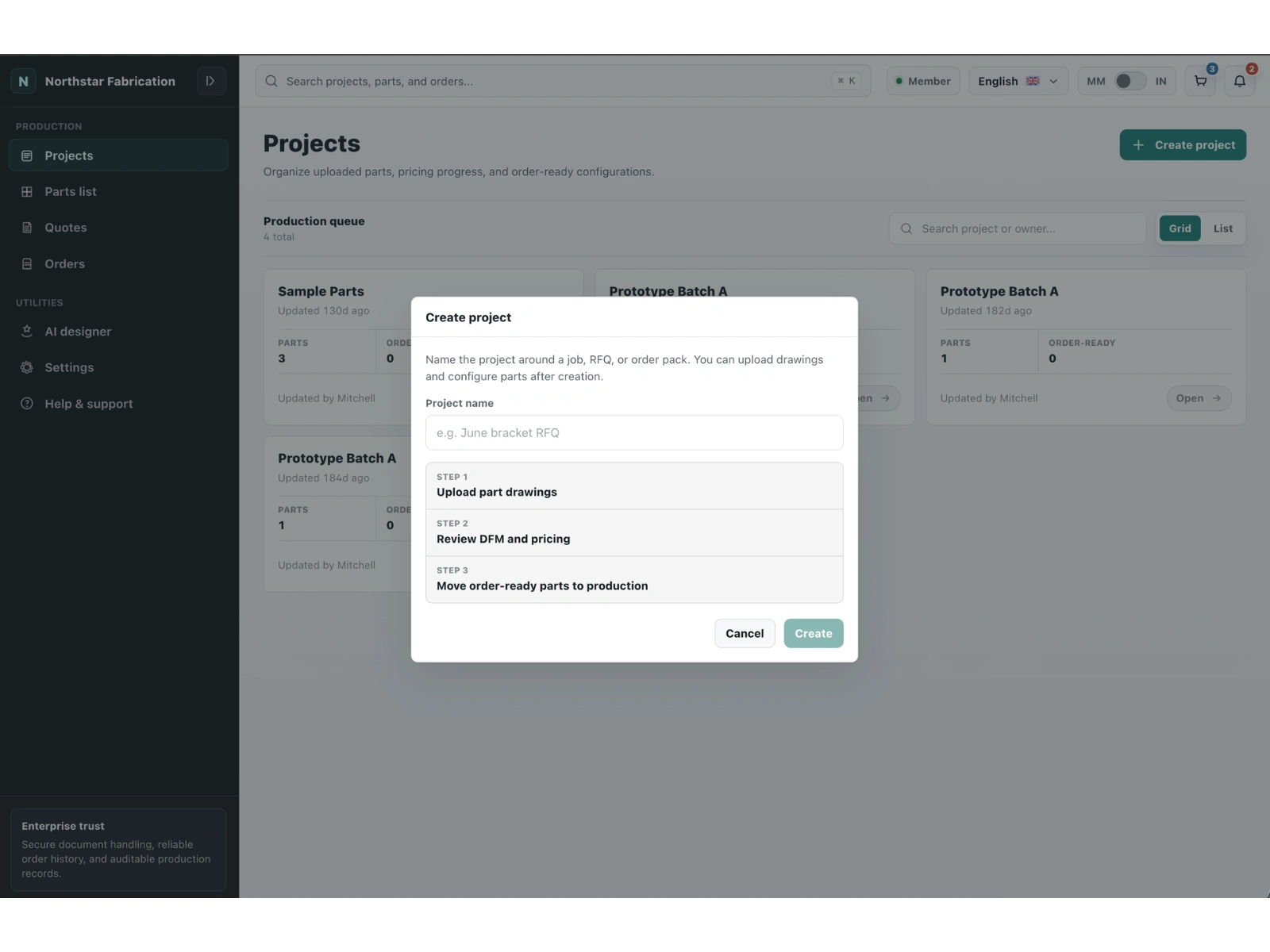
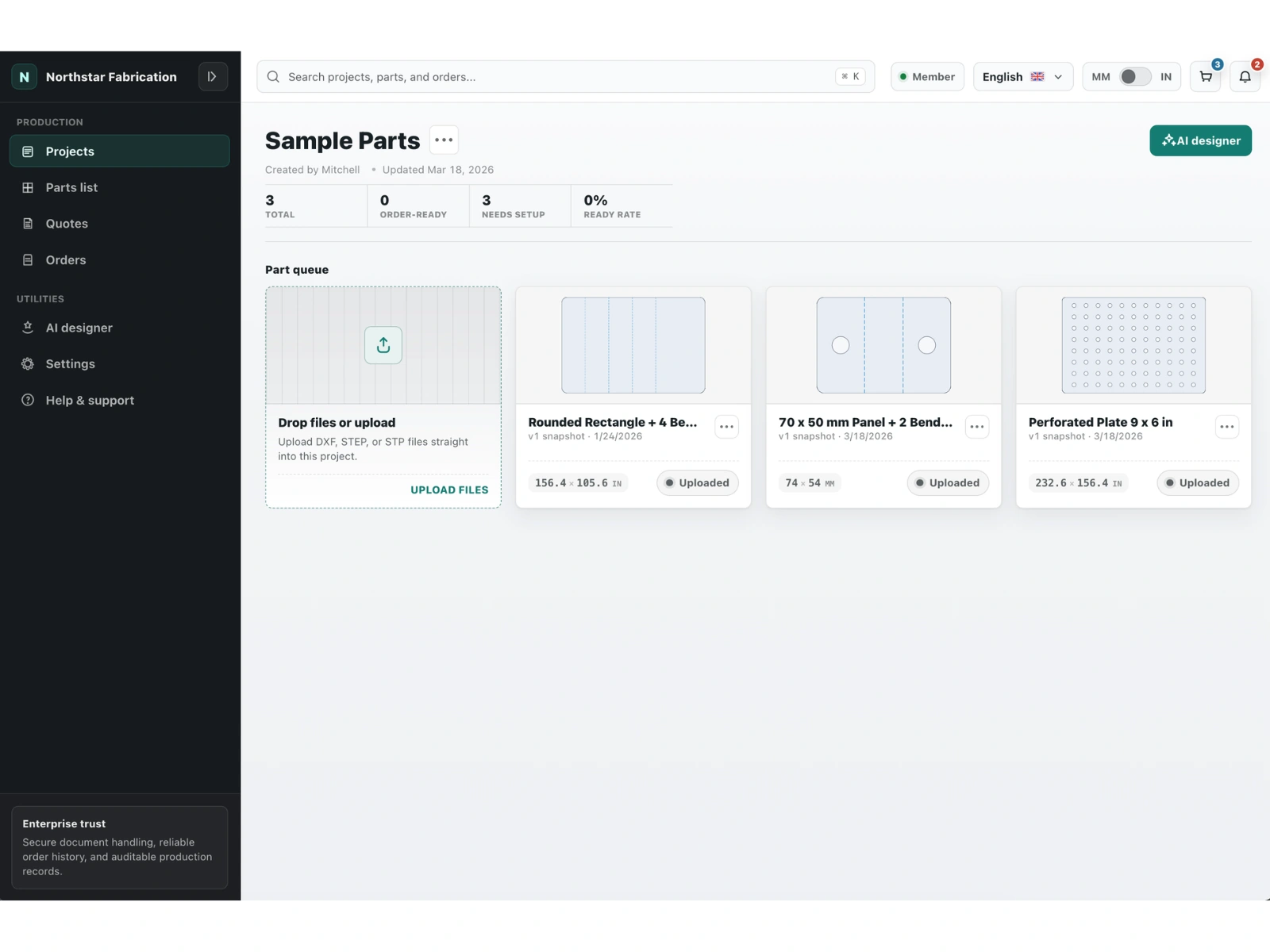
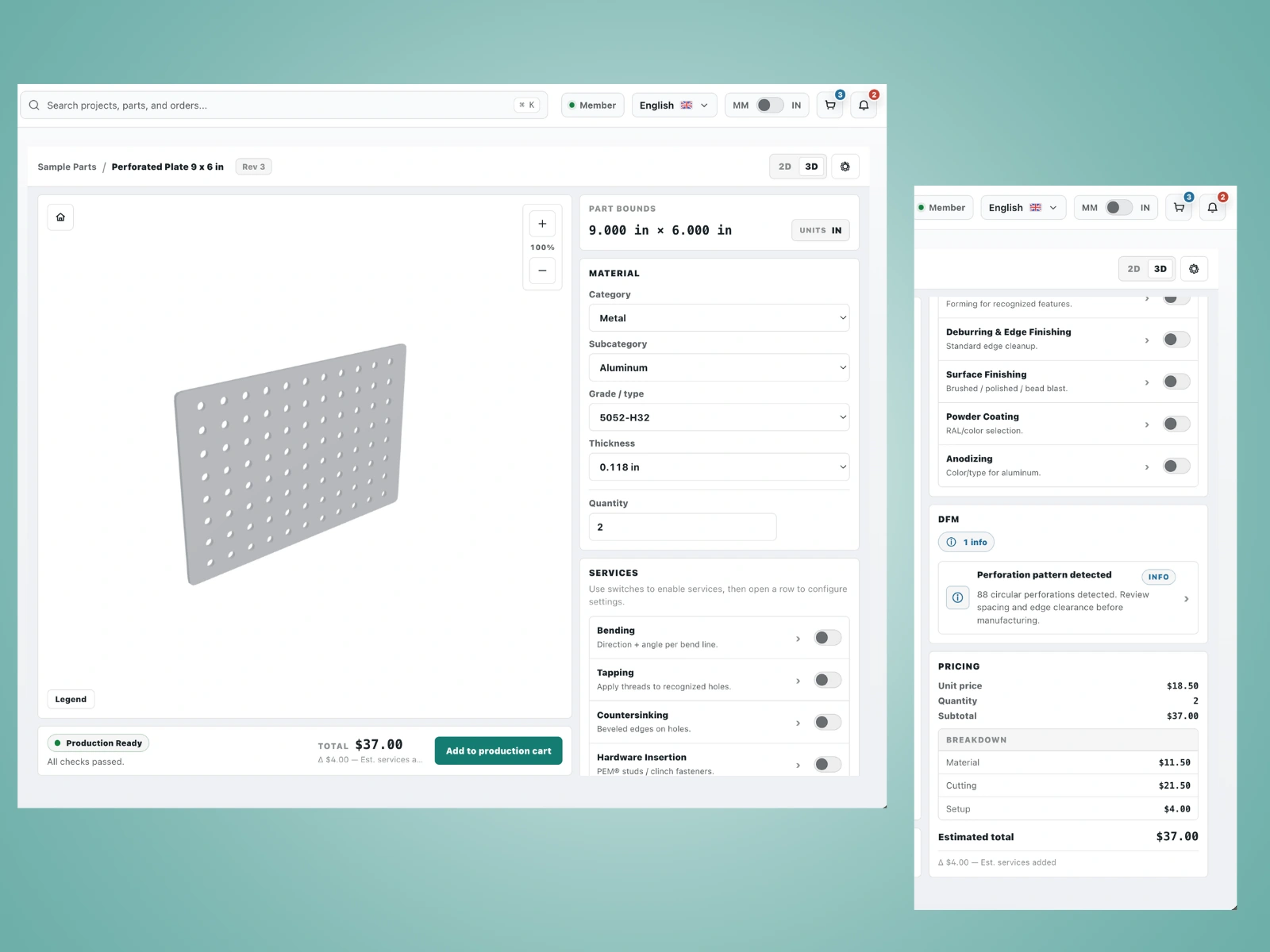
Caption: A buyer journey from organized CAD files to configured manufacturing work and a quote or order request.
Build connected customer and operator products
The customer portal covers projects, uploads, CAD review, configuration, manufacturability feedback, cart, checkout, quotes, orders, support, and production visibility.
The tenant-admin portal gives fabrication teams one workspace for customers, materials, services, pricing rules, credits, quotes, orders, production planning, operations, work centers, roles, domains, integrations, and audit activity.
Keep tenant and commercial authority on the server
Each portal uses its own Backend-for-Frontend boundary. The browser receives an opaque session rather than backend bearer tokens, while tenant identity is resolved from the verified hostname and authenticated server-side context.
The Spring Boot backend remains authoritative for permissions, tenant policy, pricing, quotes, orders, and workflow state. Policy checks, PostgreSQL Row-Level Security, tenant-scoped storage, entitlements, quotas, idempotent mutations, and audit records provide layered isolation.
Versioned OpenAPI, AsyncAPI, and JSON contracts keep the portals, backend, events, and workers aligned. GCP and Cloudflare provide the runtime, storage, edge, and custom-domain boundaries without exposing private processing services to the browser.
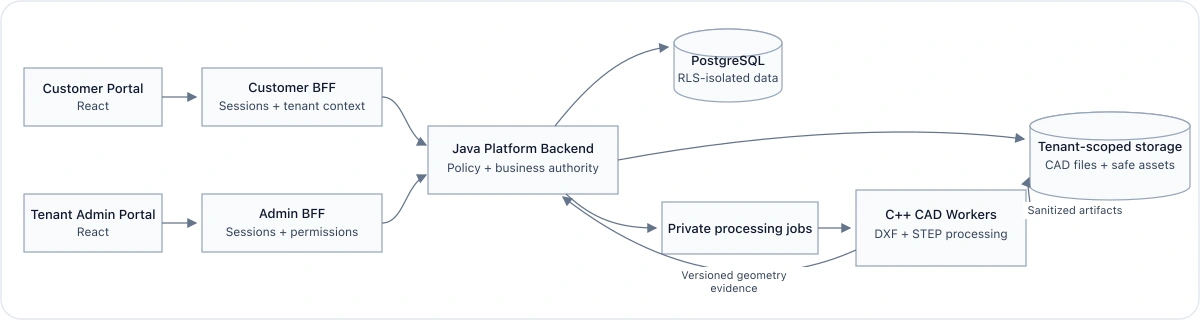
Caption: Portal-specific security boundaries protect sessions while backend services and storage keep tenant and commercial authority on the server.
Process CAD privately and fail closed
I built a private C++ geometry system for bounded DXF and STEP workflows. It verifies source identity and units, normalizes supported geometry, checks topology, extracts measurements and features, preserves supported assembly evidence, and generates sanitized 2D and 3D assets.
The engine produces traceable geometry evidence, not prices or tenant business state. Results are classified as safe for automation, requiring manual review, or blocked. Missing units, uncertain contours, unsupported geometry, unsafe repairs, incomplete topology, or unproven flat geometry are escalated rather than converted into a confident price.
Caption: Geometry processing produces traceable evidence and routes uncertainty to review instead of forcing a price.
Results
MetalFlow’s core platform is built and remains in controlled pre-launch development. The implemented scope includes the customer and tenant-admin products, secure portal sessions, tenant-aware backend workflows, versioned contracts and documentation, project and upload flows, private DXF/STEP processing, and GCP/Cloudflare delivery foundations.
In the latest controlled STEP checkpoint, 736 files were evaluated by the current automation gates:
406 were classified as safe for automation
321 required manual review
9 were blocked
The purpose of the checkpoint was to verify conservative routing rather than maximize the pass rate.
Together, the customer and tenant-admin products create one coherent journey from CAD intake and part configuration to quoting, ordering, operational control, and production visibility.
MetalFlow demonstrates the breadth of product engineering I bring to complex B2B SaaS: customer and operator experiences, manufacturing-domain modeling, secure multi-tenancy, backend authority, specialized processing, API contracts, validation, infrastructure, and controlled delivery designed as one system.
Like this project
Posted Jul 27, 2026
Designed and built a multi-tenant SaaS platform that takes metal fabrication shops from CAD intake to quoting, ordering, and production tracking, with private geometry processing, tenant-isolated security, and connected customer and operator portals.
Likes
0
Views
1
Timeline
Apr 15, 2026 - Ongoing