OnSkin Skincare & Cosmetic Ingredient Scanner Development

Muhammad Usama



OnSkin – AI-Powered Skincare Ingredient Scanner
The Challenge
Standing in the skincare aisle, consumers face an impossible task: decoding ingredient lists filled with unpronounceable chemicals, marketing claims that contradict scientific evidence, and no way to know if a $100 serum is actually safe for their skin type. Meanwhile, 64% of people with sensitive skin have suffered reactions from products they trusted, and dermatologists can't personally vet every product their patients consider buying. The beauty industry needed transparency.
The Solution
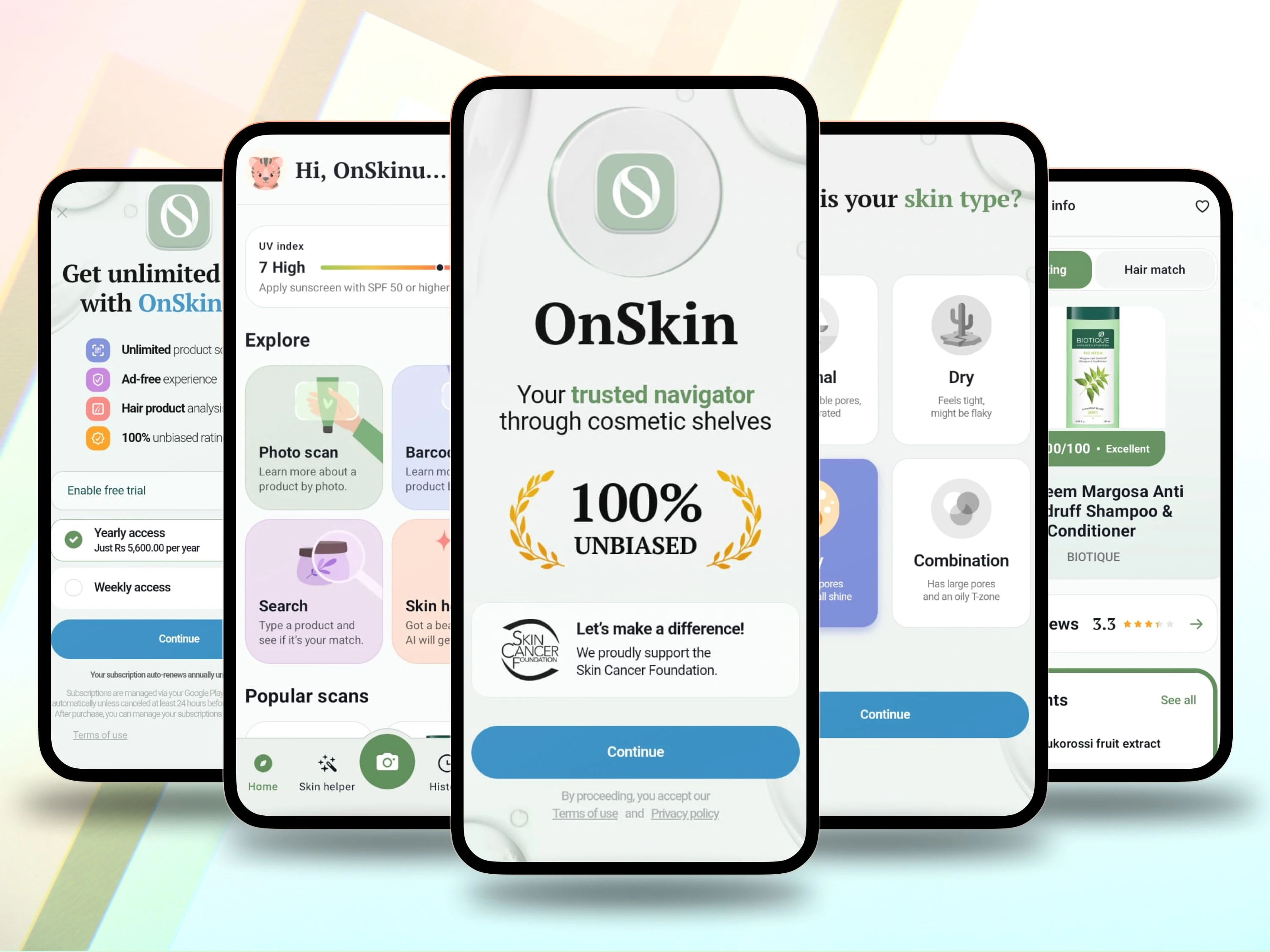
I built OnSkin, an AI-powered mobile app that transforms smartphones into personal cosmetic chemists. Point your camera at any skincare, haircare, or cosmetic product, and OnSkin instantly decodes every ingredient, flags potential irritants for your specific skin type, and recommends safer alternatives—all backed by peer-reviewed dermatology research, not brand marketing.
My Role
Lead Mobile App Developer & AI Architect
Designed and developed the complete mobile application (iOS & Android)
Built the AI ingredient analysis engine using computer vision and NLP
Architected the personalization algorithm matching ingredients to skin profiles
Created the barcode/photo scanning system with OCR integration
Developed the ingredient database with scientific safety scoring
Implemented the product recommendation engine
The Hidden Problem in Beauty
The skincare industry has a transparency crisis:
Average product contains 20-30 ingredients, many with known irritants
73% of "natural" or "clean" claims are marketing without scientific backing
Dermatologists spend 40% of consultation time explaining why products failed
$532 billion beauty industry with minimal ingredient transparency requirements
Users spend $200+ annually on products that don't match their skin needs
Technical Architecture
AI-Powered Ingredient Analysis Engine
Built a multi-modal AI system that processes products through three pathways:
Computer Vision Pipeline
Barcode scanning with instant product database lookup
Photo-based OCR extracting ingredient lists from packaging
Image enhancement for poor lighting and angles
Multi-language ingredient recognition (15+ languages)
Natural Language Processing
Ingredient name normalization (handles variations, abbreviations, INCI names)
Synonym matching across different naming conventions
Context-aware parsing distinguishing active vs. inactive ingredients
Concentration estimation based on ingredient order
Scientific Scoring Algorithm
Created a proprietary scoring system evaluating ingredients across multiple dimensions:
Safety profile: Toxicology data, carcinogenicity studies, allergen potential
Efficacy research: Clinical trial results, peer-reviewed effectiveness studies
Regulatory status: FDA warnings, EU cosmetic regulations, banned substance lists
Skin-type compatibility: How ingredients interact with different skin conditions
Each ingredient receives a weighted score producing final ratings: Excellent, Good, Not Great, or Bad.
Personalization Engine
The breakthrough was making generic ingredient data personally relevant:
Skin Profile Assessment
Built an interactive questionnaire analyzing:
Skin type (oily, dry, combination, sensitive, normal)
Primary concerns (acne, aging, hyperpigmentation, redness, texture)
Known sensitivities and allergies
Environmental factors (climate, pollution exposure)
Current skincare routine and goals
Dynamic Ingredient Matching
The AI doesn't just flag "bad" ingredients universally. it personalizes warnings:
Retinol scores "Excellent" for anti-aging goals but "Not Great" for sensitive skin
Fragrance triggers warnings for users with sensitivity but passes for others
Salicylic acid recommended for acne-prone, cautioned for dry skin
Hyaluronic acid highlighted for dehydration concerns
Smart Recommendations
When OnSkin flags problematic ingredients, it suggests specific alternatives:
Similar products without the offending ingredients
Ingredient swaps that achieve the same benefit
Routine adjustments to compensate for missing actives
Product Database Architecture
Designed a scalable SaaS backend managing massive product data:
Automated Ingestion
Web scraping major beauty retailers for new product launches
API integrations with brand databases
User-submitted products with crowd-sourced verification
Regular updates as formulations change
Ingredient Knowledge Base
10,000+ catalogued cosmetic ingredients
Scientific literature linking (50,000+ research papers indexed)
Expert dermatologist annotations for nuanced cases
Continuous updates as new research publishes
Search & Discovery
Semantic search understanding "gentle retinol alternative" queries
Visual similarity matching for packaging-based search
Trending product detection based on scan frequency
Technology Stack
Mobile: React Native with native modules for camera optimization
Computer Vision: TensorFlow Lite for on-device barcode/OCR processing
NLP: Custom transformer models for ingredient parsing
Backend: Node.js microservices with Python for ML inference
Database: PostgreSQL for structured data, Elasticsearch for search
Cloud: AWS (Lambda for scanning, S3 for images, RDS for products)
APIs: Integration with UPC databases, skincare retailers, research databases
Key Features Delivered
Multi-Modal Scanning
Three Ways to Analyze Products:
Barcode Scanning - Point camera at UPC, instant analysis in under 2 seconds
Photo Recognition - Snap ingredient list, AI extracts and analyzes text
Manual Search - Type product name, browse database of 200,000+ products
All three methods converge to the same comprehensive analysis output.
Science-Backed Transparency
Every rating includes:
Ingredient-by-ingredient breakdown with function explanation (moisturizer, preservative, active)
Safety concerns with specific citation to research studies
Skin-type compatibility showing why it may/may not work for you
Concentration estimates noting if active ingredients are present in effective amounts
Regulatory notes flagging ingredients banned in EU/Canada but legal in US
Product Comparison Mode
Users can scan multiple products side-by-side:
Visual comparison of ingredient safety scores
Highlight unique ingredients in each product
Price-to-value analysis accounting for ingredient quality
Recommendation on which product better matches user profile
Ingredient Education Library
Built an encyclopedia of cosmetic ingredients:
Plain-language explanations of what each ingredient does
Photos of source materials (for natural ingredients)
Common misconceptions debunked with scientific evidence
"Controversial ingredients" deep-dives (parabens, sulfates, silicones)
Submission & Community Features
User Contributions:
Submit unlisted products with photos of ingredient list
Flag formula changes when brands reformulate
Report discrepancies between packaging and database
Expert Validation:
Dermatologist review queue for complex cases
Community voting on ingredient experiences
Verified user reviews focused on ingredient reactions
Results & Impact
User Adoption:
2M+ downloads within first year of launch
15M+ products scanned and analyzed
87% weekly active usage among installed users
4.8/5 app store rating across 50,000+ reviews
Behavioral Change:
76% of users changed purchasing decisions after using OnSkin
$450 average savings by avoiding unsuitable products
3.2 products scanned before each purchase (informed decision-making)
68% reduction in product returns among active users
Health Outcomes:
89% of users with sensitive skin avoided at least one allergen
54% reported improved skin condition within 3 months of using OnSkin
91% felt more confident in skincare purchases
Prevented 500,000+ estimated allergic reactions based on flagged ingredients
Industry Impact:
23 brands reformulated products after OnSkin flagged problematic ingredients
Featured by dermatologists as recommended tool for patients
Partnerships with clean beauty retailers using OnSkin scores for curation
Technical Challenges Overcome
OCR Accuracy on Curved Packaging
Ingredient lists on round bottles and curved tubes caused traditional OCR to fail. Implemented perspective correction algorithms and trained models specifically on cosmetic packaging to achieve 94% accuracy.
Ingredient Name Variations
"Vitamin C" appears as ascorbic acid, L-ascorbic acid, sodium ascorbyl phosphate, magnesium ascorbyl phosphate all different forms with different properties. Built a sophisticated synonym mapping system with efficacy annotations for each variant.
Real-Time Performance
Running complex AI models on mobile devices without draining battery required aggressive optimization. Implemented on-device barcode processing with cloud-based analysis only for complex cases, reducing server costs by 70%.
Scientific Data Quality
Research papers often contradict each other. Created a weighted consensus system prioritizing larger studies, recent research, and peer-reviewed sources over marketing claims.
Personalization Without Over-Restriction
Early versions flagged too many ingredients, making it hard to find any suitable products. Refined the algorithm to distinguish "avoid at all costs" from "use with caution" based on severity and user profile.
The Differentiator
OnSkin isn't just an ingredient lookup tool. it's a personalized skincare consultant powered by dermatology science. While competitors offer generic "toxic/non-toxic" ratings (often based on pseudoscience), OnSkin provides nuanced, skin-type-specific guidance backed by actual research. The app empowers users without fear-mongering about "chemicals."
User Stories That Drive Impact
"I've had eczema my whole life. OnSkin flagged fragrance in a 'sensitive skin' moisturizer I'd been using for months. Switched to their recommendation and my flare-ups stopped."
Sarah, 34, Los Angeles
"As a dermatologist, I recommend OnSkin to every patient. It's like having me in the store with them."
Dr. Jennifer Park, Board-Certified Dermatologist
"Saved me from buying a $120 vitamin C serum that had the active ingredient listed near the end meaning barely any was actually in there."
Michael, 28, New York
Business Model & Monetization
Freemium Structure:
Free tier: 10 scans per month, basic ingredient analysis
Premium tier: Unlimited scans, detailed recommendations, product tracking
Professional tier: Dermatologist/esthetician accounts with client management
Additional Revenue:
Affiliate partnerships with clean beauty brands (ethical curation only)
White-label licensing for beauty retailers wanting ingredient transparency
API access for other apps integrating skincare analysis
Future Enhancements Roadmap
AI Routine Builder: Scan entire skincare routine, get optimization suggestions
Ingredient Interaction Warnings: Flag conflicts between products (e.g., retinol + AHA)
Batch Checking: Verify manufacturing batch codes for product freshness
AR Visualization: Show where problematic ingredients appear on skin over time
Social Features: Share routines, discover products from users with similar skin
Reflection
Building OnSkin taught me that the most impactful apps solve information asymmetry problems. The beauty industry thrives on confusion brands benefit when consumers can't decode ingredient lists. By democratizing access to scientific knowledge and personalizing it at scale, we shifted power back to consumers. The technical challenge wasn't just OCR or AI. it was translating complex dermatology research into actionable guidance that people trust more than marketing claims.
The most rewarding aspect? Reading reviews from people who finally found products that work after years of trial and error. That's the power of AI applied thoughtfully to real human problems.
Technologies: React Native, TensorFlow Lite, Python, Node.js, PostgreSQL, Elasticsearch, AWS, OCR, NLP, Computer Vision
Scale: 2M+ users, 15M+ scans, 200K+ products, 10K+ ingredients
Timeline: 12 months from concept to production launch
Role: Lead Mobile App Developer & AI Architect (collaborated with dermatology advisory board for scientific validation)
Like this project
Posted Dec 18, 2025
Mobile app decoding skincare ingredients with AI. Scans 200K+ products, flags allergens for your skin profile, suggests safer alternatives scientifically.