Go-Live Readiness & Hypercare Control Plan

Garrett Burbidge

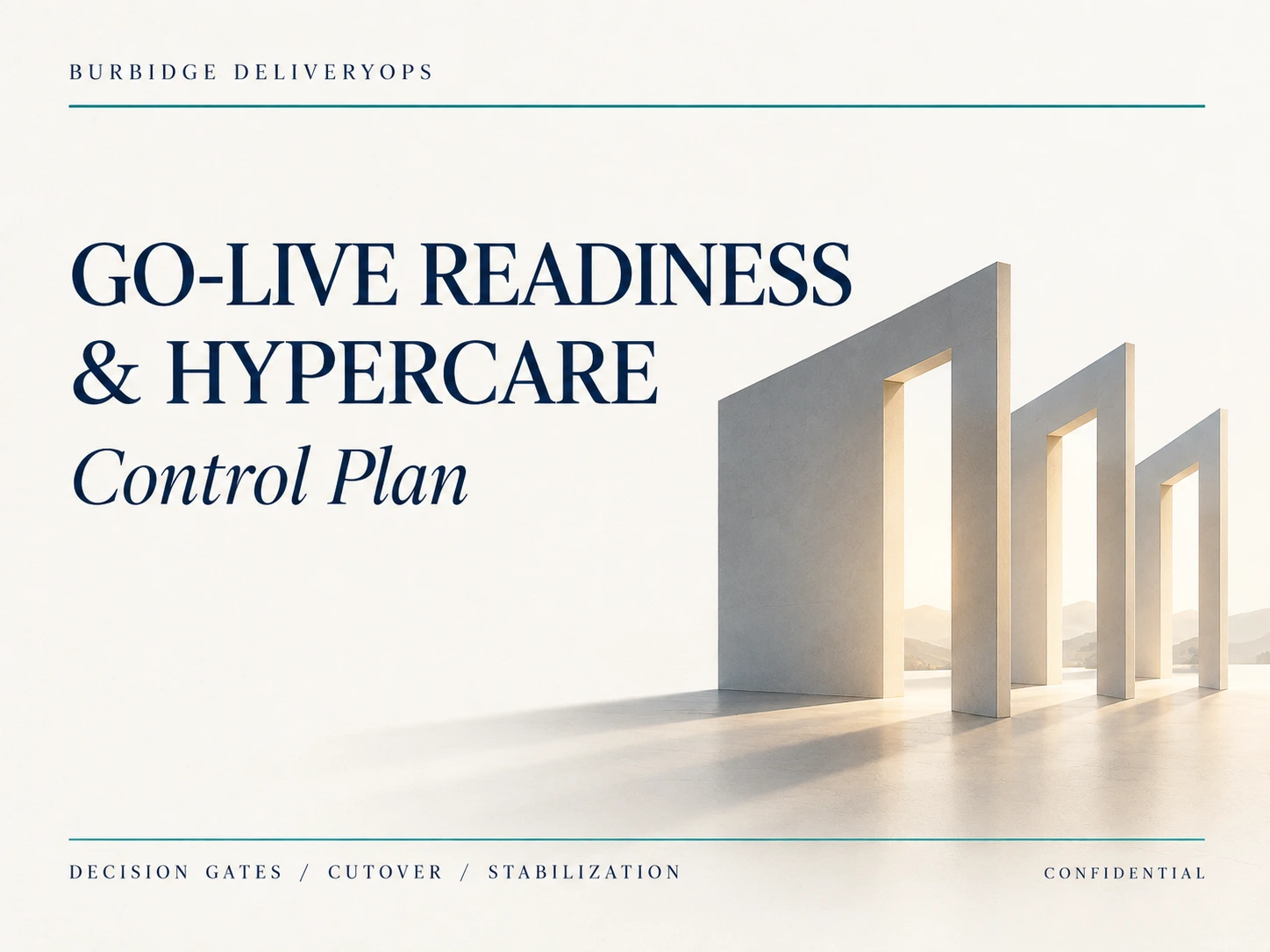
GO-LIVE READINESS & HYPERCARE CONTROL PLAN
Burbidge DeliveryOps | Original operational framework
Organization reference: CONFIDENTIAL
PURPOSE
A practical control system for moving a SaaS implementation from delivery into stable operations. This work product connects evidence-based launch decisions, a sequenced cutover, incident ownership, and measurable support handoff criteria. It defines intended operating controls rather than reporting a client engagement or achieved results.
DEFINE THE RELEASE BOUNDARY
Before scheduling the readiness review, document the release scope, affected user groups, critical workflows, integrations, migration populations, support hours, approved outage window, and recovery objectives. Assign named owners and deputies for each workstream. Record what is excluded so late requests do not silently become launch commitments.
READINESS GATES
Business readiness — Process owner confirms critical user journeys passed acceptance testing, designated users completed role-based preparation, and workarounds are documented and approved. Evidence: signed acceptance record, training completion list, and operating procedures.
Data readiness — Data owner confirms reconciliation of source and target record counts and control totals, investigation of exceptions, and approval of the final migration sequence. Evidence: reconciliation report, exception log, and recovery validation.
Technical readiness — Technical lead confirms critical integrations, access permissions, monitoring, backups, and recovery procedures were tested. Evidence: test results, access review, alert routing, and recovery rehearsal record.
Support readiness — Service owner confirms the intake channel, coverage roster, severity rules, escalation contacts, knowledge articles, and support handoff pack. Evidence: acknowledged roster and completed support walkthrough.
Release readiness — Release manager confirms task dependencies, communications, change freeze, rollback authority, and the latest safe rollback decision point. Evidence: approved runbook and rehearsal findings.
GO / CONDITIONAL GO / NO-GO
GO: Every mandatory gate has current evidence, accountable approval, and no unresolved launch-blocking issue.
CONDITIONAL GO: Only non-blocking gaps remain. Each requires a documented workaround, named owner, due date, monitoring plan, and explicit acceptance by the accountable business and technical owners. A conditional decision must not waive data integrity, security, or recovery controls.
NO-GO: Any mandatory gate lacks approval; a critical workflow cannot operate safely; reconciliation remains unexplained; or the recovery path is unproven. Pause and replan rather than downgrade the blocker to meet a date.
The executive sponsor authorizes launch after reviewing business, technical, and service-owner recommendations. Capture the decision, timestamp, evidence links, exceptions, approvers, and next review point in one decision record.
CUTOVER CONTROL SEQUENCE
T−10 business days: Confirm scope and owners, rehearse the cutover, measure task durations, and resolve rehearsal gaps.
T−5: Review readiness evidence, agree support coverage, and distribute user communications.
T−1: Revalidate approvals, freeze changes, confirm backup and recovery readiness, and conduct the final go/no-go review.
T0: Open the command bridge; execute the approved backup, migration, deployment, reconciliation, and smoke-test sequence; release users only after the designated acceptance checkpoint.
T+1: Review adoption, critical workflow execution, incident volume, reconciliations, and staffing before expanding usage.
These relative checkpoints are planning defaults, not a promised delivery schedule. Adjust them to release complexity and approved service requirements.
Runbook fields: task ID, dependency, planned start, expected duration, executor, validator, completion evidence, actual finish, and rollback impact. The release manager owns the authoritative runbook; parallel teams must not maintain conflicting status records.
ROLLBACK AND EXCEPTION CONTROL
Define measurable rollback triggers before launch: failed critical workflow validation, unexplained data discrepancies, unavailable essential integrations, or loss of the approved recovery margin. Establish a timeboxed investigation window within the available recovery budget.
The technical lead assesses reversibility; the business owner assesses operational impact; the designated release authority records the rollback decision. Preserve logs, reconcile transactions created after cutover, communicate the operating state, and validate recovery before resuming service. Do not assume a database restore alone reverses every external transaction.
HYPERCARE OPERATING RHYTHM
Use one incident register with severity, business impact, affected users, workaround, incident owner, technical owner, next update time, and resolution evidence.
P1: Critical business service unavailable, material data integrity concern, or security exposure. Activate the incident bridge immediately and involve the relevant response owners.
P2: Material degradation with a controlled workaround. Assign a lead and a timeboxed recovery plan.
P3: Limited impact, questions, or minor defects. Route through normal triage and prioritize against the stabilization backlog.
Agree response and update intervals with service owners before launch; do not imply an uncontracted round-the-clock service level. Review critical incidents continuously, hold a daily stabilization review, and issue one concise daily sponsor update.
EXECUTIVE STABILIZATION VIEW
Track critical workflows passed against total critical workflows; reconciled records against migration population; open incidents by severity and age; backlog inflow versus closures; trained active users against intended users; and ownership of outstanding exceptions. Every metric needs a source, owner, reporting cutoff, and threshold agreed before launch. Missing data is unknown, not green.
Sponsor update: overall decision status; business impact; changes since the prior update; top three blockers; decisions needed with owners and deadlines; next checkpoint.
EXIT TO STEADY-STATE SUPPORT
Exit hypercare only when critical workflows meet their approved acceptance criteria; no P1 incident remains open; residual P2 items have accepted workarounds and ownership; data controls reconcile; and service owners accept coverage, documentation, monitoring, and the remaining backlog. Require a pre-agreed stability observation period rather than exiting solely because a calendar date arrived.
The handoff pack contains the support runbook, known-error register, ownership matrix, access and monitoring references, open-change backlog, decision history, and retrospective actions. Business and service owners record acceptance.
DESIGN INTENT
Make launch authority explicit, keep operational risk visible, and prevent project closure from becoming an unsupported transfer of unresolved work. No client-identifying information or confidential operational records are included in this public portfolio presentation.
Like this project
Posted Sep 28, 2026
An original DeliveryOps framework for readiness gates, go/no-go decisions, cutover control, incident triage, and handoff to steady-state support.
Likes
0
Views
1