Healthcare Facilities Distribution and Funding Analysis

Adeniyi Ayeni

HEALTHCARE FACILITIES DISTRIBUTION AND FUNDING ANALYSIS
Overview
This report analyzes the distribution of healthcare facilities, funding allocation, and efficiency of emergency response times across urban and rural regions. It also examines disparities in healthcare access and provides strategic recommendations for policymakers.
Key Findings
Distribution of Healthcare Facilities: Urban vs. Rural
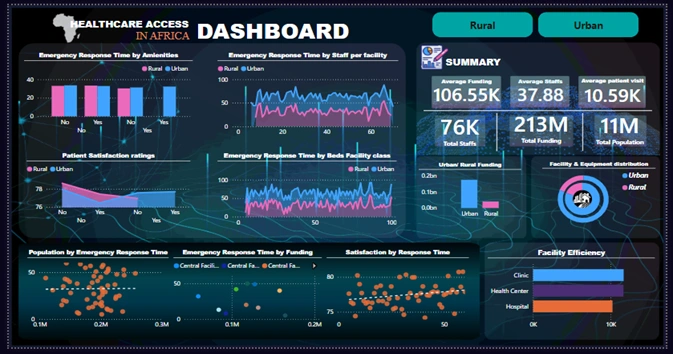
· Urban areas tend to have a higher concentration of healthcare facilities, leading to shorter travel distances for patients.
· Rural regions often have fewer facilities, requiring patients to travel long distances for medical services.
Funding Allocation: Urban vs. Rural Healthcare Facilities
· Urban healthcare facilities receive more funding on average than rural ones.
· The discrepancy in funding results in better infrastructure and more medical staff.
· Rural facilities are underfunded, impacting service delivery and patient satisfaction.
Relationship Between Funding and Emergency Response Time
· There was no proper relationship between funding and response time.
Efficiency of Facility Types Based on Funding per Patient Visit
RURAL AREAS
· Hospitals tend to receive the most funding but handle a large volume of patients, leading to them having the best efficiency.
· Clinics, despite having lower funding, often provide cost-effective patient care.
· Health Centers show higher funding per patient visits, making them the least efficient.
URBAN AREAS
· Hospitals have the best efficiency.
Actionable Insights for Stakeholders
1. Critical Factors Preventing Equal Healthcare Access:
o Limited healthcare infrastructure in rural areas.
o Unequal funding allocation between urban and rural regions.
o Lack of enough medical professionals in rural areas.
o Low emergency response time in rural areas.
2. Policy Recommendations to Bridge the Urban-Rural Healthcare Gap:
o Increase healthcare funding for rural health centers to improve service quality.
o Develop public-private partnerships to invest in rural healthcare infrastructure.
3. Optimizing Healthcare Funding Allocation:
o Use data-driven funding models to distribute resources based on patient needs and facility performance.
o Prioritize hospitals as an efficient facility type for rural expansion.
o Ensure transparency and accountability in healthcare expenditure to maximize impact.
Conclusion
Addressing healthcare disparities requires targeted funding, infrastructure development, and improved emergency response services. By implementing data-driven policies, stakeholders can enhance healthcare accessibility and efficiency in underserved regions. My report serves as a foundation for decision-making in optimizing healthcare investments and ensuring equitable medical services across all regions.
Like this project
Posted Oct 3, 2025
Analyzed healthcare facility distribution and funding, offering strategic recommendations.
Likes
1
Views
12
Timeline
Mar 1, 2025 - Mar 10, 2025