AI-Driven Waste Management System Development

debrajoy kitet


The project is live on https://hackathon-2-0-chi.vercel.app/.
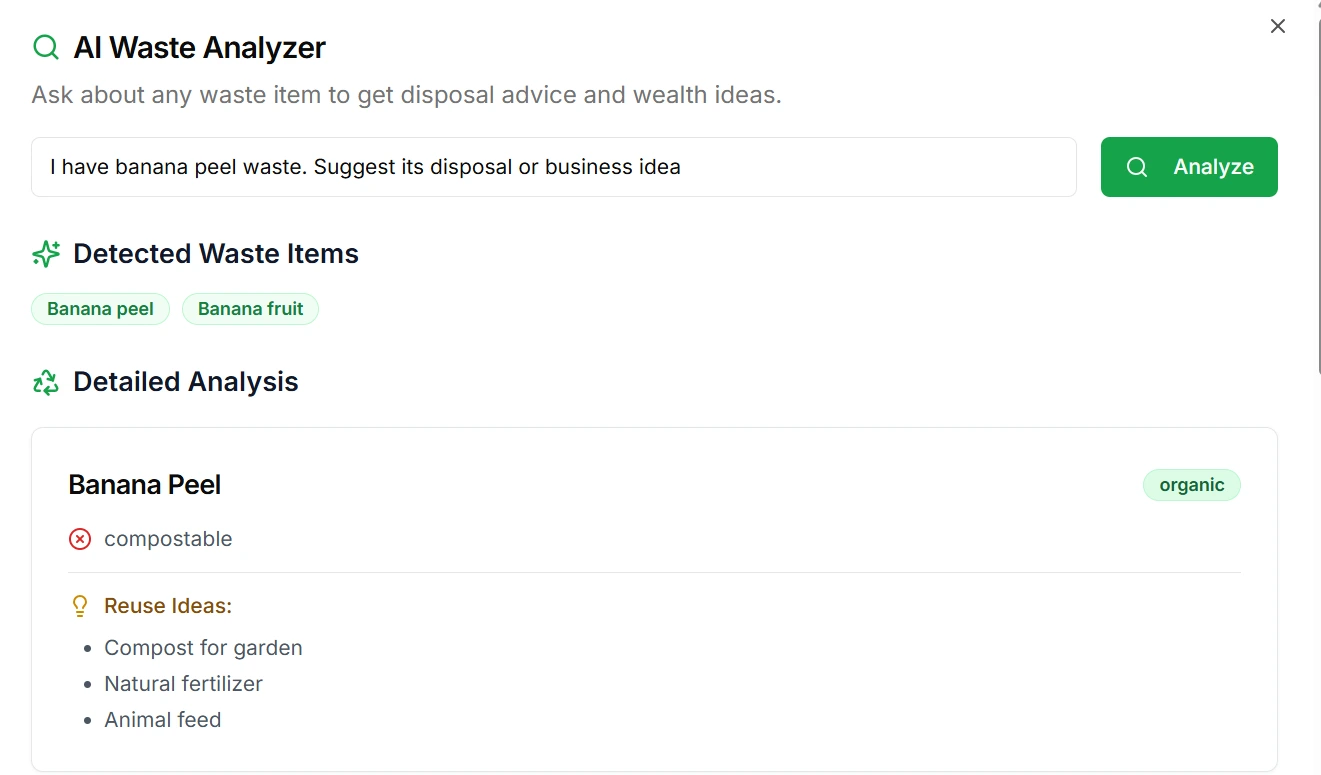
Sample screenshots from the AI-Driven waste management and recycling system are attached as:
Prompt Engineering Workflow
This project was built through an iterative prompt-first development approach where each component—from backend to frontend—was designed by giving precise instructions to an LLM.
Below is a detailed, chronological breakdown of real prompts used to generate the entire platform. These prompts demonstrate clarity of intent, architectural foresight, and rapid prototyping.
PHASE 1: Backend Foundation (LangGraph + Gemini + Firecrawl)
Setup Waste Analysis Workflow with LangGraph
Prompt:
“Build a LangGraph workflow powered by Gemini and Firecrawl to do the following in 3 steps:
Search and extract up to 5 specific waste items from content related to a user query.
Analyze each item to provide category, recyclability, health risks, and reuse ideas.
Generate 2–3 wealth creation project ideas based on analyzed items. Return a
WasteQueryState model containing all data.”Add General Question Shortcut
Prompt:
“In the run method, detect short general questions like ‘What is waste?’ or ‘How to recycle plastic?’ using keywords like ‘what’, ‘how’, ‘why’, etc., or word count <= 6. For such cases, return a quick answer using Gemini without running the full LangGraph pipeline.”
Add Pydantic Models for Workflow
Prompt:
“Define three Pydantic models:
WasteItemInfo with fields name, category, recyclability, health_risk, reuse_ideas.WealthIdea with title, description, required_materials, estimated_value.WasteQueryState with query, extracted_waste_items, items_info, wealth_ideas, quick_answer.”Firecrawl + Gemini Integration
Prompt:
“In
_extract_items_step, use Firecrawl to search for articles related to the query, scrape them, then prompt Gemini to extract specific waste items from the content. Extract maximum of 5 waste items listed one per line.”PHASE 2: Token Optimization and Output Control
Limit Waste Extraction to One Item
Prompt:
“To reduce token usage, limit extracted waste items to only one most relevant item based on the query context. Trim content if necessary and prioritize item that directly answers the query.”
Improve Wealth Idea Output Format
Prompt:
“Gemini cannot return List[T] directly. Wrap the
List[WealthIdea] in a new class WealthIdeasResponse with field ideas: List[WealthIdea]. Use this wrapper as the output schema when calling with_structured_output.”Trim Wealth Ideas to Two
Prompt:
“In
_generate_ideas_step, return only the top 2 most relevant wealth-to-income project ideas based on the waste item. Make sure the ideas are sorted by relevance and impact.”Fix Gemini JSON Output
Prompt:
“Ensure Gemini returns structured JSON format matching
WealthIdea model: Include title, description, required_materials (list), and optional estimated_value. Wrap in valid JSON list and remove unnecessary explanations.”PHASE 3: Frontend UI with TypeScript + Supabase
Mobile-First React App with API Integration
Prompt:
“Build a mobile-first React app using TypeScript. Fetch response from a FastAPI backend that returns
extracted_waste_items, items_info, and wealth_ideas. Display them in collapsible sections or animated cards. Ensure responsive layout and smooth scroll.”Supabase Authentication Setup
Prompt:
“Add Supabase email/password authentication with secure session handling. Include registration, login, logout, and real-time auth state management using Supabase client. Store tokens securely and show/hide content based on auth state.”
Add Dancing Smart Bin Loader
Prompt:
“Create a loading screen with a dancing smart bin that bounces, rotates, and sparkles using Framer Motion. Show this animation when the app is analyzing a query or waiting for a response.”
API Error Handling
Prompt:
“Implement graceful error handling on frontend when the API call fails or returns invalid data. Show a fallback error card and retry option. Ensure UI doesn’t crash.”
BONUS: UX & Aesthetic Prompts
Enhance Result Presentation
Prompt:
“Render
items_info and wealth_ideas using animated, colorful cards. Color-code recyclability (e.g., green for recyclable, red for non-recyclable). Animate entry with staggered slide-in effect using Framer Motion.”Add Fallback Data for Dev
Prompt:
“Add mock JSON responses for
items_info and wealth_ideas in case backend is unavailable. Toggle between mock and live data using a development flag.”Local Development Setup
Follow these steps to run both the backend and frontend locally:
1. Clone the Repository
2. Backend Setup (FastAPI + Gemini + Firecrawl)
Step into the backend folder:
Create and activate a virtual environment:
Install dependencies:
Create a
.env file:Create a
.env file in the server/ directory and add the following:⚠️ Replace the values with your actual API keys.
Run the FastAPI server:
The backend will run at
http://localhost:80003. Frontend Setup (React + Supabase)
Step into the frontend folder:
Install frontend dependencies:
Configure Supabase and backend API:
Create a
.env.local file in the client/ folder:⚠️ Replace the Supabase URL and key with your actual credentials from the Supabase dashboard.
Run the frontend dev server:
The frontend will run at
http://localhost:51734. Test the Full App
Go to
http://localhost:5173Register or log in using Supabase authentication
Enter a waste-related query like: "I have banana peels and old electronics at home"
Wait for the dancing smart bin animation while the AI processes your request
View the extracted items, recyclability, and creative income ideas
🛠️ Troubleshooting Tips
Ensure both
client and server folders have their respective .env files.Confirm Gemini and Firecrawl API keys are correct.
If CORS issues occur, check FastAPI CORS middleware settings in
main.py.Use mock data toggle on frontend during offline development.
Security and Fault Tolerance
RecycloHub prioritizes data protection, responsible AI usage, and resilience against unexpected failures through the following practices:
Security Measures
Supabase Authentication Secure and modern user authentication using Supabase with support for email/password login and protected user sessions.
Environment Variables Sensitive API keys (e.g., Gemini, Firecrawl, Supabase) are stored securely in
.env files and never exposed to the frontend or committed to version control.Backend API Protection FastAPI backend is structured to validate and sanitize all incoming queries, reducing injection and malformed input risks.
Structured Output with Validation AI-generated outputs are parsed against strict Pydantic schemas (
WasteItemInfo, WealthIdea, WasteQueryState) to prevent malformed or malicious data from being returned to users.Fault Tolerance Strategies
Graceful Error Handling Try-except blocks around all LLM and Firecrawl calls ensure the app doesn't crash on failure. Instead, it falls back with default messages or empty states.
Partial Response Recovery Even if some steps fail (e.g., analyzing one waste item), others continue. The pipeline returns all successful data and logs failures for debugging.
Development Fallbacks Frontend includes mock data toggles to allow testing without a live backend or API keys, ensuring smooth prototyping.
Retry and Logging Support LangGraph's built-in
arun_with_retry logic handles retryable tasks for LLMs to reduce timeout or transient errors.AI Workflow Architecture
RecycloHub leverages a structured, AI-first architecture to intelligently handle user queries using LangGraph, Gemini, and Firecrawl. The workflow is designed to be efficient, fault-tolerant, and cost-effective.
Workflow Flowchart
Core Technologies
LangGraph: Manages the multi-step stateful workflow with async support
Google Gemini (via LangChain): Handles all structured language tasks
Firecrawl: Fetches and scrapes real-time web content for contextual AI reasoning
Pydantic Models: Enforce schema validation on all AI outputs
Async/Await: Optimized for performance and concurrency across all I/O operations
The workflow ensures each component is isolated, testable, and fault-resilient—making the system highly maintainable and production-ready.
Test Queries & Expected Output
Use the sample queries below to explore RecycloHub's full capabilities. These examples demonstrate both the general Q&A flow and the full AI analysis pipeline.
General Q&A (Quick Answer)
Ask concise questions that require a definition, explanation, or procedure:
What is e-waste?How do I recycle used batteries?Why is waste segregation important?Who is responsible for waste management in Kenya?Output: A direct, expert response from Gemini with 1–2 paragraph explanation.
Full AI Analysis & Wealth Ideas
Ask contextual or descriptive questions that include a waste type or scenario:
There are many banana peels in my kitchen. What should I do with them?I have a pile of scrap metal at home. Can I turn it into something useful?There’s used cooking oil in my restaurant. How can I reuse or sell it?My compound is full of tyre wastes. Are they recyclable?Output Includes:
Extracted waste item(s) from content
Detailed analysis per item:
Type (organic, electronic, plastic)
Recyclability and health risks
Practical reuse ideas
Top 2 relevant waste-to-wealth ideas with materials and earning potential
Like this project
Posted Aug 4, 2025
Built AI-driven waste management system using LangGraph, Gemini, and Firecrawl.
Likes
1
Views
6