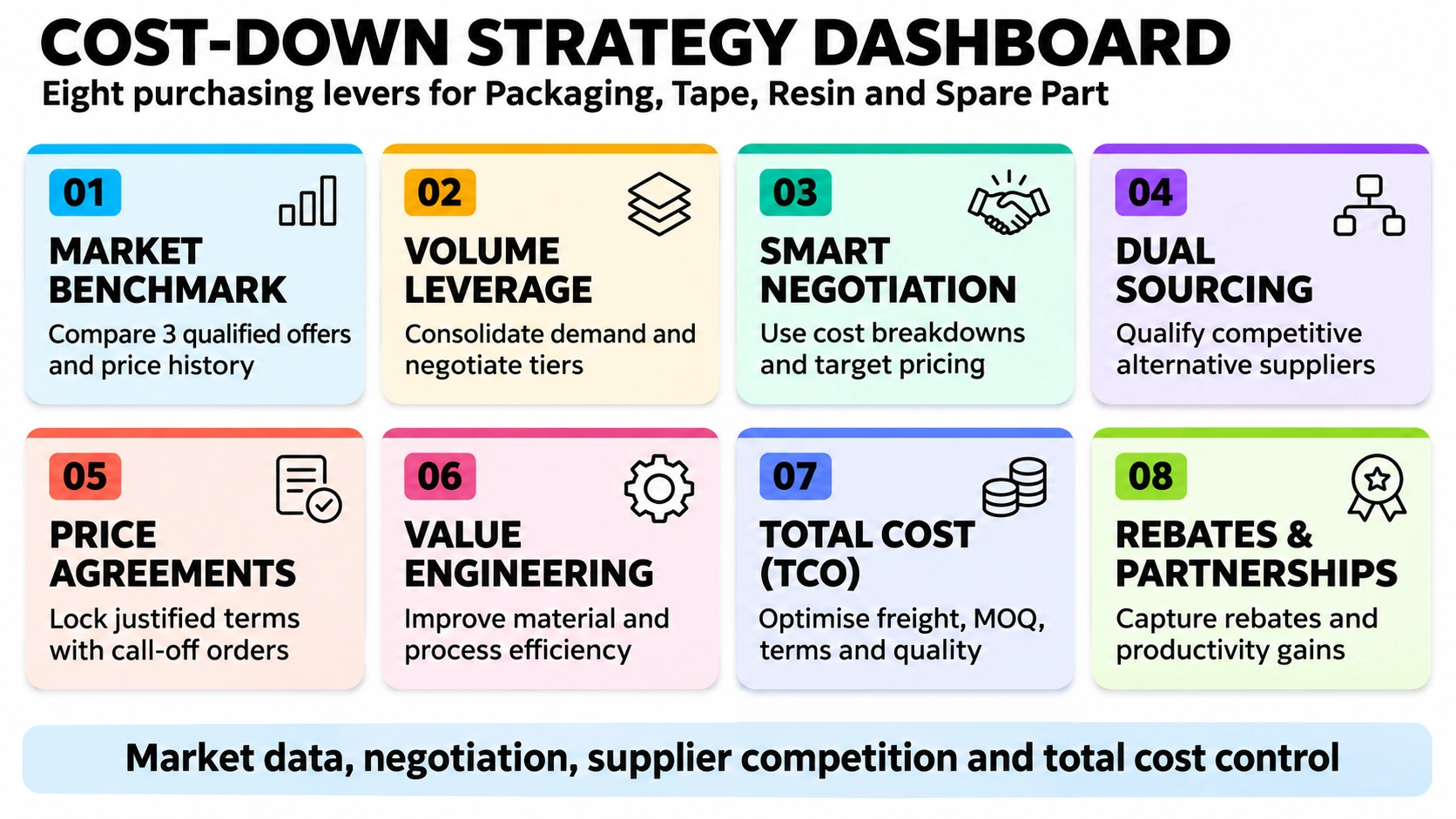
why a structured cost-down strategy is essential for organizational success:
1. Protection and Expansion of Profit Margins
In competitive markets, selling prices are frequently dictated by customer expectations and market benchmarks rather than your internal cost structure. If raw material prices, labor, or overhead expenses creep upward while selling prices remain static, gross margins erode rapidly. Strategic cost management ensures that profitability is preserved or expanded, protecting the bottom line even when top-line revenue growth slows.
2. Amplifying Competitiveness and Market Agility
Lowering operational costs provides strategic pricing flexibility. Companies with optimized cost structures can:
Underprice competitors to capture market share during aggressive market expansions.
Maintain healthy margins while offering volume discounts or flexible commercial terms to key clients.
Absorb market shocks (such as sudden tariff increases, currency fluctuations, or supply chain disruptions) without having to pass extreme price hikes downstream to customers.
3. Fueling Innovation and Reinvestment
Capital is the lifeblood of growth. By eliminating non-value-added costs and waste across procurement, logistics, and production, a company generates internal cash flow. These freed-up funds can be strategically reinvested into high-value initiatives:
Research and development (R&D) for next-generation products or sustainable material innovations.
Automation, digital transformation, and manufacturing technology upgrades.
Talent acquisition and upskilling core teams.
4. Eliminating Waste and Driving Operational Excellence
A rigorous cost-down exercise forces cross-functional collaboration—uniting Purchasing, Engineering, Production, and Finance. This collaborative audit naturally uncovers inefficiencies that routine operations overlook, such as:
Design inefficiencies: Over-specified materials or complex assemblies that drive up manufacturing costs.
Supplier consolidation: Leveraging total spend across fewer, more reliable partners to secure better volume tiers and payment terms.
Process bottlenecks: Reducing scrap rates, cycle times, and inventory carrying costs through lean methodologies.
5. Ensuring Long-Term Business Sustainability
Companies that fail to manage their cost structures risk becoming uncompetitive, cash-strapped, and vulnerable to economic downturns. A proactive cost-down culture ingrains financial discipline, ensuring that every ringgit spent directly contributes to customer value and competitive differentiation, thereby future-proofing the organization against macroeconomic volatility.