GitHub - victooorltt/ltevo-web: Landing para la agencia de dise…

Victor Lasheras


Web design and development for my future web design Agency
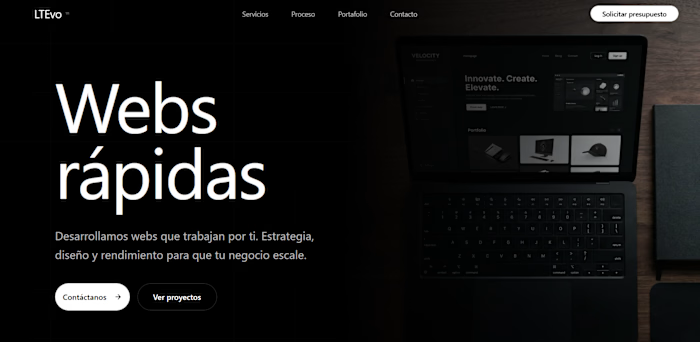
The development of ltevo.com, conceived as the digital identity platform and primary acquisition channel for a premium web design and development agency, represents an excellent frontend engineering case study. Implemented primarily using
.tsx (TypeScript React) files, the project departs from generic, template-driven web development, adopting a robust framework focused on high performance, strict typing, modularity, and Core Web Vitals optimization.Below is a comprehensive technical breakdown of the software architecture, design patterns, and optimization strategies applied to the engineering of this platform.
1. Frontend Architecture and Tech Stack
The technical core of the site relies on a modern, component-driven web development ecosystem:
TypeScript (.tsx): Strict typing brings immense robustness to the codebase. Defining data structures—such as portfolio project details, service parameters, or form validations—via interfaces and types mitigates runtime errors and optimizes the development environment with advanced autocomplete and internal documentation.
React Componentization: Development is governed by a modular architectural pattern. The interface is broken down into atomic, reusable, and independent UI components, facilitating long-term maintainability and strict separation of concerns (Clean Code principles).
Underlying Framework (Next.js / Astro): Integrating
.tsx fits perfectly into modern hybrid development environments:If running on Next.js (App Router): It leverages Server Components by default for Server-Side Rendering (SSR) or Static Site Generation (SSG), drastically minimizing the JavaScript bundle sent to the client's browser.
If running on Astro: It exploits the Island Architecture (Astro Islands), where the website's skeleton is served as pure, instant-loading static HTML, selectively hydrating interactive components (such as contact forms or mobile menus) using hydration directives like
client:visible.2. Structural Organization and Code Modularity
For a scalable digital agency project, the root directory structure is designed with a clean, engineering-first approach:
Plaintext
Atomic Component Design Pattern
Software robustness is reflected in component isolation. UI elements like call-to-action (CTA) buttons or service cards are designed to be polymorphic and highly configurable:
TypeScript
3. Strict Styling System and Premium Aesthetics (Tailwind CSS)
The aesthetic layer of
ltevo.com is implemented using Tailwind CSS under a low-level, utility-first approach. This completely avoids monolithic and redundant stylesheets:Semantic Grid Design: Complex, responsive
grid and flexbox structures ensure visual symmetry and pixel-perfect consistency across both large desktop screens and smartphones.Tree-Shaking and Performance: During build time, Tailwind analyzes the
.tsx files and purges unused CSS classes. This keeps the global CSS file weight under a few kilobytes, accelerating the browser's rendering tree processing.Dynamic Class Handling: Utilities like
clsx and tailwind-merge (cn) are implemented to inject conditional styles based on component props without causing selector collisions or duplication.4. Optimization Engineering and Core Web Vitals
As a codebase guided by strict software engineering principles, performance is a structural pillar rather than an afterthought:
Largest Contentful Paint (LCP): Hero section images are served in next-generation formats (
.webp or .avif) with explicit CSS dimensions (aspect-ratio) to eliminate initial loading delays. Pre-rendering above-the-fold content is highly prioritized.Cumulative Layout Shift (CLS): The layout implementation in
.tsx uses fixed aspect ratios and pre-defined bounding boxes for asynchronously loaded components. This ensures that the late loading of custom typography or interactive assets never causes sudden layout shifts.Interaction to Next Paint (INP): Client-side interactions (such as smooth menu transitions, hover effects, or pop-up triggers) are engineered to reduce main-thread JavaScript execution, relying on native browser hardware acceleration via CSS Transitions/Transforms or lightweight Framer Motion configurations.
5. Backend Integration and Automated Lead Pipeline
The true operational value of
ltevo.com lies in its ability to act as the frontend interface for an automated B2B pipeline:Controlled and Validated Form (
ContactForm.tsx): The lead intake form bypasses basic HTML mechanics. It is controlled using native React hooks (useState or React Hook Form) and coupled with a strict schema validation library like Zod. This guarantees that captured user data (Name, Email, Company, Message) is fully sanitized and strictly typed before leaving the client.API Edge Routes: Processed data is dispatched via asynchronous
fetch requests to highly efficient serverless Node.js API routes.Connected Ecosystem: This API serves as a secure gateway to instantly log prospects into a distributed database (such as Supabase) or trigger asynchronous serverless automation webhooks (such as Inngest or custom Python scrapers). These handle lead logging, automated client infrastructure auditing, and instant notifications.
Conclusion and Next Steps for Scalability
The architecture powered by
.tsx provides ltevo.com with exceptional flexibility. The project is not a static dead-end, but a modular software ecosystem primed for evolution.The natural next step in maturing the codebase is abstracting sections further to allow dynamic content injection (such as case studies or technical blog posts) via a lightweight ORM (like Drizzle Kit) connected directly to a Supabase PostgreSQL instance, achieving an absolute balance between premium visual design and robust backend engineering.
Like this project
Posted Jun 11, 2026
Landing para la agencia de diseño web LTEvo. Contribute to victooorltt/ltevo-web development by creating an account on GitHub.
Likes
0
Views
0