Girivalam 46: My Pilgrimage at Arunachala

Rachel M.

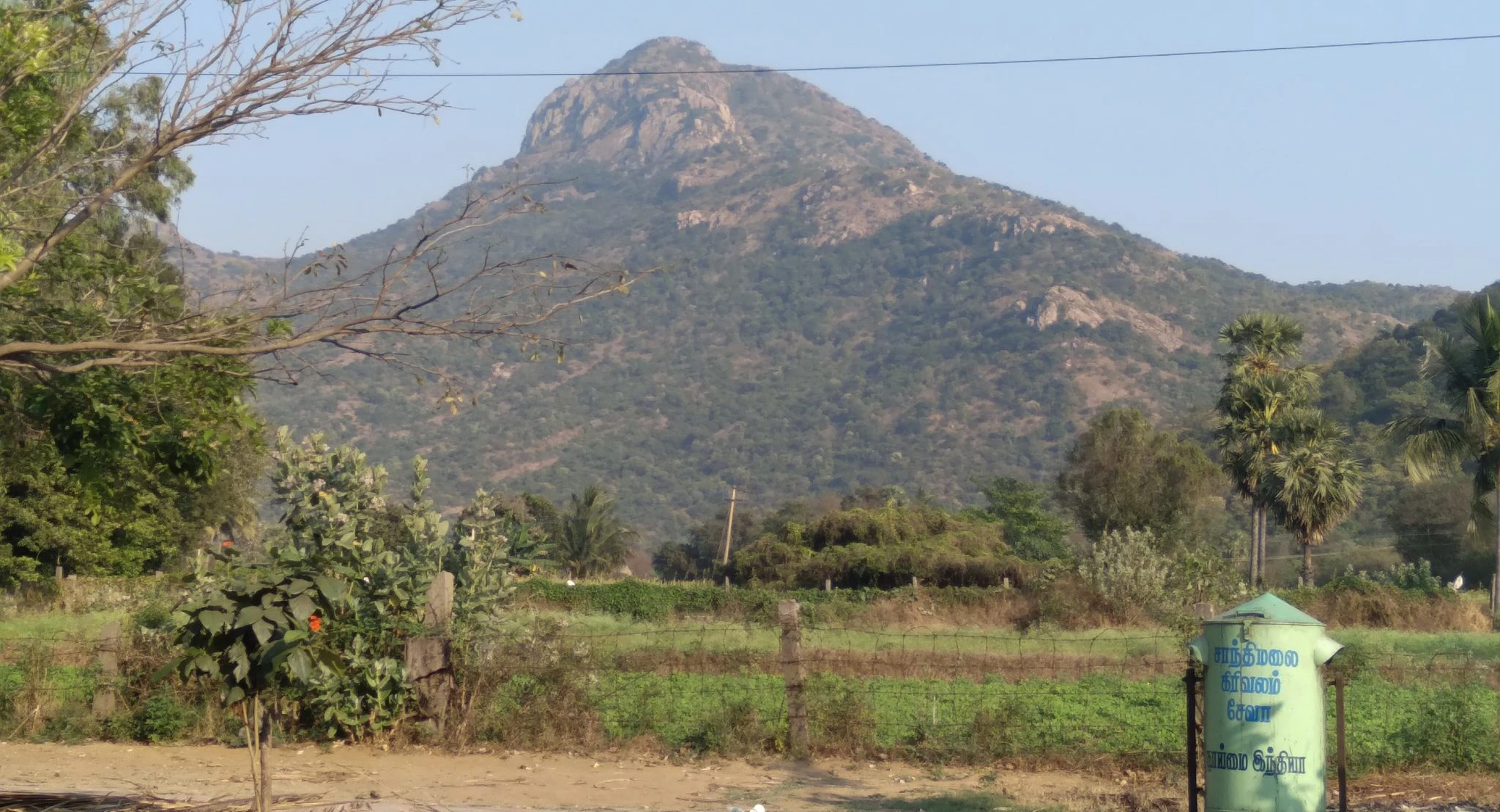
A pilgrim connects with herself and the world around her as she makes her 46th ‘Girivalam’ or circumambulation of Arunachala, a holy mountain in Southern India.
My bare feet follow the painted white line at the left edge of the black asphalt, still warm and visibly steaming after a flash tropical downpour. Returning my gaze and awareness to the sacred hill, I observe that the pace of my typically-slow steps has increased. Somehow, after so many rounds of the mountain, I seem to have lost the sensation of walking.
A pregnant monkey leaps from one high branch of a tree to another. Her sagging belly rocks back and forth over the road, releasing a small shower of ripe tamarind pods onto the ground. Of the dozen visible people, only one Indian man and I scramble to collect them.
I vaguely notice a temple priest on the side of the road shouting at me in Tamil. When I make eye contact, he offers me a few hot pink roses from a pooja. I place my right hand over my heart in gratitude, careless of the sticky tamarind still on my fingers, and outstretch my arm to receive them. I hold one of the flowers at my nose, and it marvels me that a tiny bud can sustain such an aroma. It’s always seemed logical that the more we smell the flowers, the less the flowers smell, but this is clearly not the case.
As I continue, I notice that I’m walking through the tire-smudged, straw-colored remnants of cow dung. At first, it doesn’t faze me. Then, I laugh aloud at a thought:
Enjoying the fragrance of a rose while walking barefoot through shit – this is India.
A half-naked saddhu with white ash caked on – and cracking off – his forehead waves his arms at me shouting, “Ma’am, ma’am!”
He blocks my path and makes the hand-to-mouth gesture for eating, pointing to a small lamp-lit shrine in a field near the road. I step onto the sidewalk and offer him one of the roses. He laughs and puts his hands on the crown of my head to bless me.
At the small stone temple, I softly say an Om Namah Shivaya and hover my hands over the small camphor flame on the offering plate before placing them in front of my eyes. I receive a pinch of ash to smear across my forehead and then, with hands in prayer position, I walk clockwise around the temple. As a foreigner, I am given VIP status in the line for prasadam: a scoop of black chana (what I distantly recall to be termed chickpea or, ha, what a funny word, garbanzo) and spiced rice – served on a banana leaf.
Back on the road, the saddhu sees me with my plate full of food. He is happy because I will eat. I am happy because he is happy.
I walk for a few minutes, then sit on the ground with the hill in sight, right hand full of food and left hand full of flowers. I put one of the remaining roses in my hair and one in my pocket so that I can balance the banana leaf in my cupped left hand and use my right to eat.
—
Girivalam, also called Giripradakshina, is the term for the circumambulation of Arunachala, a holy mountain in Southern India. Thousands – sometimes hundreds of thousands – of pilgrims from around India and the world come here, to Tiruvannamalai, each month to complete this 14-kilometer circuit. Traditionally, Girivalam is completed slowly and without shoes, keeping the hill to one’s right side. According to scriptures, it’s best to do this freshly bathed, dressed in white, and with attention on the Hindu deity Shiva in the form Arunachaleshwarar – the lord of the mountain.
—
Just like all other days, the ceaseless sea of sights and sounds surrounds me as I navigate temple-laden village and city roads throughout the “path.” Until the early 2000s, pilgrims had the option of completing Girivalam via the “inner path,” which is still marked by painted v’s on rocks throughout the majestic forest full of caves, small pools, and jungle shrines surrounding the base of the hill. However, this loop of the past is now deemed closed by authorities. It was recently lined with barbed-wire fencing, rendering it not only illegal to navigate, but also overgrown by the thorny twigs and branches that are not only typical of Arunachala’s terrain, but also symbolic, in some way, of life here.
Thus, my daily journey is via the “outer path,” following paved roads and nonchalantly crossing several “lanes” (for lack of a better term for the Indian free-for-all permutation of traffic) of motorbikes, pedestrians, cars, trucks, bull-carts, pedestrians, and roaming animals on a regular basis. As I walk each evening, horns honk incessantly. Dogs bark, monkeys steal fruit, and cows meander through the roads, further provoking the horn-honking. Children yell. Women yell. Men yell.
Speakers throughout the city blast nonstop, high-volume mantras, and these sacred sound vibrations, along with the others, become a blur.
Om Namah Shivaya.
Om Namah Shivaya.
One chai, ma’am, one chai.
Om Namah Shivaya.
Arunachala!
Ten rupees, please.
Please, ma’am, ma’am.
Om Namah Shivaya.
One chai.
Please, ten rupees.
Ma’am, ma’am, rickshaw, ma’am.
Rickshaw.
Ma’am, rickshaw.
What country, ma’am?
Oooooommmm namah shivaya!
Arunachala!
Ma’am!
Every so often, I feel like I come close to getting knocked over or to losing a toe or two. Once in a while, I can’t quite maintain my monk-like composure, get angry, and tell someone, in volume and monotone appropriate for a public library in the part of the world that I come from, “You shouldn’t drive like that. It’s dangerous.”
However, the hill stays silent, and after six weeks of making this loop, I tend to feel pretty silent, too.
—
“Arunachala” literally translates to something like “red hill.” However, it’s also known as the “Hill of the Holy Beacon,” the “Hill of the Holy Fire,” and the “Hill of Wisdom.” According to an ancient legend most thoroughly narrated in one of the Puranas, Arunachala is the physical form of the Hindu deity Shiva, which he took after settling a battle of ego between Vishnu and Brahma. It’s also been written that Arunachala is the spiritual center of the Earth, more ancient than the Himalayas, and the dwelling place of timeless, ageless saints, sages, and yogis who live inside the infinite grandeur of Arunachala’s mountain façade.
—
Sometimes people ask me why I’m walking every day, and I tell them the truth – I don’t quite know.
What I do know is that after 46 consecutive days of Girivalam (along with the other uncounted rounds completed throughout my past three years in Tiru) is that the more I walk around Arunachala, the more I want to walk around Arunachala.
I see that moving around the mountain each day is energizing me, that it’s cultivating a sense of ease in my life, and that it’s increasing the quality of my overall state of being. Despite sometimes preferring to spend my afternoons and evenings alone or with friends, each day I find myself zipping through the village with heart-felt anticipation of my four-hour-long loop. Each day, I see myself submitting to the magnetic pull of the hill despite my sore feet, wonky joints, cuts, splinters, and all sorts of resistance.
I see that it’s been a blessing to spend so much time simply walking and that it’s been sweet to share my time and energy with some of the orange-clad saddhus who have become part of my daily life.
However, what I feel most about walking Girivalam is a simple reflection:
Each day, I walk 14 kilometers without going anywhere.
I’ve watched myself move through hundreds of miles around the hill in this way, only to see that this place – this place where I am right now – never changes. Each day, no matter what happens, I finish where I start.
Regardless of where I go and how long it takes, I’m always Here.
I always Am.
—
Once again, my circle is complete. Facing the mountain, I press both hands together in front of my heart, then raise them above my head with gratitude to Arunachala.
“Om Namah Shivaya. Om Arunachaleshwaraya Namaha. Thank you,” I say, quite loudly. Since we’re in India, nobody looks at me for talking to a hill, to the sky, or to myself.
I rev my engine and, before driving into the darkness, signal with my beeping blinker, my high-pitched horn, and my full awareness that I’m ready now; I’m going home.
Travel Writing Submissions are Open!
Join our community of travel writers and get paid for your narrative travel stories. Join our occasional insider's newsletter to access our submissions page and send us your story.
In the first entry of the On the Edges of Europe column, travel journalist Thom Brown ventures to Estonia to explore an abandoned prison turned lakeside resort.
Gazing into the abyss, my feet felt frozen to the crumbling concrete floor. The corridor stretched into the darkness, swallowing the summer sunlight until it faded to black. Smothered by that uniquely musty smell of trapped, stale dust, I began to question the safety of this venture.
Of course it’s safe, I reassured myself.
Clutching a paper ticket and cheap, plastic audio guide earphones, it was time to explore deeper into this crumbling building, one step at a time. My right foot swung shakily forward through the air, landing with an echoey thud. The whole building seemed to tremble at the sound, and then, a shadowy figure emerged from the pitch black, moving just enough into the light for its silhouette to appear.
It was a small, ragged creature, with sharp ears pricked to attention. The animal (monster?) tilted its head so that light seeping through a crack in the walls hit its eyes and bounced back directly into my soul. It felt longer, but it couldn’t have been more than three seconds before I’d identified the animal, turned, and bolted out of the building.
“A fox! There’s a fox!”
My partner, Avely, stopped fiddling with her audio guide, looked up, and presented her well-used where-have-you-been-now? face.
We’d been separated several times on this self-guided tour of Rummu Prison. Built in 1938 and eventually closed in 2013, it’s an archetypal reminder of the harsh justice system enforced by Estonia’s Soviet occupiers. For decades, criminals sentenced to hard labor called this place home. Now, it’s one of Europe’s most eerily fascinating hidden attractions.
From Tallinn city center, the village of Rummu – home to this notorious prison – can be reached by car in less than an hour. While many will visit the abandoned Patarei Prison, close to the city center, Rummu is well worth the trip.
Unlike Patarei, Rummu Prison is a vast complex that gives visitors the sense of going on a slightly dangerous adventure. We parked and found the ticket office, which gave the impression that this would be a typical museum experience. The office had a map, a list of rules, and a friendly ticket lady behind plexiglass.
Rather than wait for a human tour guide, we paid €10 to receive our audio guide, allowing us to explore at our own pace. The self-guided tour should take two hours and comes in eight different languages. So far, this seemed like it would be fun, relaxing, and educational. Exiting through the back door of the ticket office, the widely spaced prison structures came into view, and it was clear we had no idea where to go.
Each building had a number corresponding to a button on the audio guide that, when pressed, told a compelling and often tragic story about the horrors contained within. But the numbers were hard to spot and didn’t appear in order. We often found ourselves alone, surrounded by piles of rubble, feeling like we’d wandered out of the museum and into an unattended building site.
There was a rusted guard tower on the corner. There was no indication of whether it was allowed – or indeed, safe – to climb, but there was also no sign to say it wasn’t. I placed one foot on the bottom step and felt the entire structure wobble beneath me. This sensation only worsened further up, but it was worth it to get a good vantage point of the prison complex. It was massive.
Abandoned buildings dotted the landscape. There were the shells of housing units, shops, and even a gym. Although there were other visitors, most buildings were empty upon entry, generating that niggling knot in the stomach that we shouldn’t be there and that it wasn’t safe. And, in all honesty, it wasn’t safe. Broken glass was sprinkled across every surface, sections of the ceiling hung precariously, and jagged concrete could slice your hand at any moment.
There had, to my surprise, been no obvious attempt to clean up the buildings and make them fit for visitors. There were seemingly no health and safety measures in place. A used car company bought the prison and simply opened it up to tourists in its natural, decaying state. No wonder foxes were happy to call it home.
While most museums try to immerse you in the subject at hand, none does it quite as well as Rummu. You really do feel like an adventurer as you glimpse a sense of the dread, hopelessness, and fear that must have been a daily fact of life for prisoners.
One building was the segregation block, where the most violent offenders were sent to be punished. There was only one way in and out, which took me on a scarcely lit journey past the heavy iron doors of single-occupancy cells. This led to the yard, which was divided up so that each prisoner had to exercise alone.
I, too, was alone as I explored every inch of this dark and haunting structure. A bridge in the yard was red and rusty, like the guard tower, and it shook beneath my weight. I walked up and down, mesmerized by the way the plant life had started to reclaim the cold slabs of concrete that prisoners called their garden.
We stayed longer than anticipated, determined to finish every number on the audio guide. But we weren’t done yet. The best attraction lay next door, beyond the museum walls.
Rummu is best known as the site of a limestone quarry. This is where the prisoners did their hard labor as miners. After the prison closed, the water that was pumped out of this site was allowed back in, flooding the quarry building and creating a large, beautiful lake.
In the summer, sunlight hits the lake’s surface until it shimmers with a sparkling turquoise tint. The limestone ground even looks like sand from a distance. In stark contrast to the depressing Soviet monstrosity next door, a hot day here feels like being on a Caribbean island.
I strolled down the hill to the shores of the lake to find visitors on paddleboards and pedal boats. An inflatable obstacle course had been set up, and children in high-visibility life vests giggled with glee as they failed to avoid falling with a splash into the tranquil waters.
But at the center of it all was a half-submerged building with a horrifying history. The lake was allowed to return before anything had been demolished. All the equipment was simply left abandoned, so remnants of the quarry’s infrastructure remained. Locals and tourists swam freely between these structures of repression. But in a way, that’s beautiful.
Beside the lake is a large hill created from the deposits of limestone dug up by the prisoners. I trekked toward the top, but it became steeper and more slippery higher up. Again, little thought had gone into health and safety.
In Estonia, one of Europe’s flattest countries, you have to take every chance you get to catch a view, so I kept on moving. At the peak, the flatness of Estonia became a blessing. The dense forests stretched beyond the horizon, evoking a sense of awe at this nation’s love of nature. The dazzling lake was revealed in all its glory as I looked down upon the specs of people enjoying their weekend on the water. Some sat in the cool cafe, sipping an icy drink and soaking in the peace.
From here, I could also peek over the wall at the decaying prison. While it seems a shame to let it crumble to nothingness, I can’t envision a better replacement for tyranny and enslavement than the refreshing freedom of a lakeside resort.
Travel Writing Submissions are Open!
Join our community of travel writers and get paid for your narrative travel stories. Join our occasional insider's newsletter to access our submissions page and send us your story.
Like this project
Posted Mar 31, 2025
A woman develops a daily personal pilgrimage, walking around a sacred Indian hill for days on end.
Likes
0
Views
11