90-Day Cash Flow Intelligence Engine

Ugo Chukwu


90-Day Cash Flow Intelligence Engine for SaaS & Fintech Founders
Summary
Built an end-to-end cash flow “radar” that gives founders a live 90-day cash forecast, scenario modeling, and runway alerts—powered by n8n, Supabase, and a React dashboard.
Client / Use Case
Ideal clients:
SaaS / fintech startups (Seed → Series B)
Founders, CFOs, and finance leaders who are currently forecasting in spreadsheets
Companies with multiple systems: bank, accounting (QuickBooks/Xero), payroll (Gusto/Deel), card processors (Stripe), etc.
This project was built as a full, public case study to demonstrate what I can implement for real clients who want production-style financial automation and decision intelligence.
The Problem
Finance teams and founders kept running into the same issues:
Cash forecasts live in fragile Excel models that break when the business changes.
Data is scattered across different tools (bank, AR, AP, payroll, expenses).
There’s no easy way to answer “what if?” questions without hacking formulas:
“What if we hire 5 more people?”
“What if growth slows 20%?”
“What if we cut marketing by 30%?”
Cash crunches are often discovered in the bank app, not 60 days ahead.
Key pain points:
Manual data gathering and spreadsheet wrangling every month
No single source of truth for cash inflows and outflows
No scenario engine
No proactive runway alerts
I set out to build a repeatable, automation-first solution that founders and finance teams could actually rely on.
My Role
Role: Financial Automation Engineer / Architect & Implementer
I handled:
System architecture and data model design
Supabase schema & sample data
All n8n workflows (data sync, aggregation, forecasting, scenarios, alerts, external APIs)
React dashboard design and integration with Supabase
Documentation, dev.to technical deep-dive, and Substack explainer
This is the kind of end-to-end work I can do for clients: from idea → architecture → automation → dashboard → documentation.
Tech Stack
Automation & Orchestration: n8n
Database & Warehouse: Supabase (Postgres)
Frontend: React + TypeScript + Tailwind + charting library
Logic: Python in n8n Code nodes where needed
(Optional) External APIs:
QuickBooks / Xero (AR/AP)
Stripe (payments)
Gusto (payroll)
Plaid (banking)
Repo & article:
Technical breakdown (dev.to): https://dev.to/etherlabsdev/how-i-built-a-90-day-cash-flow-intelligence-engine-541l
The Solution
I designed and built a 90-Day Cash Flow Intelligence Engine with three core layers:
Data Layer (Supabase)
Normalised tables for:
bank_transactionsar_invoices (Accounts Receivable)ap_bills (Accounts Payable)payroll_runsoperating_expensesA unified
cash_events table where every inflow/outflow is stored in a consistent, source-agnostic format.Derived tables:
daily_cash_snapshots – one row per day with opening balance, inflows, outflows, closing balance, burn averagesforecast_runs, cash_forecasts – 90-day projections (base/best/worst)scenario_runs, scenario_forecast_deltas – what-if simulationsalert_events – runway and risk alertsAutomation Layer (n8n)
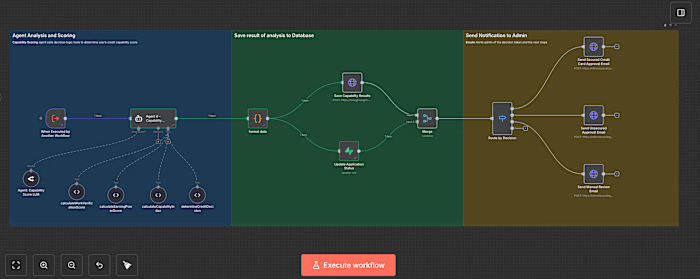
Data Sync workflows that:
Pull data from external APIs (Stripe, QuickBooks, Gusto, Plaid, etc.) or seeded sample data
Map provider-specific responses into the Supabase schema
Maintain idempotency using
(data_source_id, external_id)
Aggregation workflow that:
Converts
cash_events into daily_cash_snapshots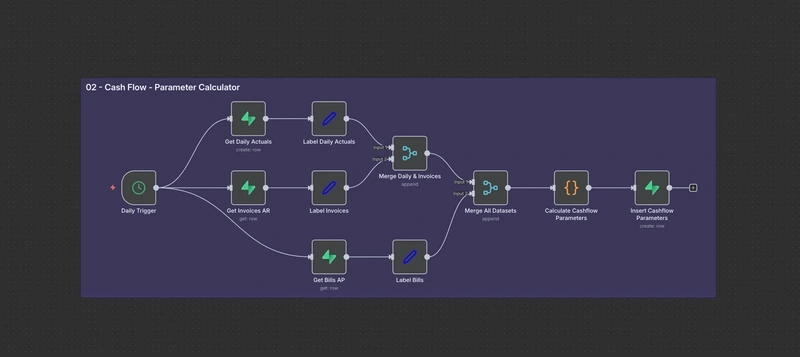
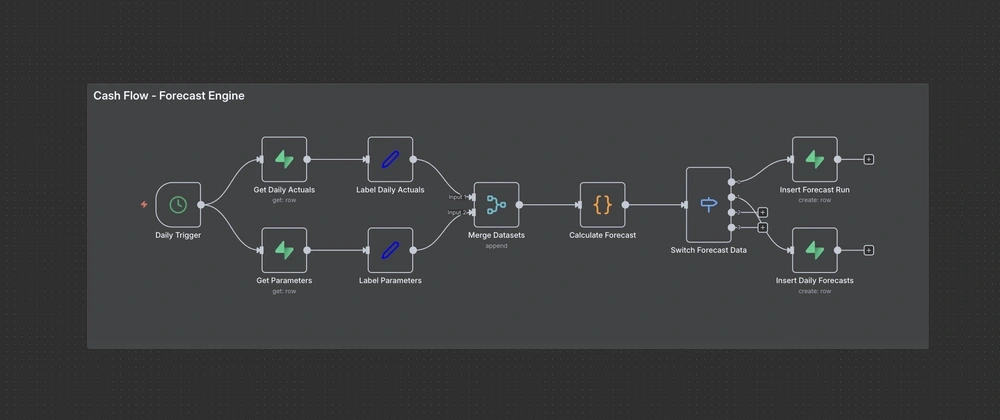
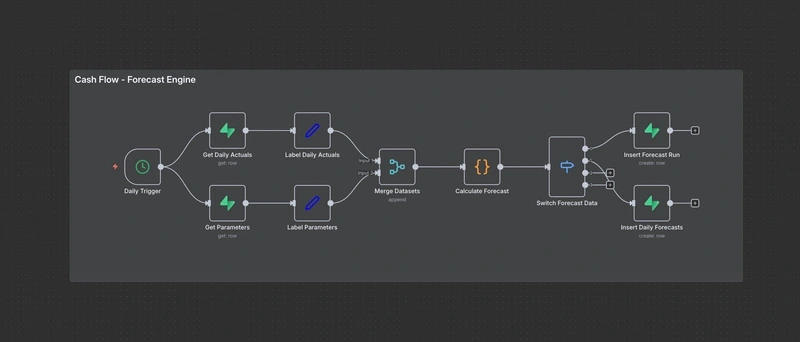
Forecast Engine workflow that:
Reads recent history and generates a 90-day cash forecast
Stores base, best, worst case trajectories
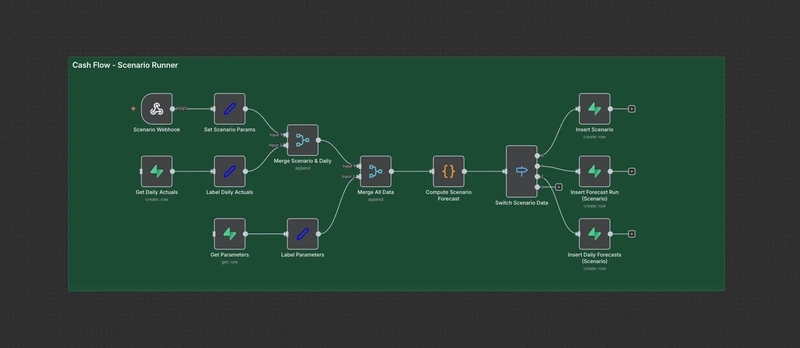
Scenario Runner workflow that:
Accepts scenario parameters via webhook (e.g. from the React app)
Recalculates the 90-day forecast with new assumptions (extra payroll, growth changes, expense cuts)
Risk Alerts workflow that:
Scans forecasts for points where cash drops below thresholds
Logs
alert_events and can push messages to Slack/email
n8n workflow
Presentation Layer (React Dashboard)
Overview page – Current cash, base & worst-case runway, next 30-day net cash, historical + forecasted cash curves, and active alerts.
Scenarios page – Baseline vs scenario comparison charts, scenario creation form, runway impact summaries.
Working Capital page – AR/AP aging buckets (0–30, 31–60, 61–90, 90+), totals, and net working capital.
Case Study page – Explains the problem, architecture, and links to code + technical article.

home dashboard
Architecture at a Glance
Flow:
External tools → n8n → Supabase raw tables
Supabase raw tables → n8n → unified
cash_eventscash_events → n8n → daily_cash_snapshotsdaily_cash_snapshots → n8n → forecast_runs + cash_forecastsBaseline forecasts → n8n → scenario runs & deltas
Forecasts → n8n →
alert_events (+ Slack/email)Supabase → React → dashboards & scenario UI

systems design
From a client perspective, this means:
You plug your systems in once,
Automation keeps the cash model updated,
The dashboard shows you where you are and where you’re heading,
You can safely ask “what if we do X?” and see a quantified answer.
Key Features
1. Unified Cash Events All money movements—regardless of source—are transformed into a consistent cash event model. This removes the complexity of reconciling multiple tools.
2. Daily Cash Snapshots Every day, the system computes:
Opening balance
Cash in / cash out
Net cash
Closing balance
Rolling burn rates
This powers fast, simple dashboard queries.
3. 90-Day Cash Forecast Using recent history, the engine generates:
Base case forecast
Best/worst-case bands
Day-by-day projected closing balances
This gives founders a clear “cash radar” instead of a static spreadsheet.
4. Scenario Modeling (“What If”) From the UI, users can run scenarios like:
“Hire 5 engineers at $X/month each”
“Growth slows 20%”
“Cut marketing by 30%”
The backend recomputes the full 90-day forecast with new assumptions and shows:
New runway vs baseline
Change in minimum cash level
When risk starts in each scenario
5. Runway & Risk Alerts Automated workflows monitor the forecast and create alerts when:
Base-case runway drops below a threshold (e.g. 60 days)
Worst-case forecast goes negative within the forecast window
Alerts can be stored in Supabase for the dashboard and pushed to Slack/email.
Value for a Real Client
If this system were deployed for a real SaaS/fintech client, they would:
Save hours per month No more manual CSV exports and spreadsheet rebuilds for cash forecasting.
See cash crunches 60+ days early Instead of being surprised by the bank balance, they get proactive alerts.
Make decisions with numbers, not guesses Hiring plans, marketing spend, and runway conversations can be anchored in modeled scenarios.
Have a reusable, API-driven tool It’s not just a one-off Excel; it’s a system that can grow with their tech stack.
What I Can Do for You (as a Freelancer)
Based on this project, here’s how I can work with you:
Design & implement financial automation systems Cash forecasting, payment recovery, revenue leakage detection, commission engines, etc.
Connect your existing tools QuickBooks, Xero, Stripe, Gusto, Plaid, banks, custom APIs—pulled into a clean data model.
Build dashboards your team will actually use For founders, finance, and ops teams—simple, visual, and tied directly to live data.
Ship full, documented projects With readmes, diagrams, technical articles, and handover docs so your team can own it long-term.
If you’re interested in implementing a version of this Cash Flow Intelligence Engine for your own company—or want something similar tailored to your stack—feel free to reach out on Contra and we can map out a build together.

Scenario Dashboard
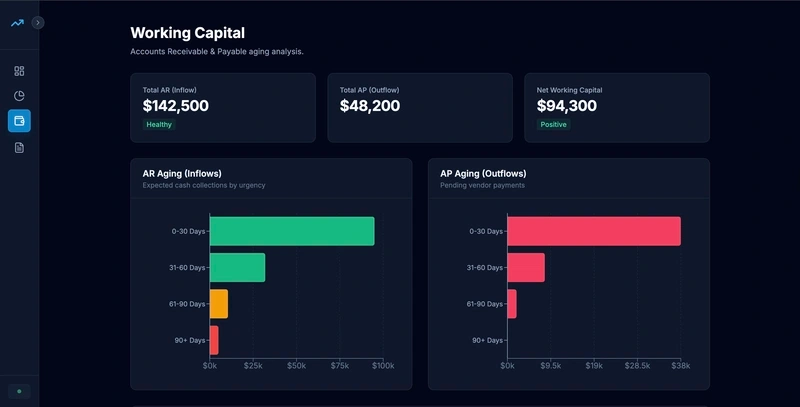
Working Capital
If you're into:
FinOps / financial automation
No-code/low-code with real engineering patterns
Turning workflows into actual products
…then this pattern (n8n + Supabase + React) is extremely powerful.
If you fork this, adapt it, or use it with a real company, I'd love to hear what you build. 🙌
Links
You might also love this builds
📝 I Built an Automated Payment Recovery System That Recovers 3x More Failed Payments: Read here
📝 I Built a System That Finds $663K+ in Lost Revenue - Here's the Complete Technical Breakdown: Read here
Like this project
Posted Dec 2, 2025
Built a cash flow forecasting engine for SaaS/fintech founders using n8n, Supabase, and React.
Likes
2
Views
32
Timeline
Nov 16, 2025 - Nov 21, 2025