Automation Upside Autopsy | Fictional Buyer Operations Screen

Ty Milroy

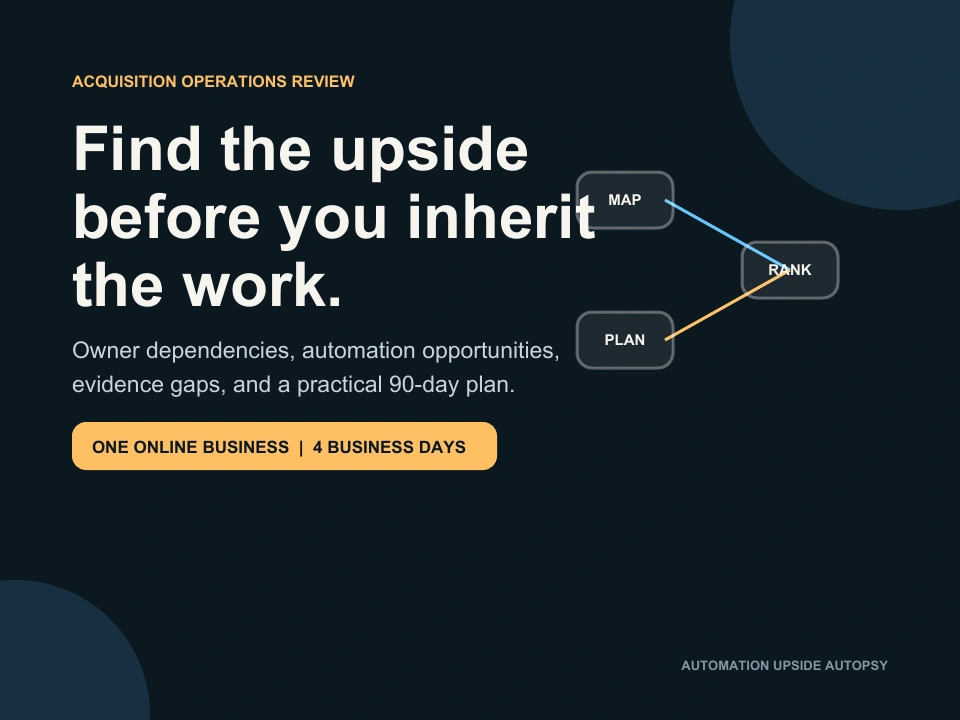
Buying a small online business means inheriting the operation behind the listing.
I created this fictional case study to demonstrate the delivery standard for Automation Upside Autopsy. The sample maps five recurring workflows, exposes four owner or tool dependencies, separates safer automation candidates from high-consequence work, and turns the findings into seller questions plus a 30, 60, and 90-day operating sequence.
The strongest apparent time burden is not automatically the best first automation. In this sample, affiliate reconciliation remains on hold because the payout logic and source definitions are undocumented. Delivery-exception triage ranks higher because it is frequent, rule-based, reversible, and can be tested privately with human review.
The package demonstrates:
a concise operational decision brief;
an owner and transfer dependency map;
a ranked opportunity register with confidence, risk, and acceptance metrics;
a do-not-automate-yet list;
evidence requests and seller questions;
a staged 30, 60, and 90-day plan.
Northstar Templates is fictional. Every workflow, figure, score, and observation is synthetic. This is self-produced work, not a client engagement, completed acquisition, savings claim, due diligence opinion, or investment recommendation.
The live service covers one small online business, up to 12 recurring workflows and 10 tools, with delivery in four business days.
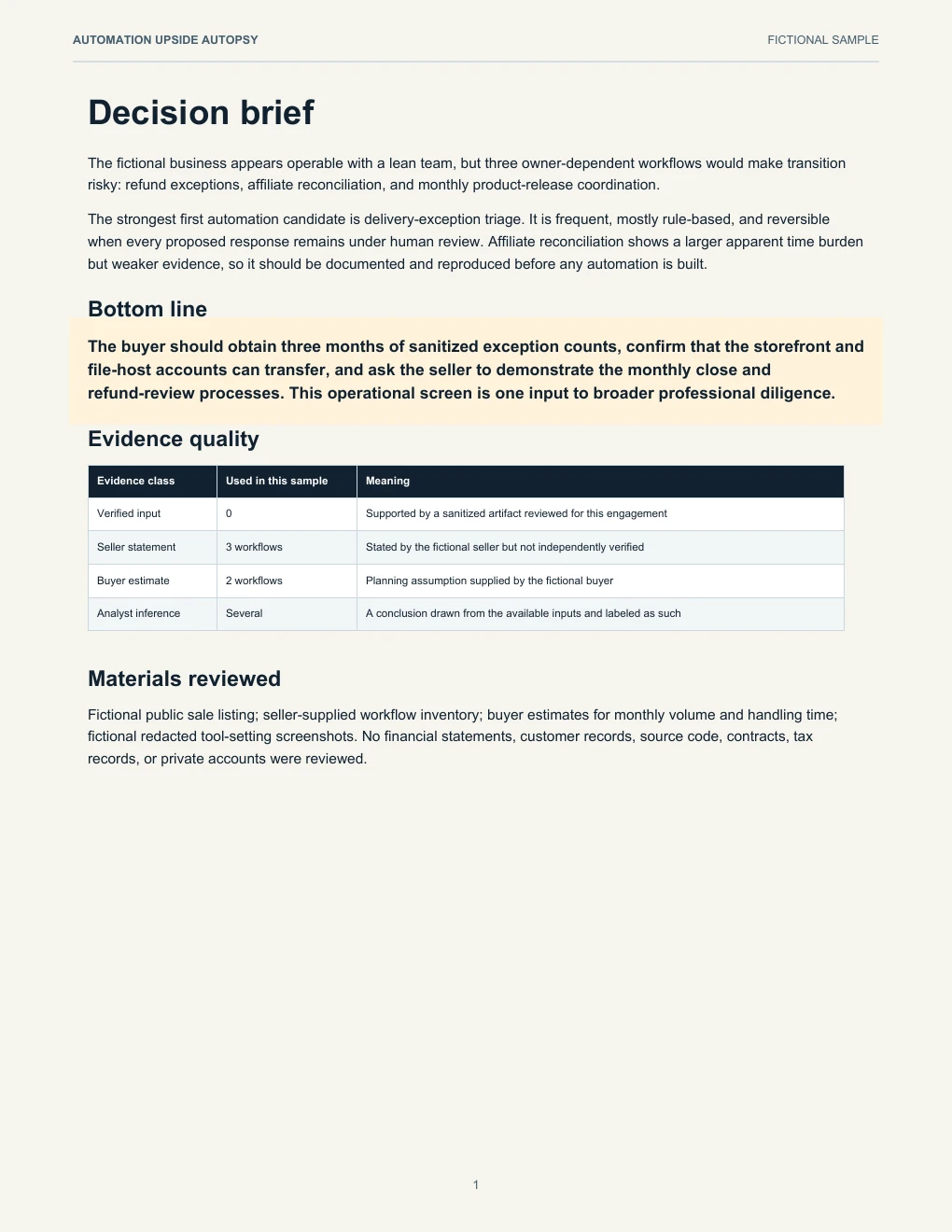
Decision brief: separates the bottom line from the quality of supporting evidence.
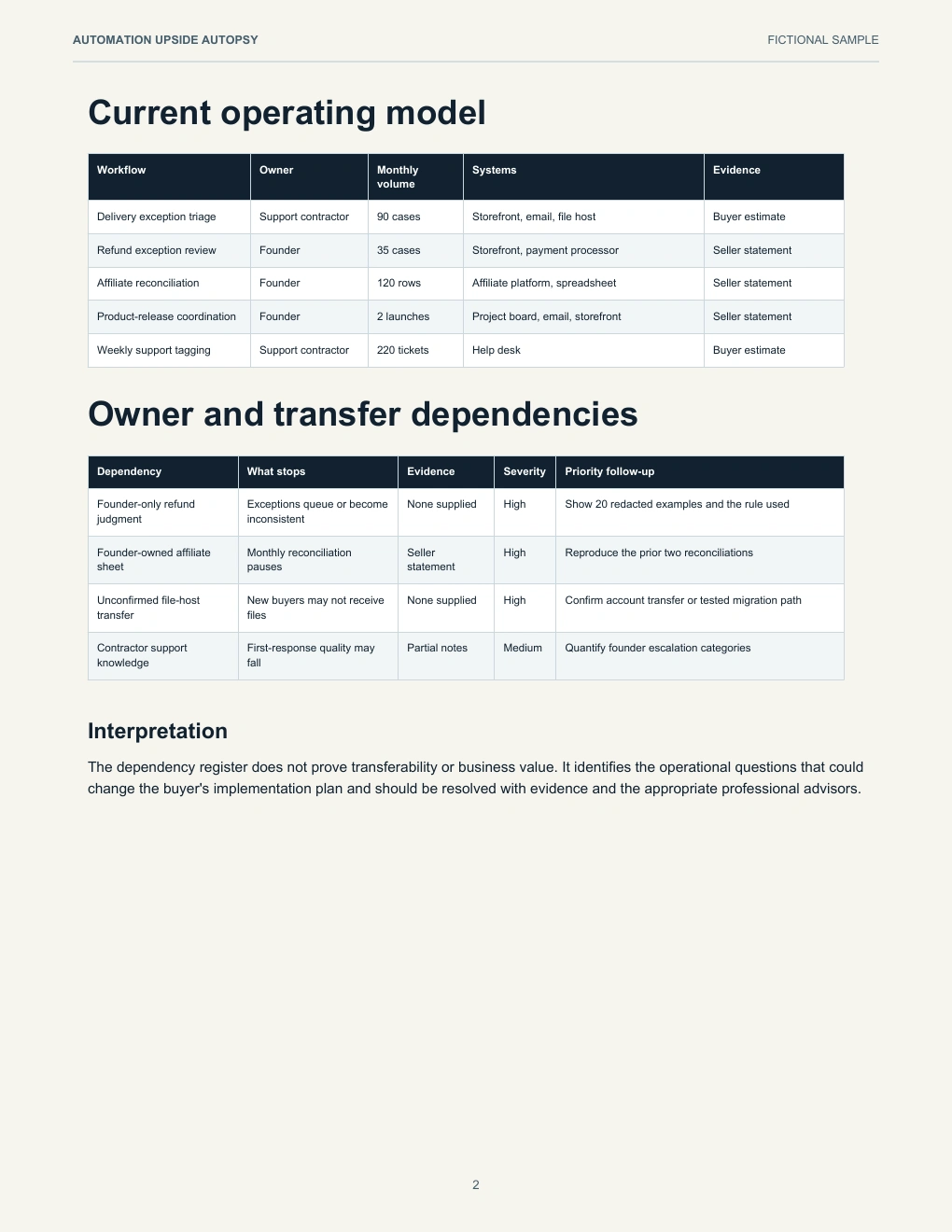
Dependency map: shows what may stop when the owner or a fragile system leaves.
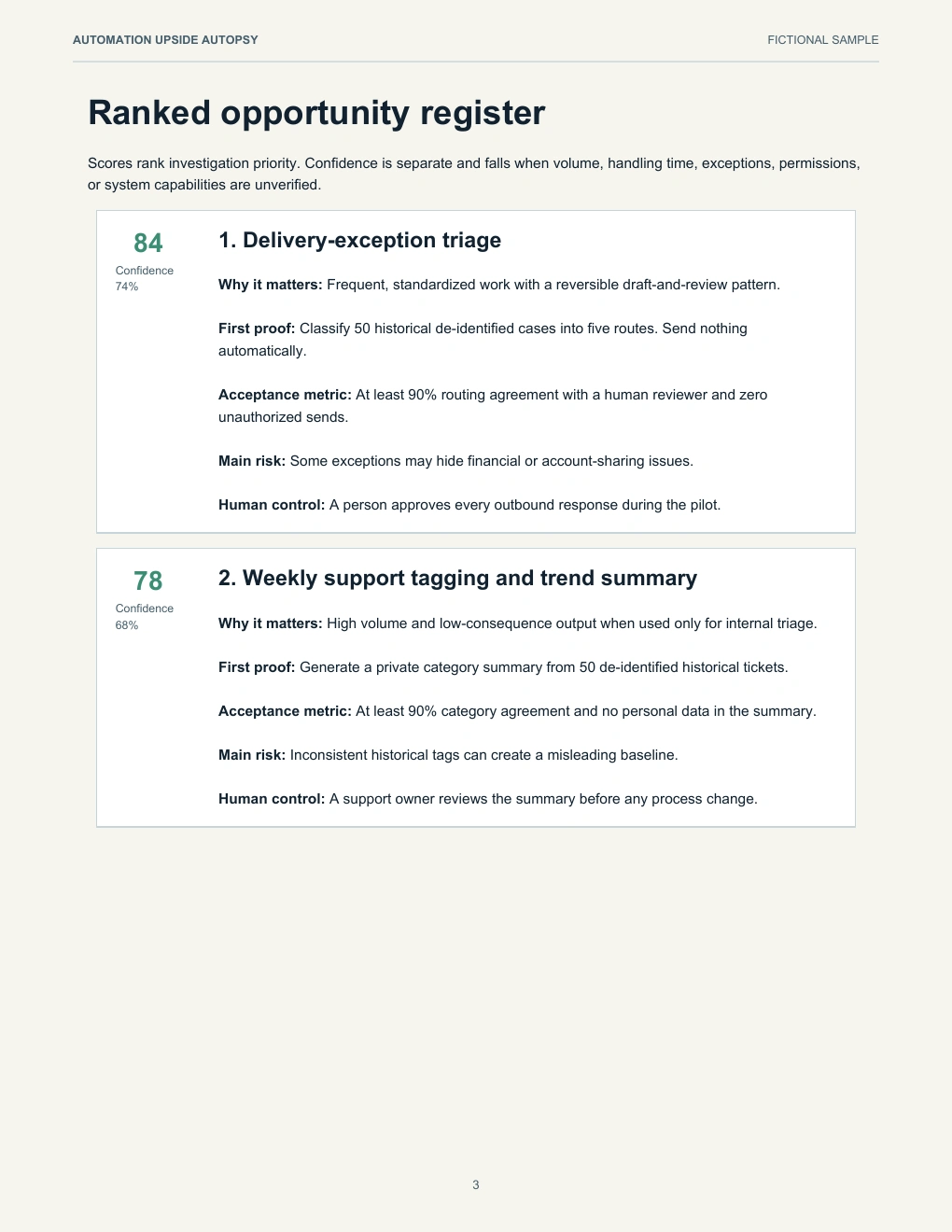
Opportunity register: ranks investigation priorities while keeping confidence and human control visible.
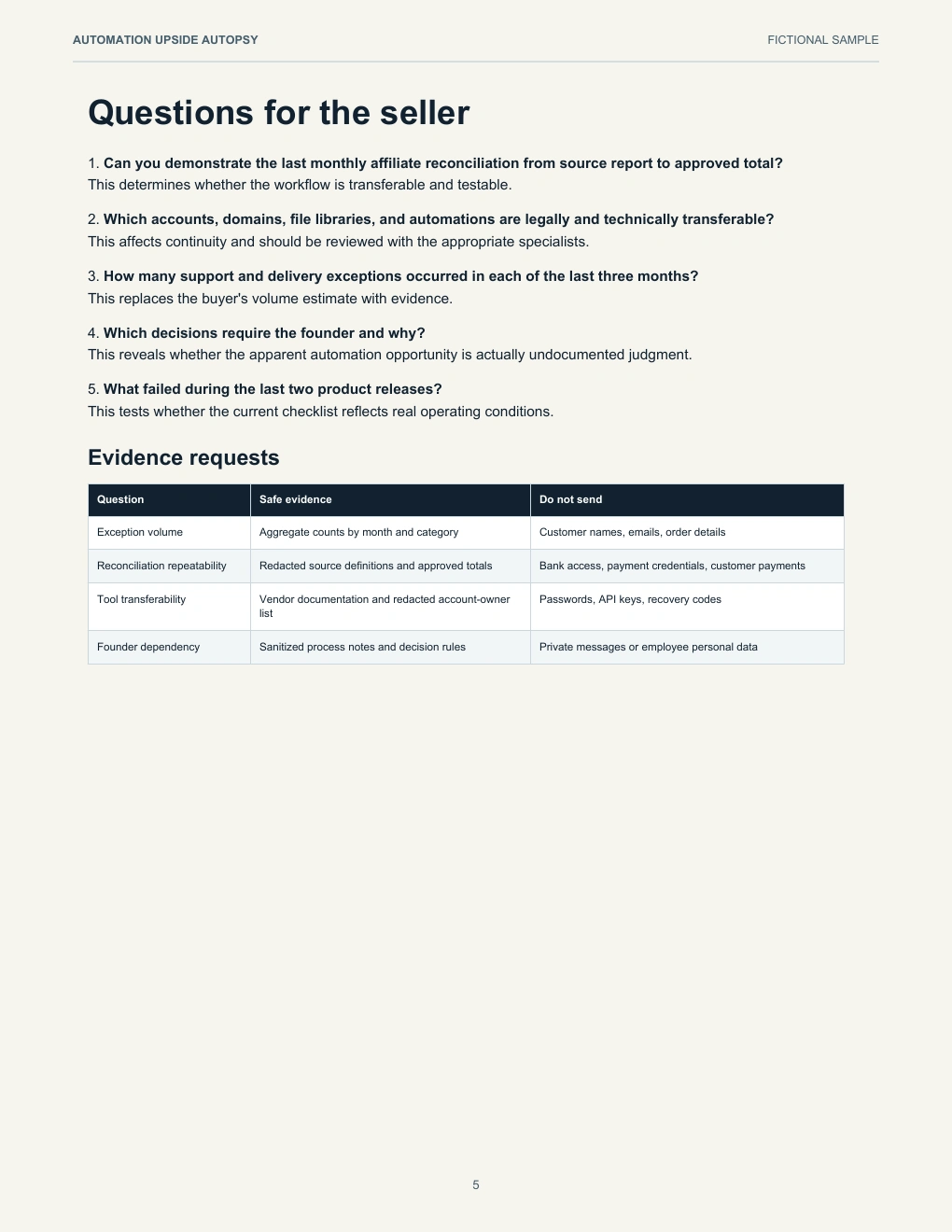
Seller questions: converts assumptions into safe, specific evidence requests.
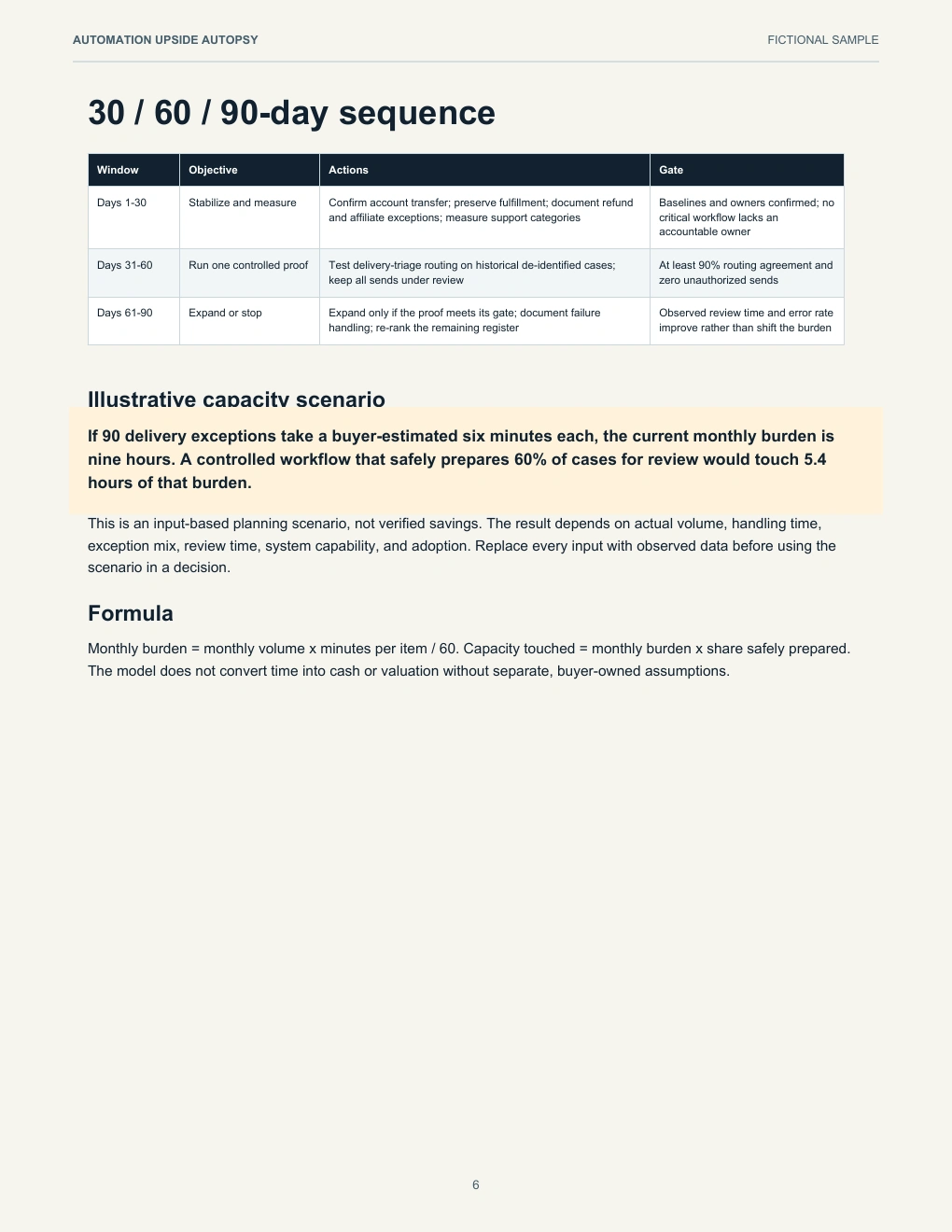
Roadmap: sequences stabilization, a controlled proof, and an expand-or-stop gate.
Like this project
Posted Sep 17, 2026
Fictional buyer-operations case study mapping owner dependencies, evidence gaps, safer automation opportunities, and a practical 90-day plan.
Likes
0
Views
6