Why Most Web3 Projects Fail Before They Launch

Mubarak Makinde

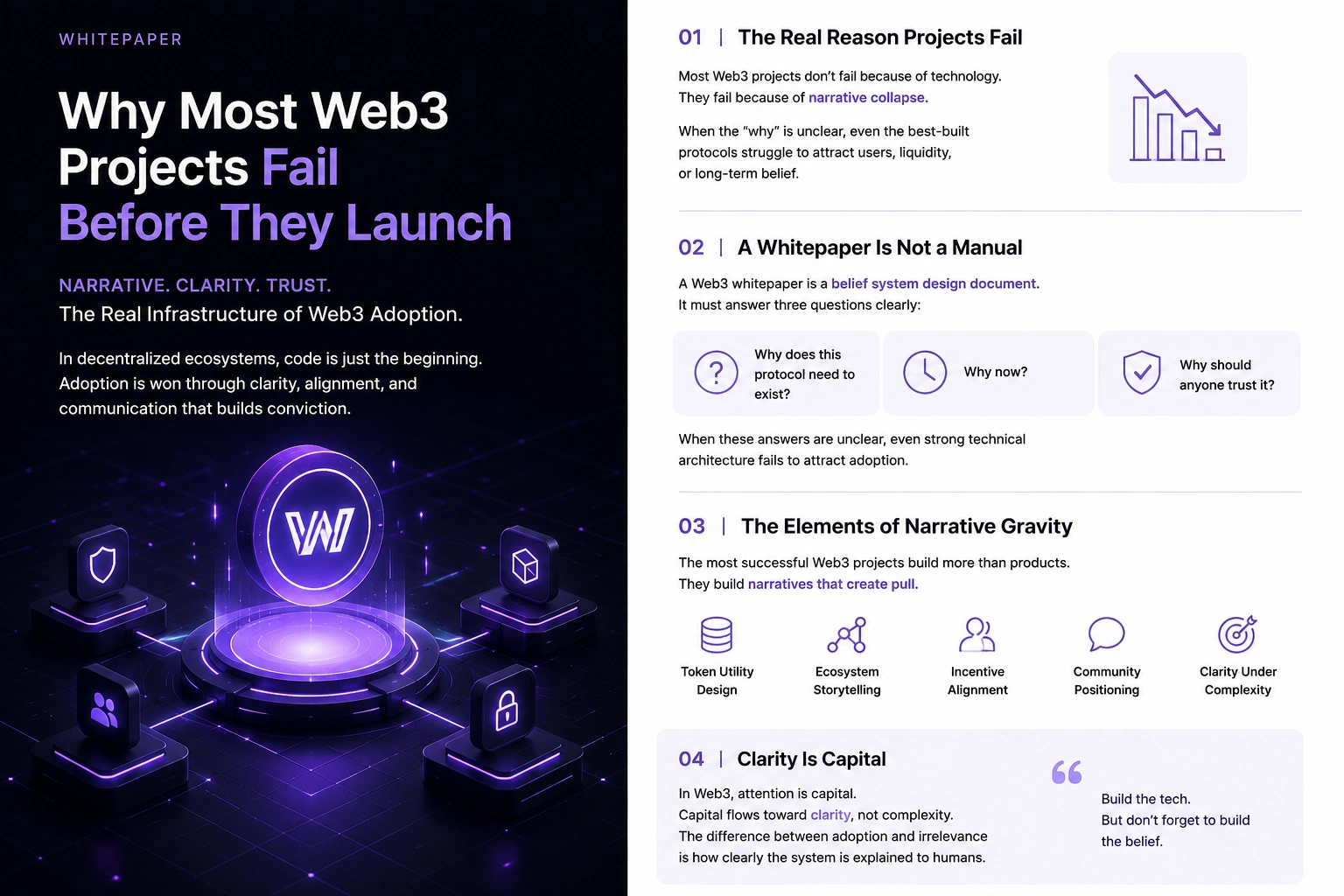
Why Most Web3 Projects Fail Before They Launch
Most Web3 projects don’t fail because of technology.
They fail because of narrative collapse.
In decentralized ecosystems, trust is not assumed, it is constructed entirely through communication. And yet, many projects treat whitepapers, token docs, and pitch narratives as technical documentation rather than market positioning tools.
This is a critical mistake.
A Web3 whitepaper is not a manual. It is a belief system design document.
It must answer three questions clearly:
Why does this protocol need to exist?
Why now?
Why should anyone trust it?
When these answers are unclear, even strong technical architecture fails to attract liquidity, users, or community adoption.
The most successful Web3 projects understand this early. They do not just build infrastructure, they build narrative gravity.
That narrative is carried through:
Token utility design
Ecosystem storytelling
Incentive alignment language
Community positioning
And most importantly, clarity under complexity.
Because in Web3, attention is capital. And capital flows toward clarity, not complexity.
This is why whitepaper writing is not documentation work, it is market architecture communication.
The difference between adoption and irrelevance is often not code quality.
It is how clearly the system is explained to humans.
Like this project
Posted Jan 15, 2025
Most Web3 projects don’t fail because of technology.
Likes
0
Views
1