
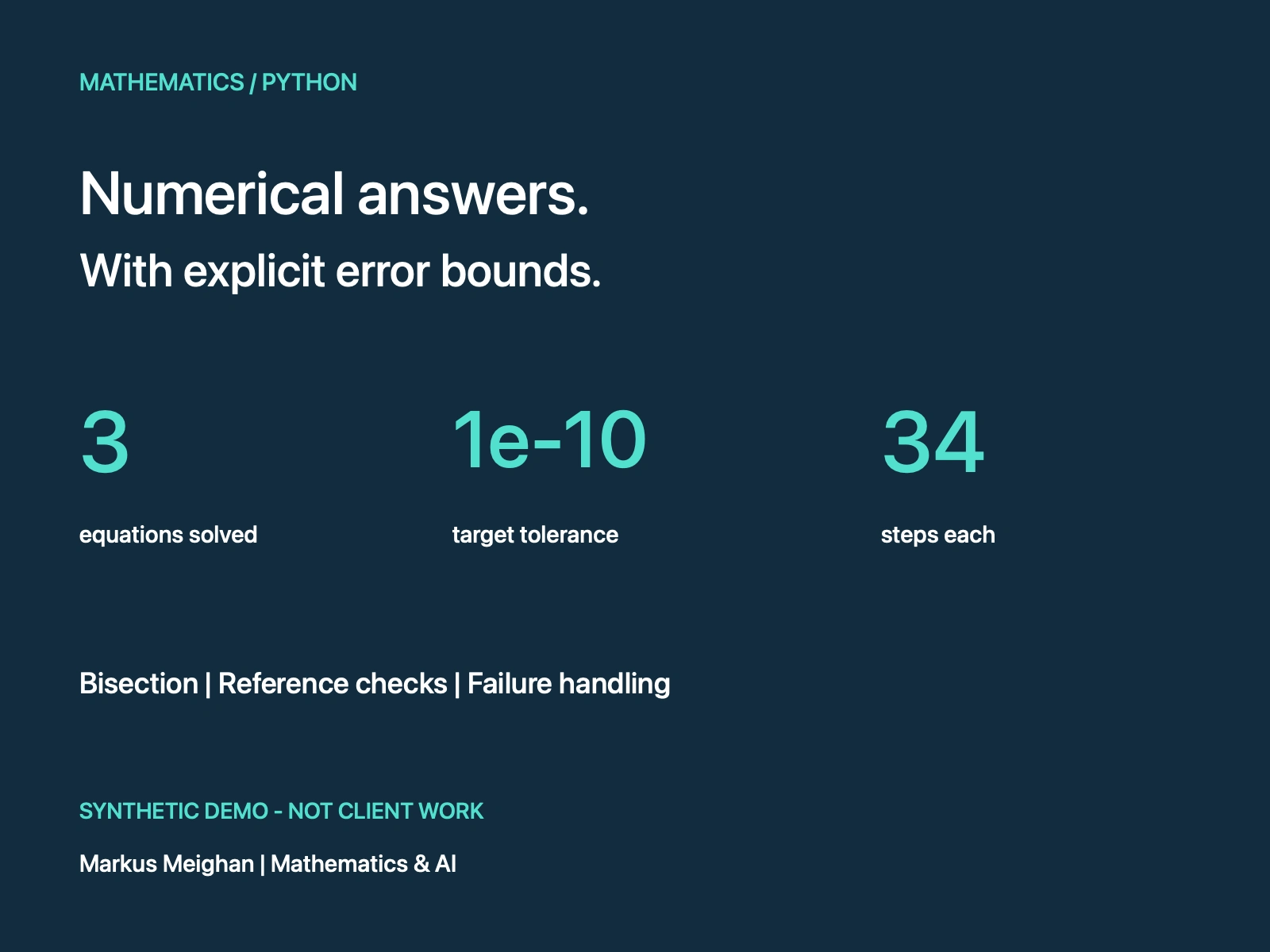
A numerical answer is more useful when its accuracy and assumptions are clear. This self-directed Python demonstration solves three scalar equations using bisection, reporting the root, bracket-based error bound, residual and iteration count. Synthetic portfolio work, not a paid client engagement.
METHOD
Start with a sign-changing bracket for a continuous function, then halve the interval until its half-width is at most 1e-10. The implementation checks input bounds, rejects non-finite function values, handles endpoint roots and reports an iteration-limit failure explicitly.
MEASURED RESULTS
x² - 2 = 0: 1.414213562326
cos(x) - x = 0: 0.739085133246
x³ - 2x - 5 = 0: 2.094551481598
All three examples reached a bracket half-width of approximately 5.82e-11 in 34 iterations. Reference-root comparisons passed; residuals were below 2e-9. Residual and root-location error are reported separately because they measure different things.
QUALITY CHECKS
Tests cover three reference roots, error bounds, a root at an endpoint, invalid brackets, non-finite function values and an intentionally insufficient iteration cap. All checks passed.
DELIVERABLES
A standard-library Python script and a machine-readable JSON results report, with reproducible examples and assertions. No paid API, special application or client data is involved.
SCOPE AND LIMITS
Bisection needs a continuous function and a suitable sign-changing bracket. This demo uses ordinary floating-point arithmetic, not certified interval arithmetic, and does not claim to find every root. It demonstrates the care appropriate for small numerical scripts, calculation checks and reproducible mathematical workflows.
0 likes · 3 views · Nov 4, 2026
Three equations solved with bisection, explicit error bounds and reference checks. Tested Python demo with reproducible results and failure handling.
