Support Request AI Agent: Hybrid GenAI Triage in UiPath

Imad Eddine Berjamy


Overview & Operational Problem
Customer support queues are flooded with unstructured requests where a single mistyped keyword or ambiguous subject line sends a ticket to the wrong back-office team. Pure rule-based RPA routers break whenever customers phrase a deposit issue, withdrawal delay, or product inquiry in unexpected natural language—yet handing the entire workflow over to an autonomous agent introduces unnecessary latency, cost, and audit risk.
I built Support Request AI Agent for UiPath (github.com/imadui/support-request-AI-agent-UiPath) to demonstrate a pragmatic hybrid pattern: deterministic UiPath orchestration handles file monitoring, JSON parsing, and downstream folder routing, while a constrained GenAI step performs semantic intent classification.
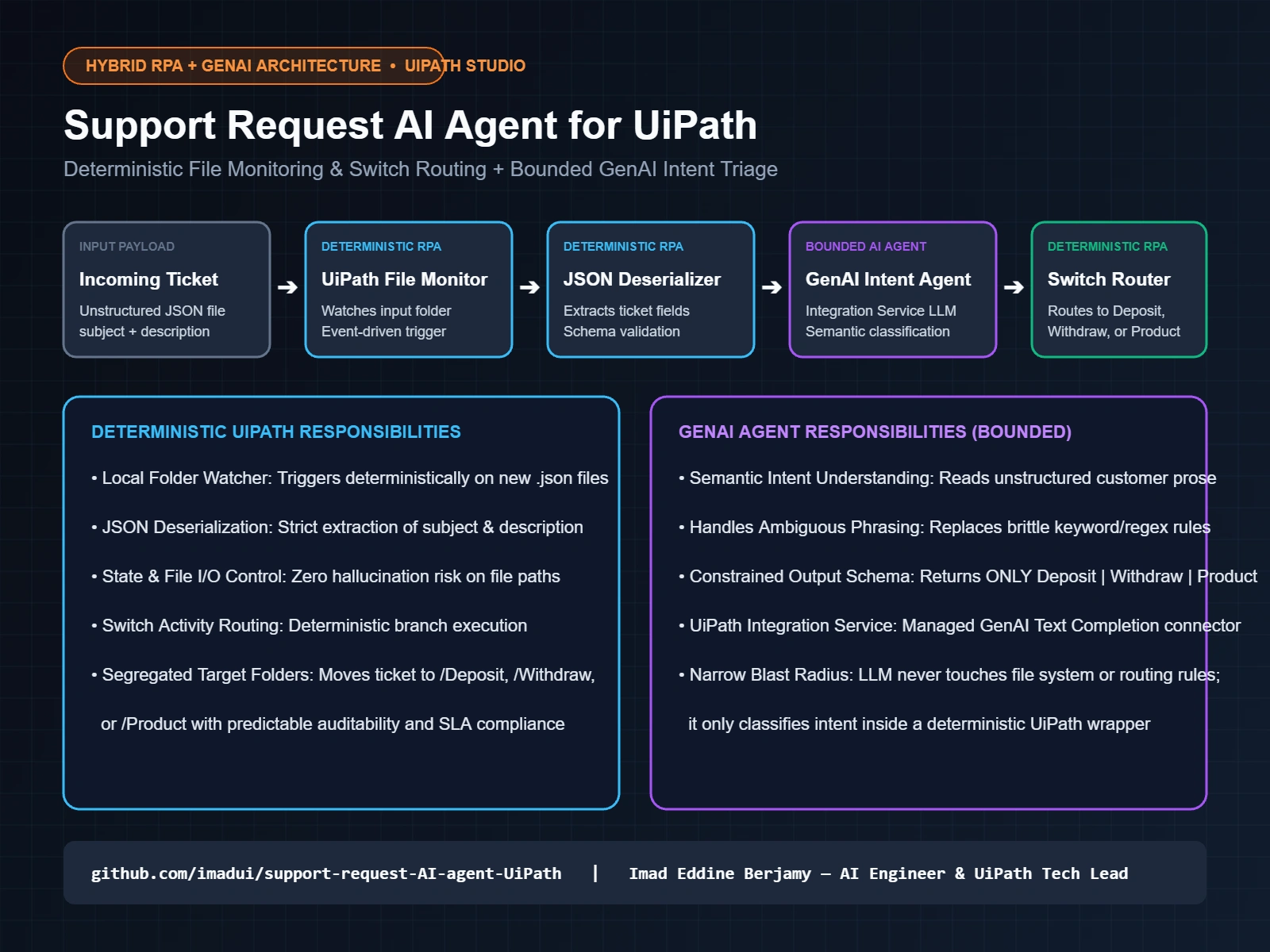
End-to-End Architecture & Process Diagram
The workflow executes an event-driven pipeline inside UiPath Studio (2023.10+) connected to UiPath Integration Service GenAI Activities:
[ Incoming Ticket (.json) ] ➔ [ UiPath File Monitor ] ➔ [ JSON Deserializer ] ➔ [ GenAI Intent Agent ] ➔ Deterministic Switch ➔ [ /Deposit ] | [ /Withdraw ] | [ /Product ]Deterministic Responsibilities vs. AI Agent Responsibilities
Rather than treating the LLM as an all-purpose workflow engine, the architecture enforces a strict boundary between deterministic RPA controls and bounded AI inference:
Deterministic Layer 1 — Event-Driven File Monitoring (UiPath): Continuously watches the designated incoming directory for newly dropped
.json support ticket payloads and triggers execution automatically without human intervention.Deterministic Layer 2 — JSON Deserialization & Schema Extraction (UiPath): Parses the structured ticket file and extracts the
subject and description fields deterministically before invoking any external model.AI Agent Layer — Semantic Intent Triage (UiPath Integration Service GenAI): Passes the extracted
subject and description into the Generate Text Completion activity to classify nuanced natural-language intent into a strictly constrained category: Deposit, Withdraw, or Product.Deterministic Layer 3 — Switch Routing & Folder Segregation (UiPath): Evaluates the returned category inside a deterministic UiPath
Switch activity and moves the ticket file into its corresponding target folder (Deposit, Withdraw, or Product) for downstream fulfillment.Technical Stack & Repository Structure
Orchestration & Workflow Engine: UiPath Studio (2023.10+),
Main.xaml, project.json, VB.NET expressions, and deterministic Switch control flow.AI / LLM Integration: UiPath Integration Service with configured GenAI Activities connection (
Generate Text Completion).Source Code & Documentation: https://github.com/imadui/support-request-AI-agent-UiPath (MIT License).
Like this project
Posted Oct 20, 2026
Event-driven UiPath Studio workflow combining deterministic file monitoring & Switch routing with bounded Integration Service GenAI ticket intent triage.