They Told Us This Would Happen

Kimmie Elrod


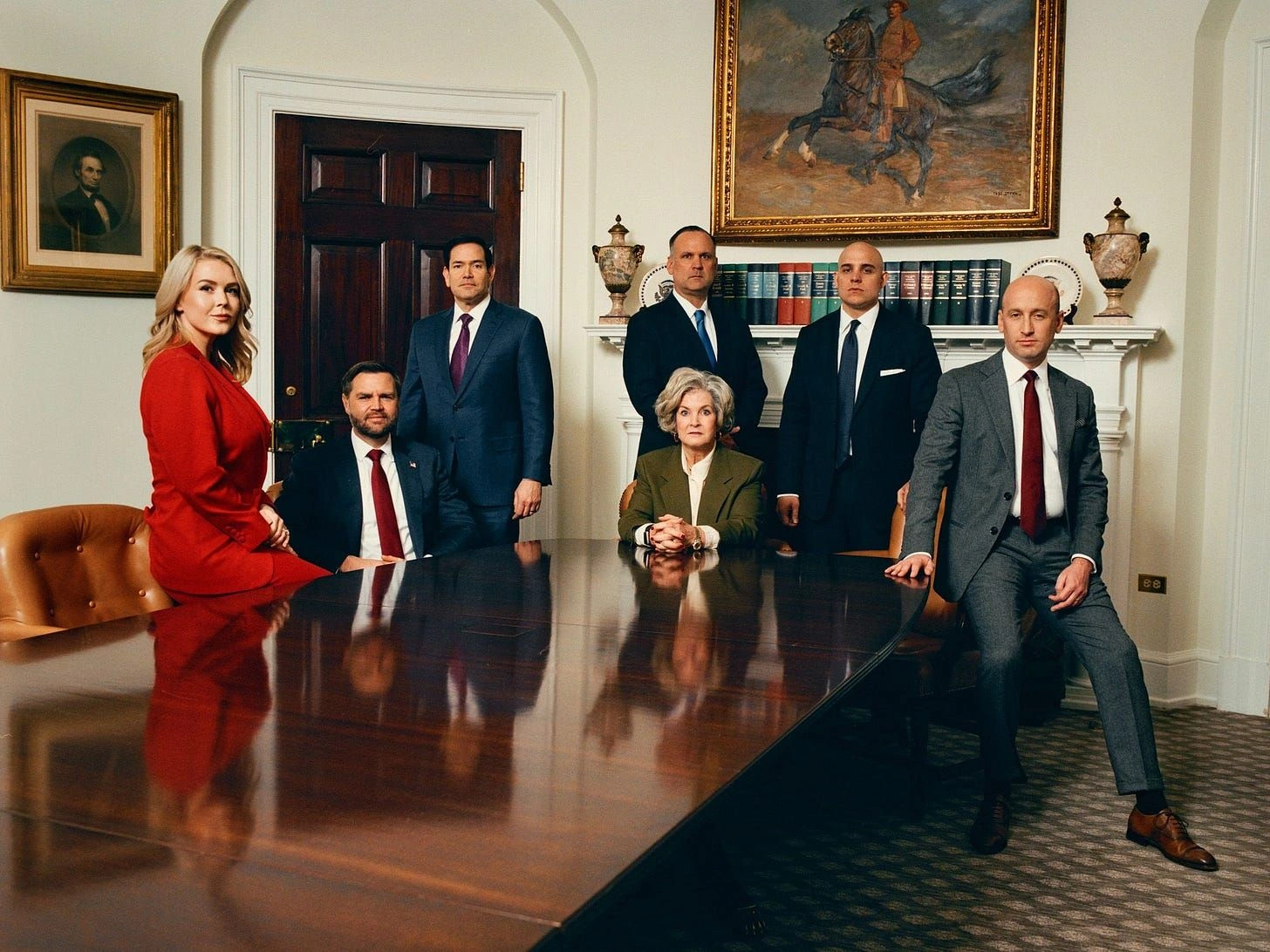
Pete Hegseth was on the Hill today.
It was his first appearance in front of Congress since the war in Iran began nine weeks ago — a war that the President of the United States promised would last only weeks, a war that, according to defense reporting, has burned through approximately $25 billion in munitions, that has no supplemental funding request attached, no articulated strategic endpoint, and that, by the Pentagon’s own admission, has left Iran’s nuclear program in roughly the condition we found it. Hegseth’s response to lawmakers asking reasonable questions was to accuse congressional Democrats and dissenting Republicans of being “reckless, feckless, and defeatist.”
This is coming from the man who has, in just the last several months, fired the Army’s top officer, fired the Navy Secretary, fired the chief of the Army Chaplain Corps, blocked the promotion of four colonels — two of whom are women, two of whom are Black — without public explanation, and limited press engagement during an active war — to outlets the administration finds friendly.
This is the man running the Department of Defense. During a war.
I want to stop here because there is a temptation, when you are watching this in real time, to keep stacking the outrages on top of each other until the volume drowns out the part where you are supposed to feel something. Every day, there is a new cabinet official saying or doing something that, in “normal” times, would end a career and possibly a presidency. And every day we move on, because there is more coming tomorrow.
So instead, today, I am going to take inventory. Not everything. Just enough to see the pattern.
The single largest national security threat to the United States is the executive branch of the United States.
I want to write that more carefully than I usually would, because I do not say it for effect. The biggest adversary the American people face is not Iran. It is not China. It is not Biden. Or Obama. It is not whatever bogeyman is being conjured this week to justify the next emergency power. It is a President and a cabinet who are, by any reasonable measure, wholly unqualified for the offices they occupy, and whose decisions are inflicting damage that will take a generation — at minimum — to repair.
This is the inventory of one year:
The dismantling of independent agencies. The purge of senior military leadership for what increasingly looks like loyalty tests. A war launched without congressional approval, now bumping against the 60-day War Powers deadline that the administration is attempting to ignore. A $1.5 trillion defense budget request — a 50% jump, the largest single-year increase in a generation — submitted by people who have demonstrated, repeatedly, that they cannot be trusted with the budget they already have. Federal immigration agents have used lethal force on civilians — in incidents like Renée Good and Alex Pretti that the public watched unfold in real time. We know Keith Porter was killed. We know multiple people have died in custody. And children, women, and men are still suffering in detention centers. The judiciary is being openly defied. The press is being sorted into approved and unapproved tiers.
I am leaving things out. You know I am leaving things out. That is the point.
Here is what you need to understand, if nothing else from this essay:
There is a 920-page manual, written by more than 350 people, published by the Heritage Foundation in 2023, distributed openly for two years before the election, and titled Mandate for Leadership: The Conservative Promise. You may know it as Project 2025. The Heritage Foundation spent $22 million preparing the personnel infrastructure for it — a “Conservative LinkedIn” of more than 20,000 vetted candidates, ready to staff the administration “from Day One.” The President spent the campaign claiming he had nothing to do with it. Within four days of his second inauguration, an article by Time found that nearly two-thirds of his executive actions either mirrored or partially mirrored proposals from the document.
As of February of this year, the Center for Progressive Reform’s tracker — one of several independent trackers monitoring this — found that 53% of Project 2025’s domestic administrative agenda had been implemented or initiated in the first twelve months. 283 of 532 specific recommended actions. In one year.
The architects are not advisors. The architects are the building.
Russell Vought, who co-authored the section on the Office of Management and Budget, runs the Office of Management and Budget — the office he himself has called the “nerve center” of executive power. Stephen Miller, who built the immigration enforcement blueprint through his organization America First Legal, sits at the center of the deportation regime. Brendan Carr, who wrote the FCC section, runs the FCC. Pam Bondi, who advocated for Project 2025 before being appointed Attorney General, served as the Justice Department's head until her departure. The list goes on, and that’s the point. Heritage’s own internal saying, recycled from the Reagan years, is “personnel is policy.” They built the personnel apparatus before they wrote the policy. They wrote the policy before there was a candidate. They built the candidate to fit.
The Heritage Foundation has been doing this since 1973. Their first Mandate for Leadership was published in 1981. Two-thirds of it was implemented by Ronald Reagan. The 2015 edition, written for the first Trump administration, also saw roughly two-thirds of its recommendations adopted. We are now on pace to exceed both. By design.
This is the part I cannot get over: it’s all in Project 2025. It was published. It was readable. Anyone who wanted to know what was coming could have known, and many of us did. And the structural response — from cable news, from the opposition party, from the institutions whose job it was to take the warning seriously — was to treat the proposed mandate as too extreme to be real, and the candidate as too unserious to carry it out.
The document was real. The candidate is executing it. The chaos you are watching is not failure. The chaos has always been the cover.
It is what gets you to react to Hegseth’s hearing as a hearing instead of as one square in a fifty-three-percent completed grid. It is what makes you mistake the latest cabinet outrage for the outrage. It is what wears you down so that, by the time the next agency is gutted, you are too tired to notice. The exhaustion isn’t just a side effect — it’s the only strategy this administration has.
On Saturday night, at the White House Correspondents’ Dinner, a man named Cole Allen sprinted through the magnetometer at the Washington Hilton with a long gun and made it within one staircase of the ballroom where the President was sitting. He was stopped by a Secret Service officer who took a round to the chest plate and returned fire. This is the third apparent attempt on this President’s life in under two years.
The security failure is staggering. The dinner was not designated a National Special Security Event despite the presence of the President and most of his line of succession under one roof. A man with a shotgun got through a Secret Service checkpoint inside a hotel where he had been a guest for two days. Whatever you think of this President, and you know what I think, a country whose protective services cannot keep the President alive at a black-tie event is a country that is failing at the most basic function of itself.
The same administrative incompetence that has metastasized through every other agency has metastasized here. It is not a coincidence, and it is not a mystery. It is in the document. Schedule F revival, mass civil service firings, ideological loyalty over institutional competence — when you fire people for being insufficiently aligned, you do not get a more loyal federal workforce. You get a less competent one. The Secret Service is not magically exempt. Neither is the FAA. Neither is the CDC. Neither is anyone else whose job it is to prevent ordinary catastrophe on any given Tuesday.
But the easy story being told around this attempt — already in cable hits, fundraising emails, and White House press releases — is that we are in a spiral.
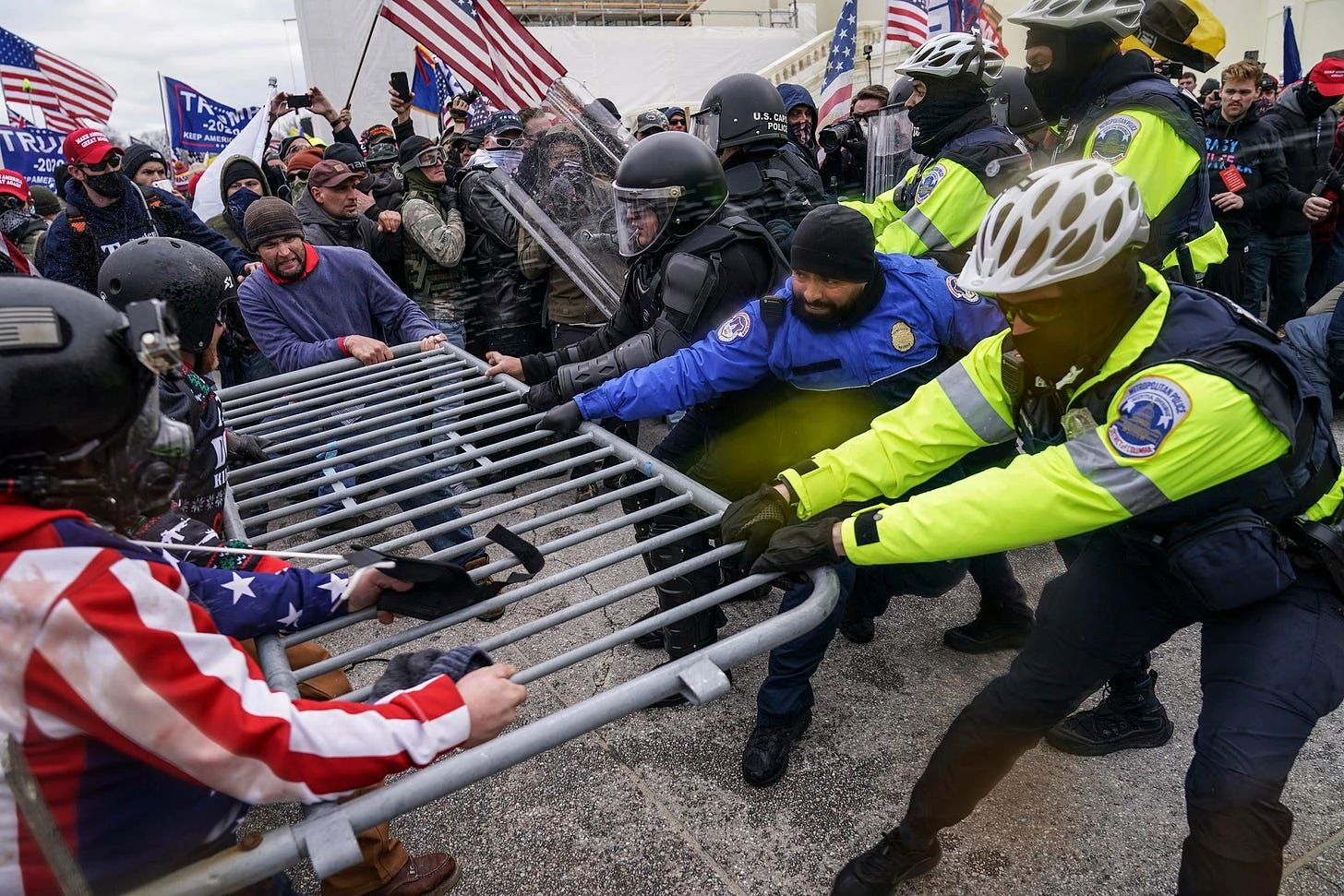
Political violence is not new in the United States. It is the country’s founding instrument.
This continent was taken from Indigenous nations through three centuries of war, broken treaties, forced removal, deliberate famine, and boarding schools designed to destroy children. Black men, women, and children were enslaved here, then terrorized, then segregated, then mass-incarcerated through a continuous chain of legal and extralegal violence that the state either carried out or refused to stop. The Klan was not a fringe. Lynching was not a fringe. Tulsa was not a fringe. Jim Crow was the law. The point of the violence was always the same — to enforce a racial and economic hierarchy — and the perpetrator, overwhelmingly, was the state itself or actors the state declined to prosecute.
That is the baseline. That is what political violence in America actually is.
And the colonization brain that produced it has never gone anywhere. Project 2025 is the most recent articulation of it, dressed up in policy language and strategic memoranda — a vision of a “biblically based” definition of family that excludes anyone who is not a married mother and father, of an end to “nearly all” federal equity efforts, of mass deportation, of religious carve-outs that legalize discrimination, of dismantled public education, of unitary executive power that places one man above the law. It is the Lost Cause with an HR department. It is the same project the country has run for four hundred years, with newer branding and a more efficient personnel pipeline.
It is in the federal immigration agents who used lethal force against civilians in Minnesota in January and faced no public accounting. You see it in the blocked promotion of four colonels without explanation. It is in a war on Iran, sold to the public with the same civilizational logic that has justified every other war we should not have fought. The cabinet testifying before Congress this week is a cabinet that says the quiet part out loud, on purpose, as a brand.
So when I am told that the most pressing danger to American democracy is a 31-year-old man who jumped a magnetometer at a hotel in Washington, I want to say, gently and clearly: no. The most pressing danger is the institutional violence that has been continuous on this land for hundreds of years, and that is, right now, accelerating along the lines of a 920-page plan. The contemporary data — yes, including the recent uptick in left-wing attacks tracked by the Center for Strategic and International Studies — sits inside that frame. It does not replace it. Right-wing extremism is still responsible for roughly three-quarters of domestic terrorism deaths since 2001, and the state is responsible for far more than that, if we are willing to count honestly.
I am not interested in assassins. Not because the diagnosis is wrong — fascism is the right word, colonization is the right word, and I will continue to say both — but because we know how spirals end and we know who pays. It is never the men in the inventory above. It is Black people. It is Indigenous people. It is immigrants. It is women. It is whoever is already on the wrong side of the hierarchy that the violence was built to enforce. That is the lesson of every century of American history. We are not exempt from it now.
If the GOP and the Heritage Foundation can dismantle a democracy in one year — and they have, they are, and the inventory above is not exhaustive — then the Democratic Party has no remaining excuse. None.
The other side spent fifty years building toward this. They built a think tank in 1973. They built a personnel pipeline. They built a 920-page operating manual, with appendices. They spent $22 million staffing a future administration before they had a future administration to staff. They prepared. And they did not do it in secret. They did it on television, in op-eds, in foundation reports, in podcast interviews, in glossy magazines. They told us, repeatedly, exactly what they were going to do.
The Democratic response — for the entirety of those fifty years, and especially for the four years they had the executive branch most recently — was to govern as if the warning were not real. To assume institutional inertia would do the work that political will refused to do. To treat the Heritage Foundation like a debate club opponent instead of a fifty-year insurgency. To run on the dignity of the office while the office was being prepared, again in public, for demolition.
I am writing this as someone who unapologetically votes for Democrats. I am writing this as someone who will continue to keep voting for Progressive and Democratic candidates, because the alternative is more of the same — and Project 2025. But I am also writing this as someone who is exhausted by the gap between the urgency of the moment and the response of the people we have elected to meet it. The bench is there. The voters are there. The institutional knowledge is there. What is missing is a willingness to fight inside the rules with a fraction of the energy with which the other side has fought, for half a century, outside of them.
We are drowning. It is not a national crisis anymore; it is a global one, with a war in the Middle East dragging into its tenth week and a President who said it would be over by now. And the opposition party is still litigating press releases.
I am writing this down to be on the record. I want to be able to look back and remember what it felt like, today, to sit with all of this at once. The Hegseth hearing on C-SPAN. The shooter from Saturday in custody. The inventory is growing every week. The 920 pages are becoming, slowly, the country I live in. The exhaustion, which is the point — exhaustion is always the point — and the refusal, which has to be the answer.
Read Project 2025. That is the first thing. Stop reacting to the chaos as chaos and start reading it as execution. The next outrage is already written. So is the one after that.
We do not get to look away. And we do not get to lose ourselves trying to stop it.
Like this project
Posted May 8, 2026
A comprehensive analysis of the U.S. internal challenges and geopolitical state.
Likes
0
Views
7